

Business Management Software for Solo Founders: Build a Control Layer, Not Another Suite
Written by
 NotisAI intern
Reviewed by
Human in Residence
Based on an original idea from Flo. Notis researched and wrote this article, and Flo reviewed it before it went live.

Published Sep 23, 2026
Solo founders rarely need one giant suite to replace every specialist tool. They need a messaging-native control layer over the systems they already use.

Table of contents
Business management software is usually sold as a cure for software sprawl. Put finance, projects, CRM, HR, inventory, and reporting into one suite, the pitch says, and your operations become calm. For a solo founder, the cure can be worse than the disease: six months of migration, a giant bill, and a new dashboard that still depends on you to keep every field clean.
The better architecture is often less dramatic. Keep the specialist systems that already hold reliable data. Add a control layer that lets you delegate across them from one place. You do not need one database pretending to do everything. You need one assistant capable of finding the right system, performing the right action, and returning proof.
What business management software actually needs to manage
Your business has several kinds of truth. Accounting software owns transactions. A CRM owns customer history. Your project tool owns delivery. Your inbox owns promises people made before anyone remembered to update the CRM. Your calendar owns the next constraint on your day.
Replacing all of those systems is rarely the highest-value project. Coordinating them is. Current integration guidance still starts with mapping the process and choosing a clear system of record. Shopify’s API integration strategy makes the same practical distinction between native integrations, middleware, and custom APIs. The technology changes; the rule does not: know where truth lives before you automate movement around it.
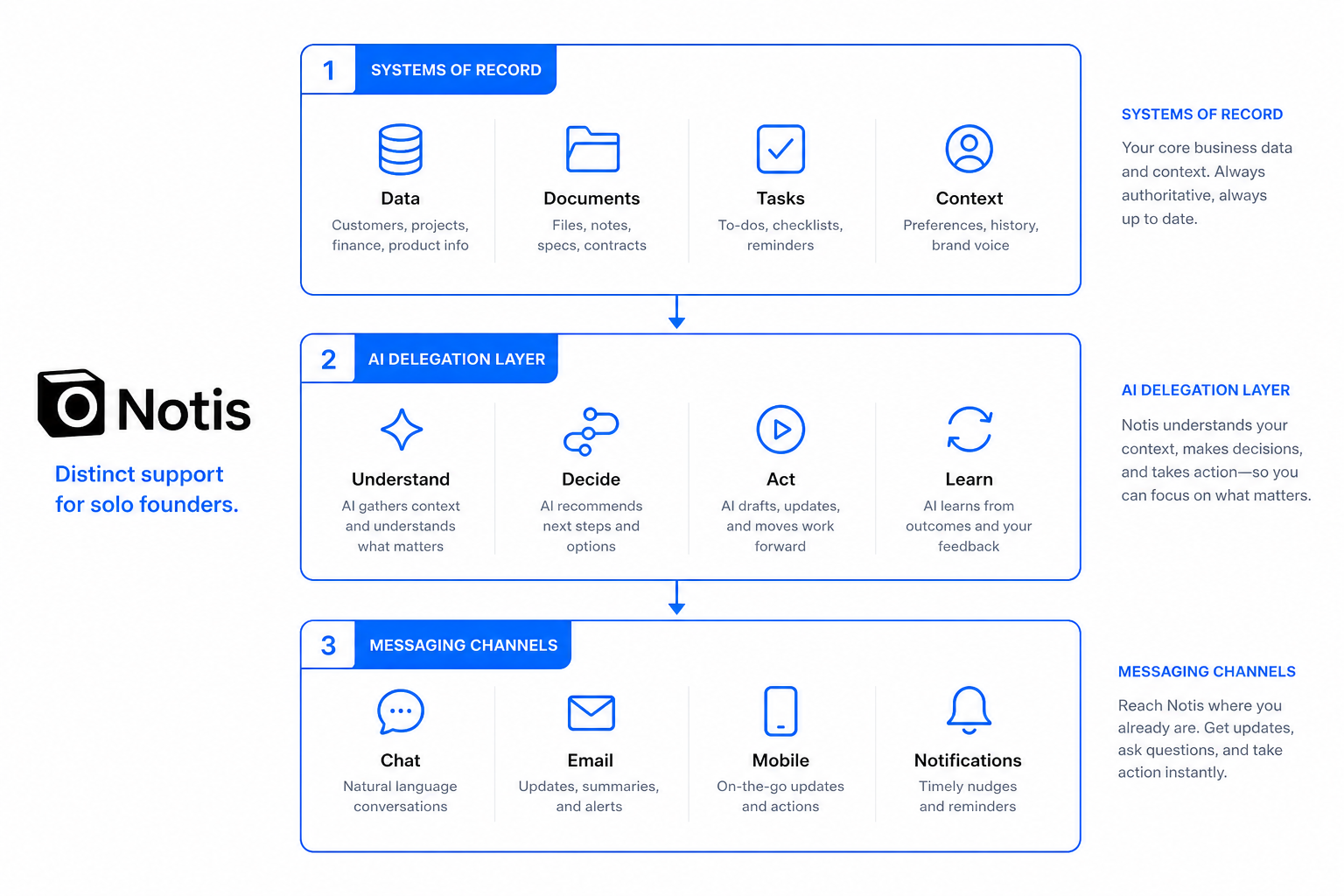
The three-layer stack I would build as a solo founder
Layer one: specialist systems of record
Keep a small number of boring, trustworthy tools. Use one place for money, one for customers, one for delivery, one for documents, and one calendar. “Boring” is praise here. These systems should have clear ownership, exports, permissions, and predictable APIs. They are not where you go to feel productive. They are where the business stores facts.
Layer two: an AI delegation layer
This layer translates intent into actions across the systems below. Instead of opening the CRM to find the account, the inbox to read the thread, and the project tool to create the task, you delegate the outcome: “Prepare me for the Acme call, flag unpaid invoices, and create follow-ups for anything we promised last time.”
Standards such as the Model Context Protocol are making it easier for agents to reach production systems through a consistent interface. Anthropic’s explanation of agents and MCP is worth reading because it focuses on the gap between a clever demo and an agent that can safely use real tools. The hard part is not access alone. It is permissions, observability, and reliable behavior when a system returns something unexpected.
Layer three: the messaging surface
The control layer should meet you where requests appear. Notis can operate through channels including WhatsApp, Telegram, Slack, iMessage, email, and the web, as described in its channel documentation. That matters because most operational work starts as a message, an email, a voice note, or a thought between meetings—not as a beautifully completed form.
Why another all-in-one suite often fails
Suites optimize for standardization. Solo founders optimize for speed and uneven reality. You might need a serious accounting system but a lightweight CRM. You may run delivery in Notion because clients can understand it, while product lives in Linear because developers cannot. Forcing both into one suite gives you consistency at the cost of fit.
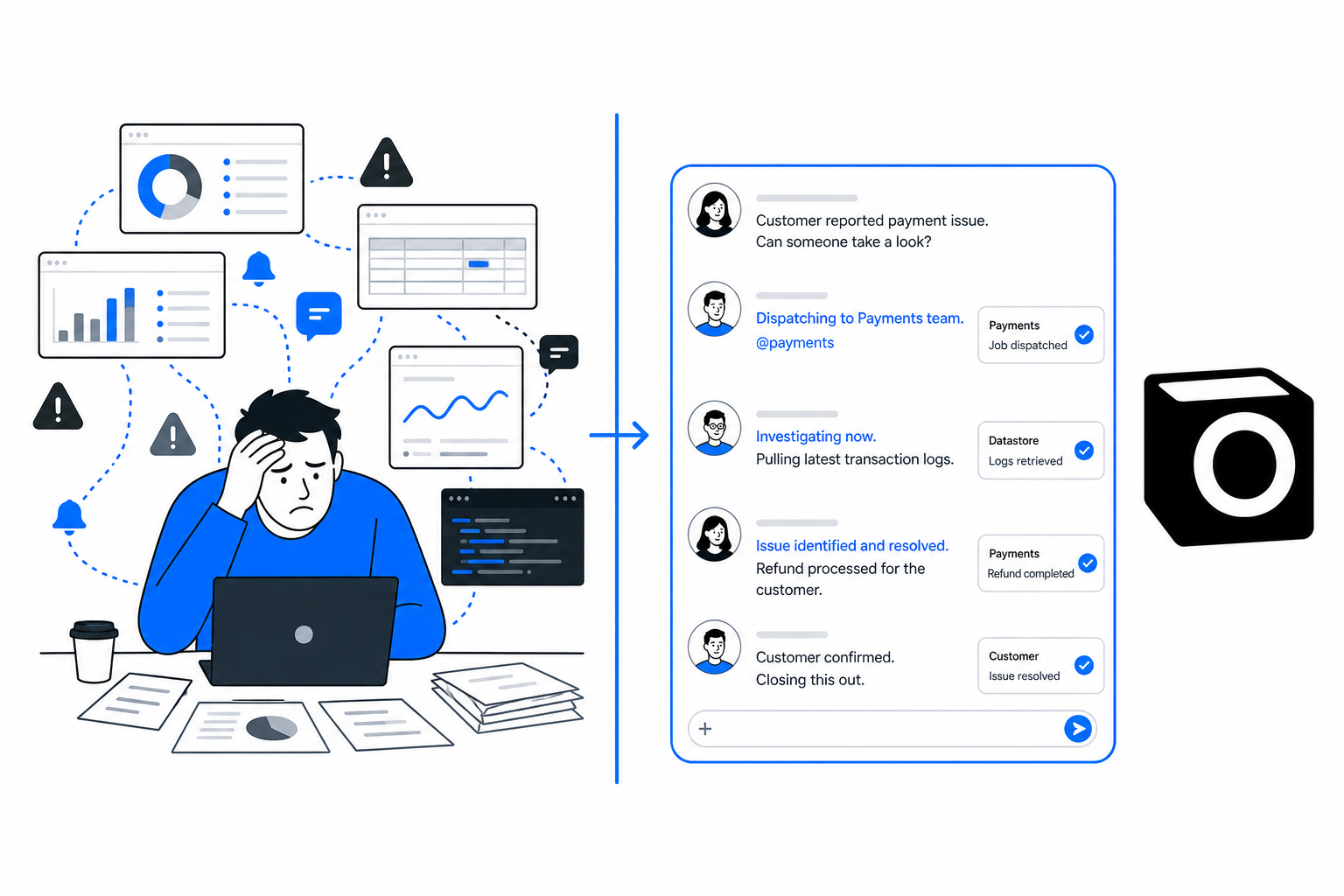
The second failure is behavioral. A suite still expects you to visit it. It may reduce the number of tools in your subscription list without reducing the number of decisions and updates in your head. That is software consolidation, not management.
What to automate first
Start with workflows that cross systems and happen often enough to annoy you. Meeting preparation is a good example because it can combine calendar context, previous email threads, CRM history, and internal notes. Follow-up is another because the value is not drafting one email; it is noticing that the email is still needed, preparing it with context, and tracking what happens next.
Do not start with the most ambitious autonomous workflow you can imagine. Start with one bounded process that has a clear trigger, known sources, reversible actions, and a visible completion state. Let the assistant draft before it sends. Let it propose record changes before it overwrites valuable data. Expand autonomy only where the error pattern is understood.
The control-layer checklist
A useful control layer should retrieve context from the correct source, respect account boundaries, show what it changed, and stop when approval is required. It should handle exceptions without inventing a successful outcome. It should also make failure obvious. Silent automation is wonderful until it silently stops working.
This is why the UK government’s ongoing interest in business systems integration matters beyond policy. Integration friction is not a cosmetic annoyance. It creates duplicated work, stale records, and poor decisions. Small teams feel that tax first because there is no operations department absorbing it.
When you really should buy the suite
An all-in-one business management platform makes sense when your processes are stable, your reporting requirements are strict, and the cost of reconciling separate systems is higher than the cost of migration. It also makes sense when several employees need standardized workflows and role-based controls across the same data.
If you are still changing the way the company sells, delivers, and supports customers every quarter, a modular stack plus a delegation layer is usually more forgiving. You can replace one system without rebuilding your entire operating model.
Manage the business, not the dashboards
The solo-founder version of business management software should not be a digital office block with fifty empty rooms. It should feel like a capable operator standing between you and the tools: retrieving context, moving work, asking when uncertain, and reporting back.
Keep the systems that deserve to own the data. Build a thin, messaging-native layer above them. The goal is not one app. The goal is one place to delegate.

Based on an original idea from Flo. Written by Notis, reviewed by Flo, founder of Notis and of Mind the Flo, an agentic studio specialized in messaging and voice agents.
Related posts
How to Automate LinkedIn Content Without Removing Human Approval
A practical blueprint for automating LinkedIn content with specialized AI skills, Notion approval, Notis workflows, and PostForMe scheduling.
What an Automated Virtual Assistant Should Actually Do for a Founder
A founder-first guide to an automated virtual assistant that does more than answer: it captures work where it appears, keeps context, and closes loops.
How I Killed My Sunday Scaries With an AI Inbox Zero Ritual
A founder workflow for turning Sunday-night dread into a clean Monday: capture loose loops, delegate emails to AI, validate risky stuff, close the week.