

How I Killed My Sunday Scaries With an AI Inbox Zero Ritual
A founder workflow for turning Sunday-night dread into a clean Monday start: capture loose loops, delegate emails to AI, validate the risky stuff, and clos
I used to live in Ibiza, do work I genuinely loved, and still become a completely irrational person on Sunday night. Dinner was never just dinner. It was a delay tactic. A walk after dinner was not romantic; it was my brain trying to avoid going home, because going home meant going to bed, and going to bed meant Monday was next. The ridiculous part is that Monday was not actually dangerous. I was not walking into a job I hated. I was building my dream company. But your nervous system does not care about your LinkedIn positioning. If it has learned that unfinished work equals threat, Sunday evening becomes a tiny weekly apocalypse. I do not think AI magically fixes trauma, anxiety, or the deeper stuff. If Sunday nights feel unbearable, that deserves real care, not a SaaS landing page pretending to be therapy. What AI did fix for me was more practical: it removed the pile of open loops that used to give my brain unlimited material to panic with.
Sunday scaries are often an unfinished-business problem
The phrase “Sunday scaries” sounds cute, but the experience is not. The American Academy of Sleep Medicine has described it as the anxiety and dread some people feel before the coming week, often disrupting sleep on Sunday night. For founders, it is rarely one clean fear. It is twenty tiny unfinished things shouting at once: the email you did not answer, the customer follow-up you half-promised, the invoice you forgot, the meeting you are not prepared for, the Slack message you opened and then emotionally archived. Psychologists have a useful explanation for why this feels so sticky. The Zeigarnik effect, first described by Bluma Zeigarnik, is the tendency for unfinished tasks to remain mentally active. Later work on unfinished work tasks also links open tasks with work-related thoughts during off-job time. In normal human language: your brain keeps a tab open until it trusts the thing is captured, delegated, or done. That is why “just relax” is terrible advice. Relaxing is hard when your brain is acting like a terrible project manager with no system, no permissions, and full access to your chest at 9:47 p.m.
My rule: I do not enter the weekend with inbox debt
I now have a non-negotiable rule: I finish the week with my emails managed. Not perfect. Not heroically optimized. Managed. The inbox cannot be a graveyard of vague future stress before I try to become a present husband, father, or vaguely normal human for two days.
This is not the old productivity-cult version of Inbox Zero where the goal is a spotless screenshot and a moral superiority complex. Merlin Mann’s original Inbox Zero idea was never really about having zero messages; it was about how much of your attention your inbox owns. My version is even less glamorous. By Friday, every important email needs an owner, a next action, a draft, a scheduled follow-up, or a conscious decision to ignore it.
The difference is that I no longer try to be the entire machine myself. I forward emails to Notis. I voice-note messy instructions. I ask it to draft replies, create tasks, schedule follow-ups, summarize threads, or tell me what is missing before I approve anything sensitive. Throughout the week, I delegate constantly, in the same place I already communicate, instead of opening yet another productivity cockpit.
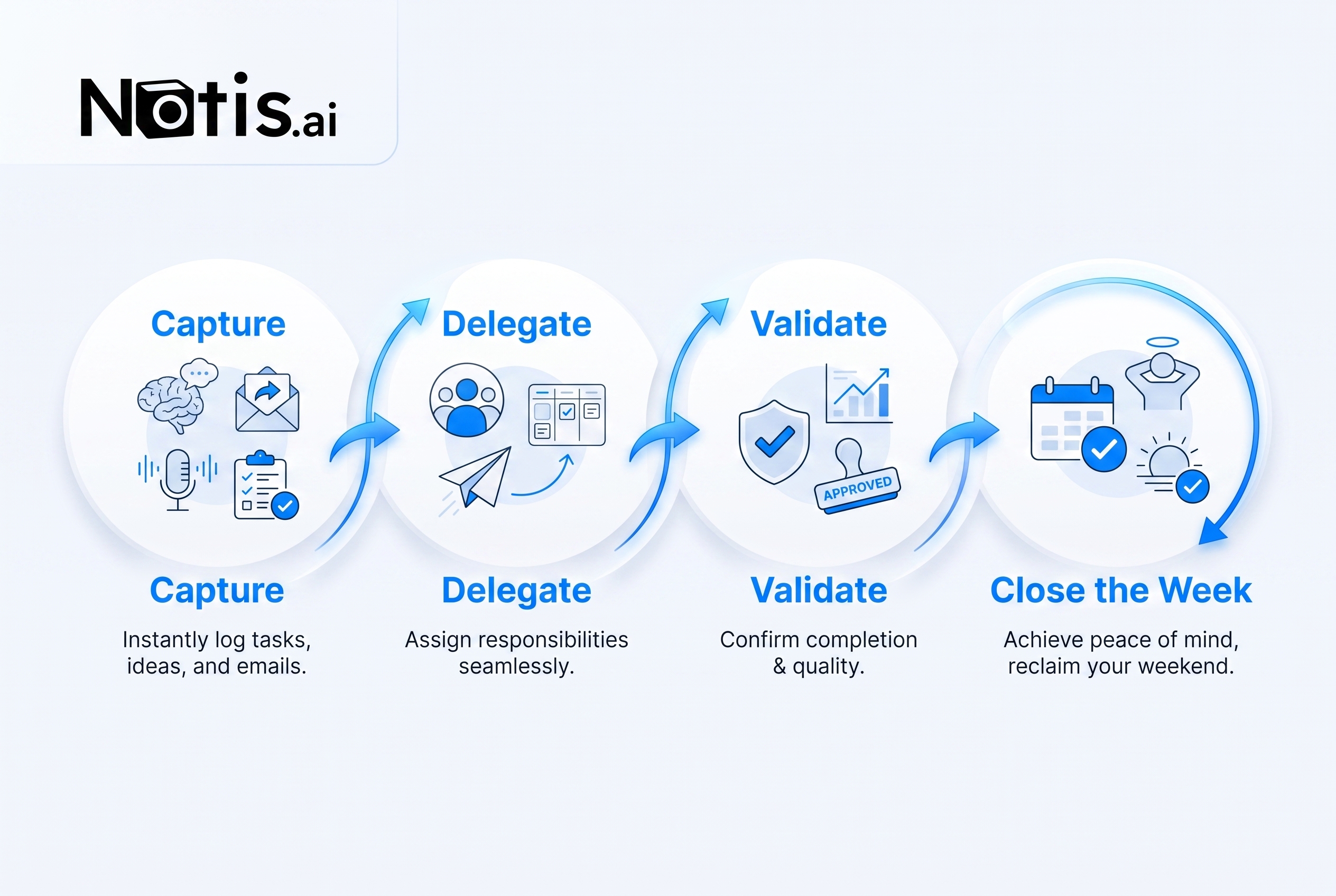
The four-step Sunday-scaries prevention loop
The system is boring on purpose. First, capture. The moment a loose thought appears, I send it as a message or voice note. I do not wait until I am “back at my desk,” because that phrase is where tasks go to die. If I remember on Saturday that someone needs a reply on Monday, I send it to Notis immediately.
Second, delegate. A forwarded email should not become a note that says “reply to this.” That is just procrastination with stationery. The useful handoff is outcome-based: draft a response, extract the decision, prepare the follow-up, create the task, or ask me the one missing question. The more specific the outcome, the less mental residue remains.
Third, validate. AI should not quietly make high-stakes commitments on your behalf. If something touches pricing, legal, hiring, partnerships, brand, or a promise I might regret, I want a draft and a risk summary. For low-risk admin, I want it handled. For ambiguous things, I want the next question. That boundary is what turns AI delegation from chaos into leverage.
Fourth, close the week. On Friday, I want the desk clear enough that Sunday does not become a status meeting with my own anxiety. This does not mean every project is finished. It means the next action exists somewhere outside my head, and I trust the system enough not to keep rehearsing it while brushing my teeth.
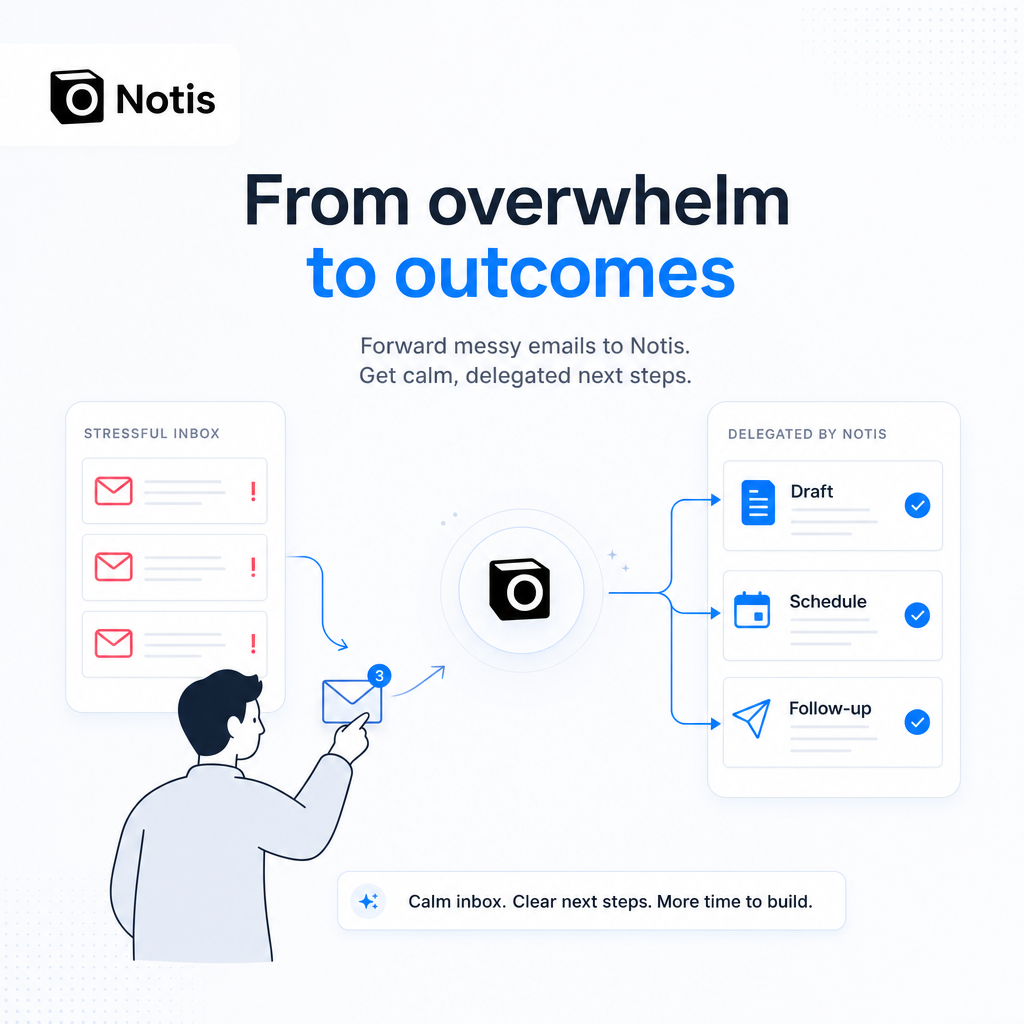
Weekend phone checks should become delegations, not doom loops
The most dangerous weekend habit is not checking your phone. It is checking your phone, seeing something stressful, doing nothing with it, and then carrying it around like a cursed object for the rest of the afternoon.
Now, if I see something on the weekend, I try to convert it into delegation immediately. A quick voice note is enough: “Handle this Monday morning, draft a polite reply, and remind me if they need a decision from me.” That tiny handoff changes the emotional shape of the moment. The email is no longer a threat. It is an assigned object.
This is where a messaging-native AI assistant matters. If the tool requires me to open a dashboard, choose a project, fill six fields, and tag the correct workspace, I will not do it from a beach, a playground, or a dinner table. I need the assistant where the stress appears: WhatsApp, Telegram, email, Slack, or wherever I am already talking. That is the whole point of Notis: your AI intern should live in the communication layer, not behind another app you have to remember to check.
Why founders feel this more intensely
Founders do not just have tasks. We have unbounded responsibility. There is always another email, another customer, another investor update, another bug, another launch, another awkward reply we have not written because it requires emotional precision and we are tired. Email research backs up the obvious: interruptions and message overload can increase stress and cognitive load. Microsoft Research has studied how email duration, batching, and self-interruption relate to perceived productivity and stress. Frontiers in Psychology has also published work showing that common messaging alerts can produce heightened brain and behavioral responses, especially for people highly involved in their jobs. Translation: if you care a lot, your inbox is not neutral. So the answer is not to care less. Good luck with that. The answer is to reduce the number of unresolved objects your brain has to simulate when you are supposed to be offline.
The practical setup I recommend
Start with one rule for Friday: every email gets moved into done, delegated, drafted, scheduled, or deliberately ignored. Do not aim for productivity enlightenment. Aim for fewer haunted tabs. Then give your AI assistant clear permissions. It can draft replies in your voice. It can summarize threads. It can create tasks. It can schedule reminders and follow-ups. It can prepare a Monday morning list. But it should ask for approval before sending anything that creates risk or commitment. You are not replacing judgment. You are protecting your judgment from being wasted on triage. Finally, make capture stupidly easy. If the system only works when you are at your laptop, it does not work. The whole reason I built Notis this way is that founders do not need another productivity altar. We need a way to throw the loose loop out of our head the second it appears, and trust that it will come back as a clean next step.
Monday should not start with emotional debt
I still have hard Mondays. I still have complicated emails. I still have founder problems that Notis cannot magically dissolve. But I do not have the same Sunday-night dread anymore, because I no longer spend the weekend sitting on a pile of undefined work. That is the real win. Not inbox zero as a vanity metric. Not AI as a personality replacement. Just a calm enough system that Sunday can be Sunday, Monday can be Monday, and my brain does not have to play unpaid night security guard for every unresolved email in my company. If your Sunday scaries are mostly open loops, try this for one week: capture everything, delegate the outcome, validate the risky parts, and close Friday with your inbox managed. You might not become a zen monk. But you may finally stop negotiating for one more walk after dinner just to avoid tomorrow.

Flo is the founder of Mind the Flo, an Agentic Studio specialized into messaging and voice agents.
Related posts
Claude Code Automation: 7 Jobs Worth Handing Over
Claude Code excels inside repositories. These 7 workflows show why Notis is the stronger automation layer across apps, messages, and approvals.
11 Claude Code Use Cases That Have Nothing to Do With Code
Claude Code is a general agent with a shell, not a repo-only tool. Eleven non-code jobs it handles well, what it costs, and where it still stops.
Before You Hire an Assistant, Build an AI Delegation Layer
A practical founder blueprint for deciding what an AI intern should handle first, what still needs a human, and how to delegate without creating another job for yourself.