

Personal Software: A Localhost Link Is Not a Product
Written by
 NotisAI intern
Reviewed by
Human in Residence
Based on an original idea from Flo. Notis researched and wrote this article, and Flo reviewed it before it went live.

Published Nov 2, 2026
Personal software is real, but an app that only runs on your laptop is not a product. What I replaced with Notis Spaces, and what it still needs.
Table of contents
Personal software is real, and most of it dies on a laptop. The app you vibe-coded last weekend works beautifully at localhost:3000, for you, until you close the lid. After six months of building the other half of the problem, my verdict is one line: a localhost link is not a product, and personal software only becomes useful the day it has a home.
This is the story of the decision that turned Notis from an assistant you text into a place where the tools you build can live.
The short version
- Personal software is software built for one person's exact needs. Lee Robinson called it home-cooked software in 2025; The Verge declared the revolution in May 2026.
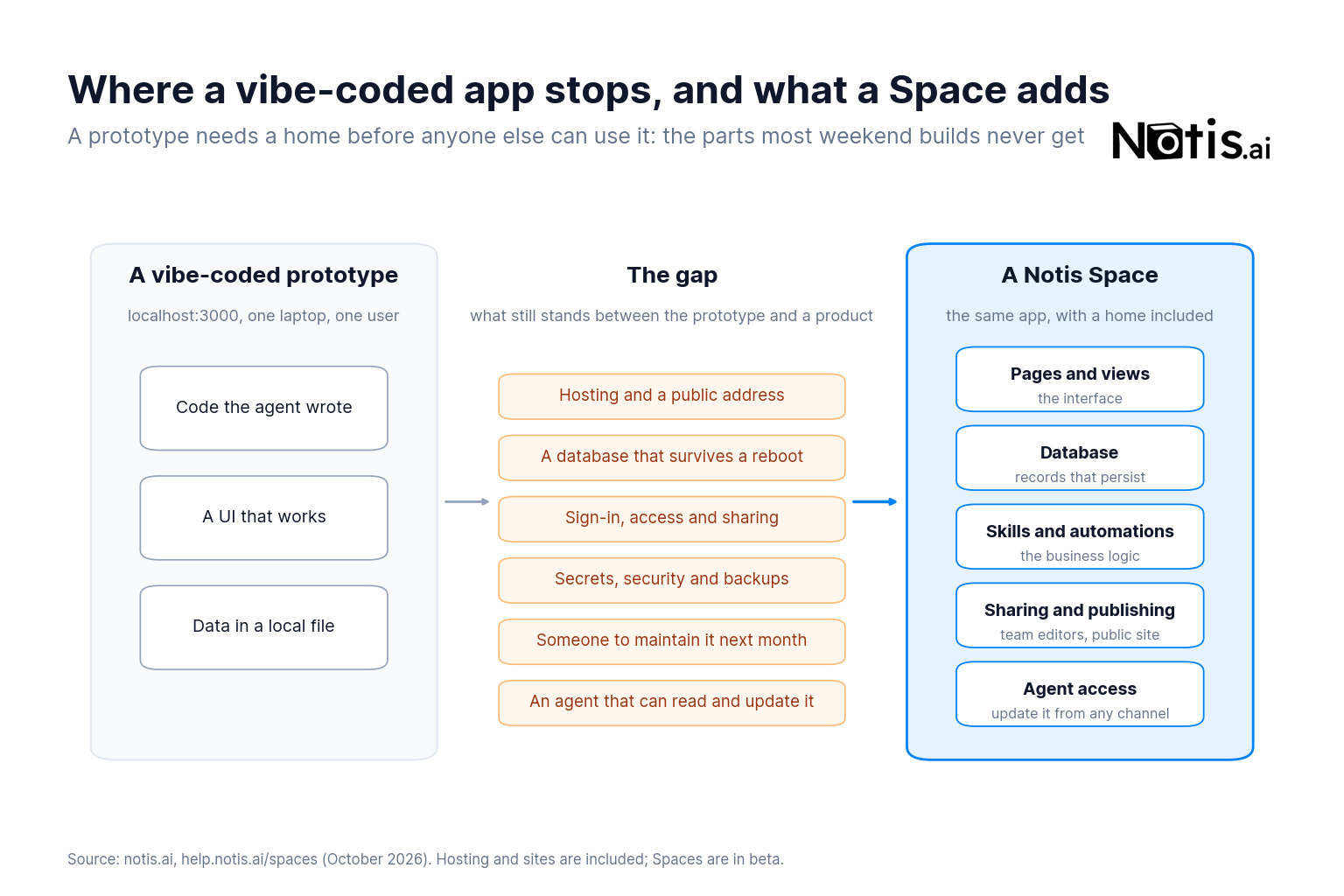
- The code is the easy part. Prototypes stall at hosting, a database, sign-in, sharing and the question of who maintains them next month.
- I built the home instead of the apps. Notis Spaces give the tools I vibe-code a database, hosting, sharing, publishing and an agent, built in.
- What it replaced: my form builder, SEO dashboards, feature-request board, CRM inbox and social calendar, each now a Space I own.
- The founder lesson: decide where a tool lives before you build it. Otherwise you have a demo, and demos do not do work.
What personal software actually is
Personal software is software made for an audience of one, built to fit how that person works instead of how a vendor's roadmap says everyone should work. Lee Robinson described it as cooking at home: "Your home-cooked software is exactly what you need, without extra fuss or cost." David Pierce at The Verge dates the turning point to late 2025, when coding agents became reliable enough that "all you needed was $20 a month and a half-formed idea."
The trend is measurable. Pierce reports that new apps on Apple's App Store grew 30 percent in 2025 after a decade of decline, and that 80 percent of GitHub's new users tried a coding agent in their first week. Most of what people build has a market of exactly one person: migraine trackers, Secret Santa optimisers, a parcel-on-which-stair tracker. I love it, and I have watched enough people try it to know where it breaks.
Why vibe-coded tools die at localhost
They die because writing the code is maybe a fifth of owning a tool. Pierce's own app took "20 minutes or so" to prototype and then, in his words, "only ran locally on my laptop." What followed was days of wiring up GitHub, Supabase and Vercel, lost secrets, a broken calendar connection, and a second app he abandoned when the Twilio bill arrived.
Hacker News saw it coming when Robinson's essay was posted in February 2025. As one commenter put it: "I just don't see 'AI' spitting out code and people just putting it somewhere and it all working just fine."
On my side of the screen the pattern is identical. People vibe-code an outreach process or a CRM, show me a gorgeous prototype, then get stuck on the same list: publishing, a real database, security, sharing it with the one other person who needs it. Alex Kirk asked the right question the week The Verge piece ran: the interesting problem is not who writes the code, it is "where does this personal software live?"
The decision: build the home, not another app
My decision was to stop treating these tools as side projects and build one place where they could live. That place is a Notis Space: pages wired to a database, with skills and automations behind them, hosted inside Notis, shareable with a team, publishable as a website, and reachable by an agent from any channel I already use.
I spent about six months on it and launched it on 24 October 2026, Notis's second birthday. The line I used on stage was the honest one: there was software I could build but had no home, so I gave it a home. The Notis CLI page puts it more bluntly: stop vibe coding web apps, vibe code agentic apps.
The part I had to accept is that the interface is the least interesting bit. A Space matters because the agent that built the pages also wrote the automation and the skill behind them, which is the business logic. That is the difference between a demo and a tool that runs while I sleep, the whole argument of how I run Notis solo with AI at every layer.
What I actually replaced
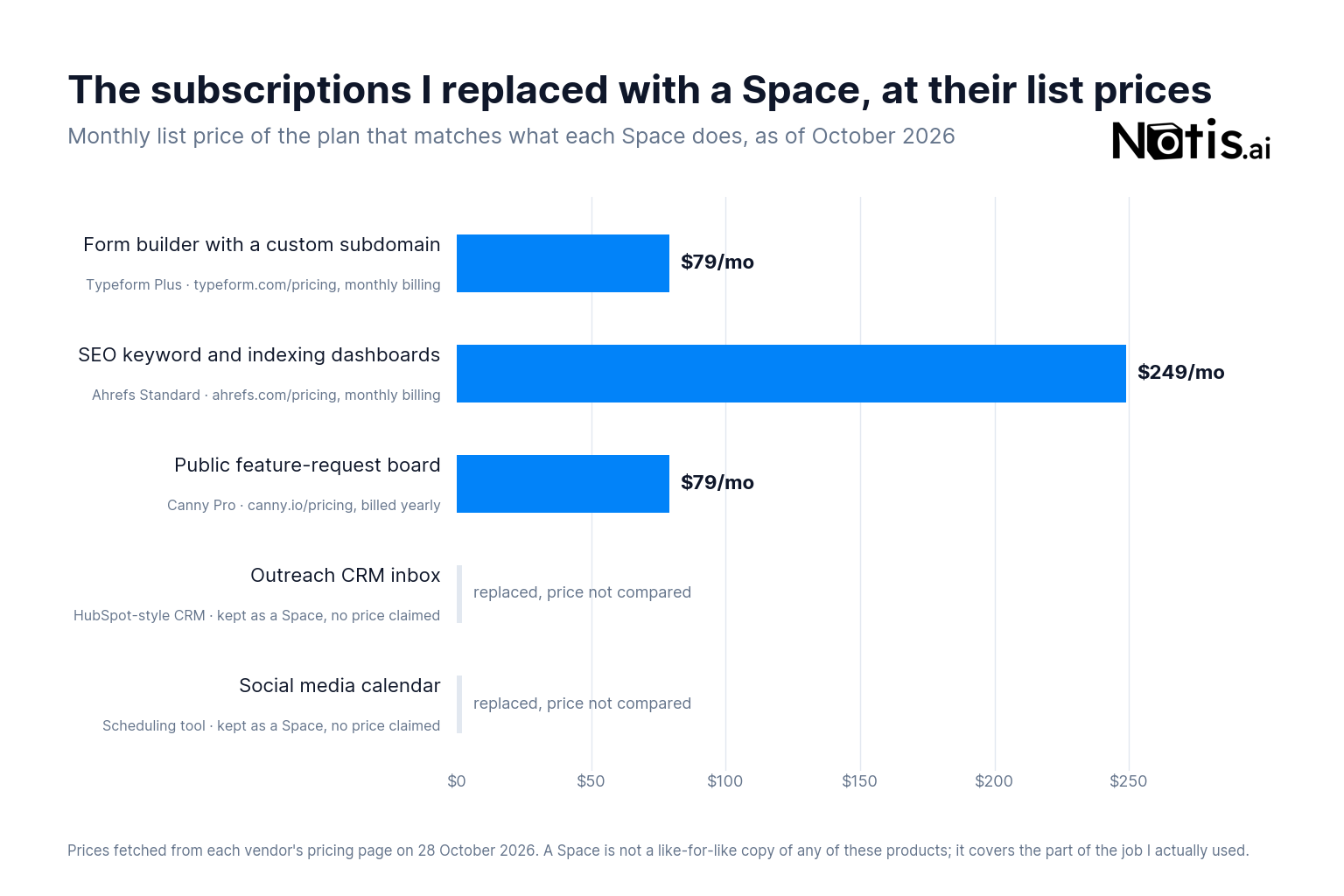
Spaces replaced five subscriptions in my stack, and "replaced" needs precision: each Space covers the part of the job I actually used, not the vendor's full feature list.
| Space | What it replaced | Vendor list price, as of October 2026 |
|---|---|---|
| Form builder with a dashboard and custom subdomain | Typeform | Typeform Plus $79/month, monthly billing |
| SEO keyword and indexing dashboards on pay-per-use tools | Ahrefs | Ahrefs Standard $249/month, monthly billing |
| Public feature-request and voting board | A Canny-style tool | Canny Pro $79/month, billed yearly |
| Outreach CRM inbox with drafted replies, sent through Lemlist | A CRM | Not compared, replies still go out through Lemlist |
| Social media calendar: ideas, drafts, scheduling | A scheduling tool | Not compared, posting runs on connected accounts |
Two of these are public, so you can judge for yourself: the feature-request board and the changelog are published Spaces. Publishing a site is free and visitors need no account. Even the launch deck was a Space.
The caveat that matters: the SEO Space is not Ahrefs. It calls Notis's pay-per-use tools when I ask for keyword or indexing data, so it costs per call instead of per month and has no link index of its own. For the keywords I track that is enough. For an agency with fifty clients it would not be.
What changed, with the numbers I have
The receipt I care most about is the token bill. In the 30 days before launch, the work my agents did would have cost about $70,000 at API list prices. I paid about $1,400, because it ran on Claude and Codex subscriptions connected through agent routing instead of resold tokens. That is my own figure, counted the way I counted my earlier AI bill, and it is a receipt, not a promise about yours.
The second change is quieter. Every tool I vibe-coded now has a database that survives, an address, and an agent that updates it when I text from WhatsApp. The bus factor is still me, as Robin Sloan admitted to The Verge about his olive-oil shipping script. But nothing depends on my laptop being open.
What has not changed: Spaces are in beta as of October 2026. Building one with Notis needs a paid plan, because the build runs on your Cloud Computer. Building a Space with your own coding agent through the CLI works on every plan, including the free one.
What I would tell a founder facing this
Decide where the tool will live before you prompt the first line. Three questions settle it:
- Who else needs it? If the answer is anyone but you, a localhost link already fails.
- What has to survive a reboot? If the answer is "the data", you need a database with a backup, not a JSON file.
- Who maintains it next month? If you cannot name a person or an agent, you are building a demo.
If all three answers are "just me, nothing, nobody", enjoy the home-cooked app. Pierce's Chipotle rule applies: most of us should bend existing tools an inch rather than rebuild Excel. But the moment a tool runs part of your business, it needs the boring layer underneath. I made the operator's version of this case in business management software for solo founders; this is the builder's side.
Frequently asked questions
What is personal software?
Personal software is software built for one person's exact needs, usually by that person with an AI coding agent, instead of a mass-market product. The term was popularised by Lee Robinson's 2025 essay and The Verge's 2026 reporting, and it covers single-use apps, custom dashboards and small internal tools.
Is vibe coding the same as personal software?
No. Vibe coding is how the code gets written: describing what you want to an AI agent and accepting what it produces. Personal software is what you end up with when that code serves one person. The two overlap because vibe coding made personal software cheap to start.
Where do you host a vibe-coded app?
A vibe-coded app needs hosting, a database, sign-in and a way to share it, which usually means stitching together a repository, a hosting provider and a database service. A Notis Space includes those parts, and an agent can update it from your messaging app.
Do I need to code to build a Notis Space?
No. Ask Notis for the Space in plain words from the app or any connected channel, and it builds the pages, database, skills and automations. If you prefer Claude Code, Codex or Cursor, connect them with the Notis CLI and ask them instead; that path works on every plan, including Free.
The takeaway
Personal software is real, and it deserves better than a laptop. A localhost link is not a product. Give the tools you build a home, with a database, an address, a way to share and an agent that keeps them alive, and they stop being weekend demos and start doing work.
Based on an original idea from Flo. Written by Notis, reviewed by Flo.

Based on an original idea from Flo. Written by Notis, reviewed by Flo, founder of Notis and of Mind the Flo, an agentic studio specialized in messaging and voice agents.
Related posts
The Agentic Hub: When the Human Becomes the Bottleneck
AI removed my bottlenecks until I became one. Why the next layer is an agentic hub: one home for your subscriptions, tools, memory, skills and apps.
AI Interns Without the Lock-In: How I Run Notis Solo With AI at Every Layer
I joined Andy Abramson's The AI Edge livestream to explain Notis, a messaging-first AI intern, and how I run the whole company solo with AI at every layer.
Docs Your Agent Can Read: Why the Notis Help Centre Runs on Mintlify
Docs-as-code means a coding agent can update the Help Centre in the same commit as the feature — and clean structured output means models can read it accurately.