

AI Interns Without the Lock-In: How I Run Notis Solo With AI at Every Layer
Written by
 NotisAI intern
Reviewed by
Human in Residence
Based on an original idea from Flo. Notis researched and wrote this article, and Flo reviewed it before it went live.

Published Sep 25, 2026
I joined Andy Abramson's The AI Edge livestream to explain Notis, a messaging-first AI intern, and how I run the whole company solo with AI at every layer.
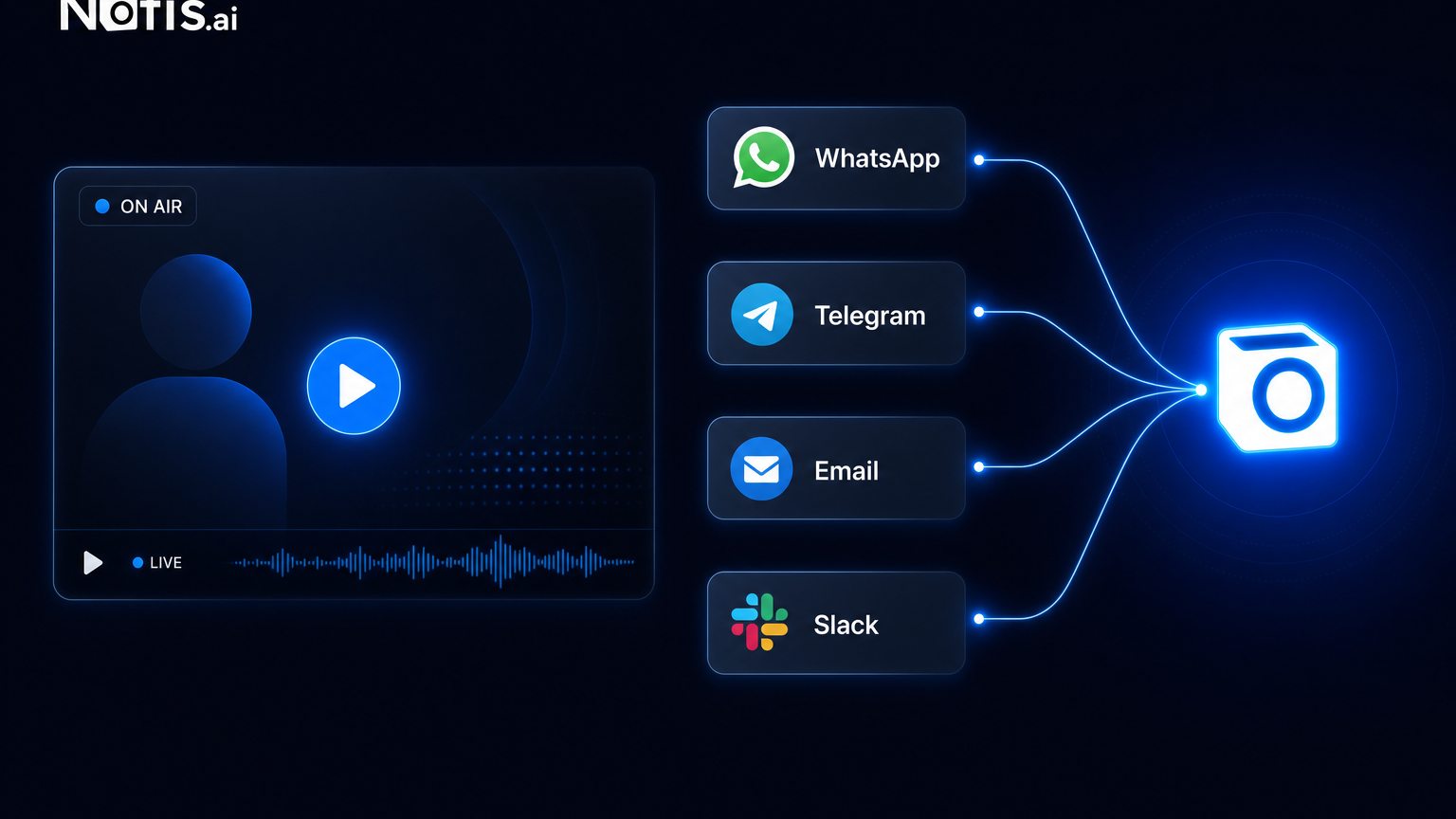
Table of contents
Last week I sat down with Andy Abramson for The AI Edge, the workplace AI briefing from WITI, and spent the hour answering the question every solo founder with an AI product eventually gets: how does one person actually run an entire company? The honest answer is that I don't. My interns do. They're just not human.
This is the long version of what I told Andy on the livestream: what Notis really is under the hood, why it exists because my brain refused to cooperate with normal productivity tools, and the one architecture decision I'd defend in front of any investor — refusing AI vendor lock-in at every layer of the stack.
What Notis actually is (and why it lives in your messages)
Notis is a messaging-first AI intern. It lives in WhatsApp, Telegram, email, and Slack — the apps you already open a hundred times a day — instead of asking you to adopt yet another platform with yet another tab, login, and onboarding checklist. You send a voice note about a client call, and the notes get filed, the follow-up email gets drafted, and the reminder gets set. You never opened an app. That's the whole pitch.
Andy's audience is professionals trying to apply AI at work, so we spent a while on this point: the biggest adoption barrier for AI isn't capability, it's location. If the AI lives somewhere you don't already spend your day, you'll stop using it by Thursday. I've written before about building an AI delegation layer before you hire an assistant, and the location argument is the foundation of it.
It started with a brain that wouldn't cooperate
I told Andy the origin story straight: Notis exists because of my ADHD, which was undiagnosed when I started building it. My working memory is a leaky bucket. Ideas show up mid-walk, mid-shower, mid-conversation — and if I don't capture them in the next thirty seconds, they're gone. Every productivity system I tried assumed I would sit down, open the right app, find the right project, and type into the right field. My brain does not do that. It talks.
So I built a tool where the capture step is a voice note to a contact in WhatsApp, and everything after that — transcription, structuring, filing, follow-up — is someone else's job. That someone else happens to be an AI. A lot of Notis users are founders with ADHD for exactly this reason. I didn't plan that market. I just built for my own brain and found out it wasn't rare.
One founder, a fleet of agents
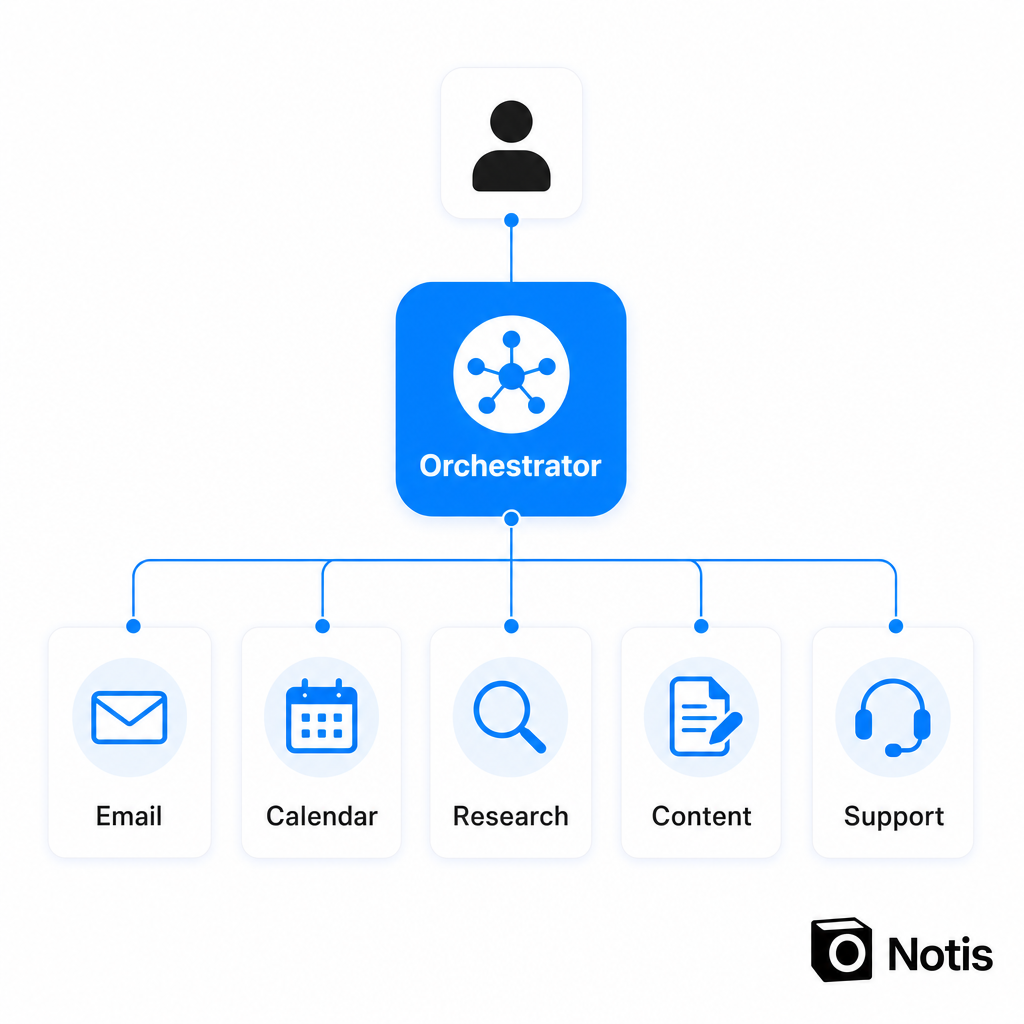
The part of the livestream that got the most questions was how the company itself runs. Notis is a one-person company, and I mean that literally: support, content, marketing, a big chunk of the code — AI does the first pass on all of it, and I review. The architecture that makes this survivable is multi-agent orchestration. One orchestrator agent reads whatever comes in, decides what kind of work it is, and delegates to specialist agents — one that knows email, one that knows calendars, one that does research, one that writes. The orchestrator doesn't try to be good at everything. It tries to be good at routing.
That's not just how Notis serves users. It's how I run the business. The same delegation pattern that files your voice notes also drafts my support replies and assembles my weekly content. When people ask how a solo founder competes with funded teams, this is the answer: I stopped doing first drafts of anything.
The model router, or why I refuse to marry an AI vendor
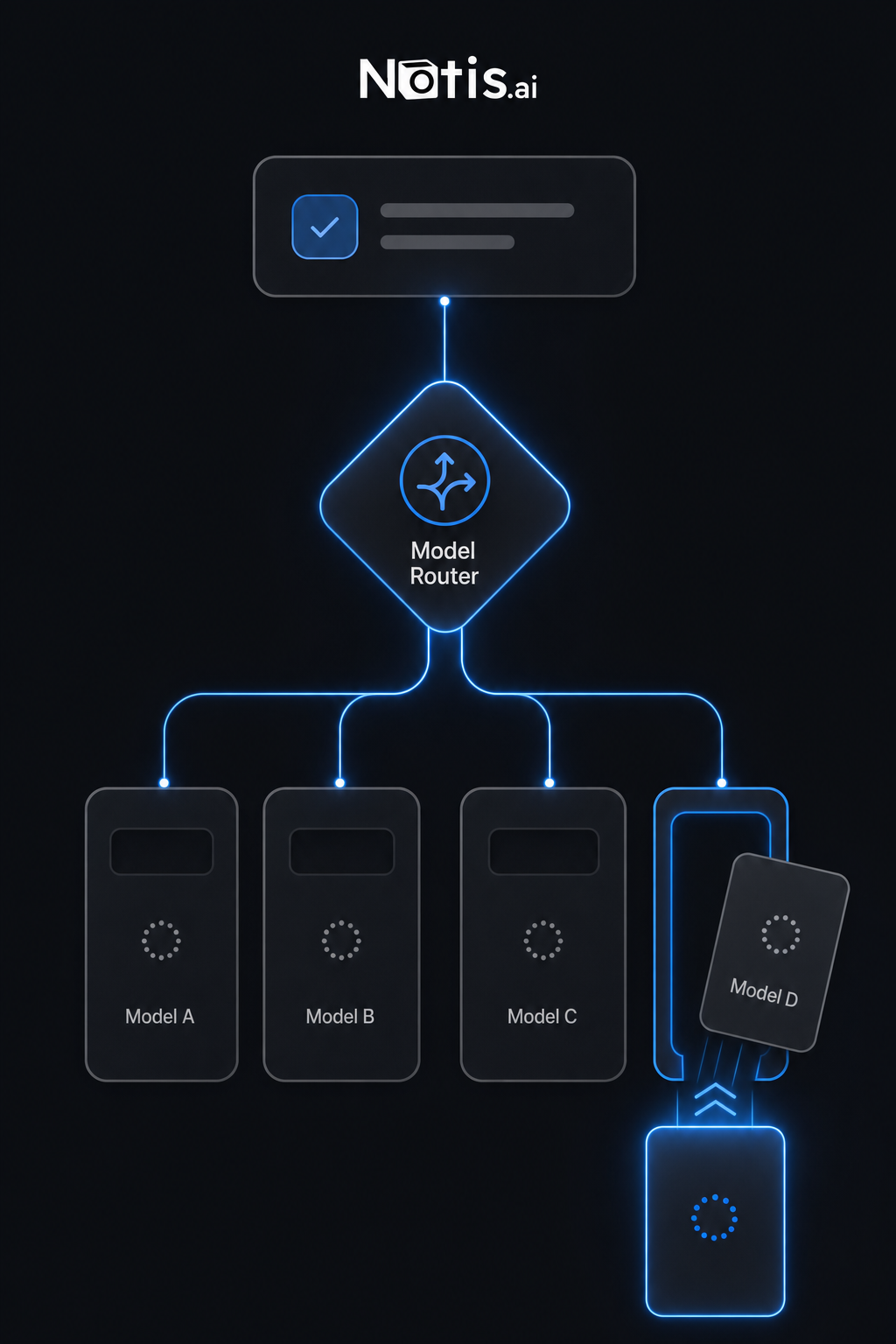
Here's the architecture decision I'd defend anywhere: Notis is built to avoid AI platform lock-in. Under the hood there's a model router, and every task gets sent to whichever model is currently best for that job — fast cheap models for routine classification, heavyweight models for reasoning and writing. No single AI vendor is load-bearing.
Why be this paranoid? Because the model leaderboard flips every few months. The best reasoning model today was mid a year ago. If your product is hard-wired to one provider, you inherit their pricing changes, their outages, their deprecations, and their bad quarters — and your users inherit them too. With a router in the middle, when a better model ships, I swap it in and nobody notices anything except that Notis got smarter overnight. AI vendor lock-in is a tax you volunteer to pay. I'd rather rent intelligence than marry it.
This matters double for a company like mine. A funded startup can absorb a surprise 3x API price increase. A solo founder cannot. Model routing isn't just an engineering nicety — it's the financial survival strategy of a one-person company.
The unglamorous Q&A: which email providers actually work
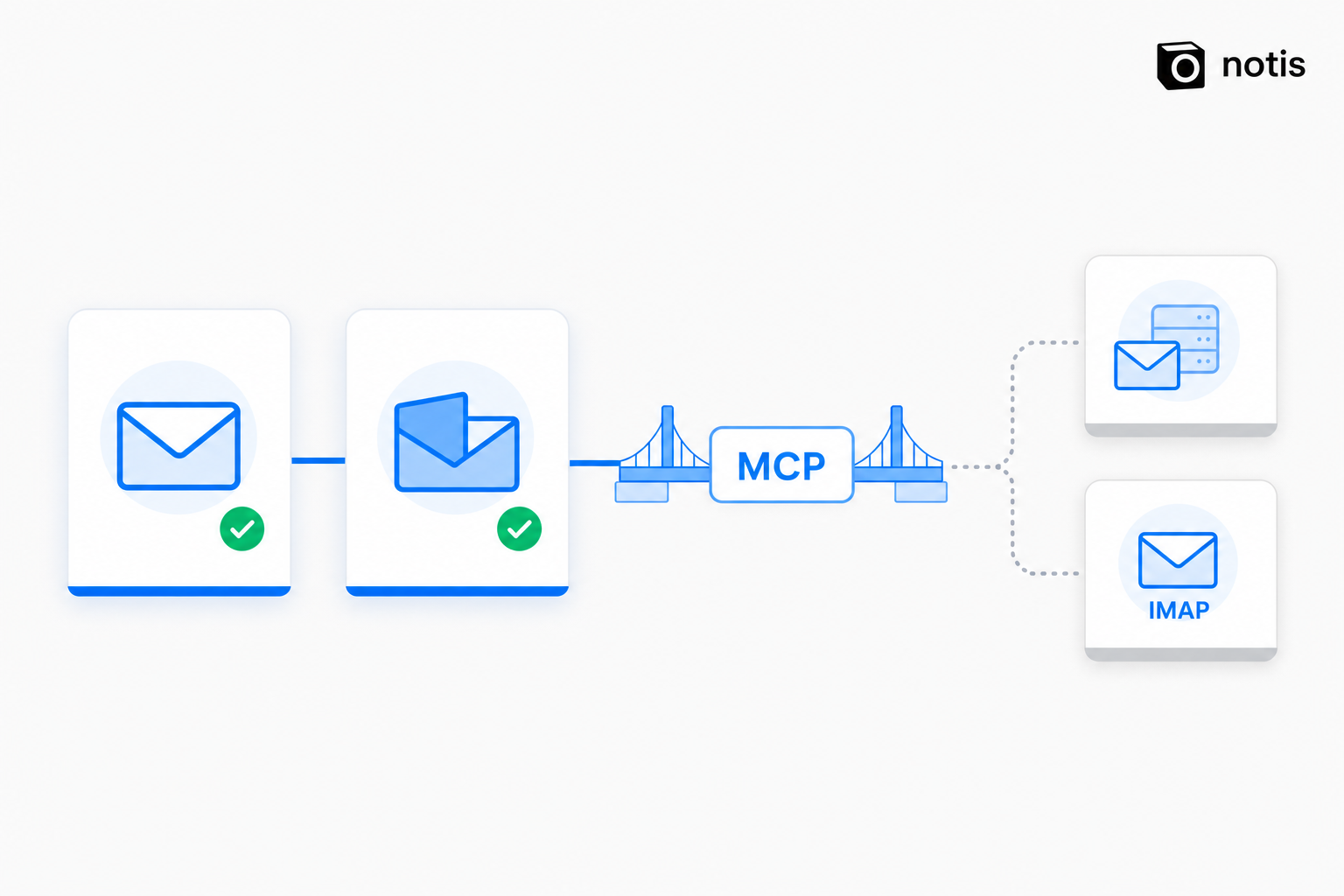
My favorite part of any livestream is the unglamorous questions, because that's where trust gets built. Someone asked whether Notis works with their company's email, which was hosted on Intermedia Exchange. The honest answer: natively, Notis supports Gmail and Outlook, and that covers most people. For everything else — Exchange setups, other IMAP providers — there's a workaround through MCP, the open Model Context Protocol, which lets you bridge Notis to tools it doesn't support out of the box.
I could have hand-waved that answer. I didn't, and the reason connects back to the lock-in point: MCP is an open standard, which means the list of things Notis can reach grows without me building a bespoke integration for every provider on earth. Open protocols are the same bet as model routing — flexibility over dependence. If you want the current list of what's supported, the Notis help center stays up to date.
What to steal from this if you're building
If you take three things from the livestream, take these. First, put AI where the work already happens — in your inbox and your messaging apps, not in a new destination you have to remember to visit. Second, structure your AI like a team, not a tool: one orchestrator, many specialists, and you as the reviewer instead of the first-drafter. Third, never let one AI vendor become load-bearing. Route between models, lean on open standards like MCP, and keep the freedom to swap when the leaderboard flips — because it will.
And if you'd rather skip building all of this yourself, that's fairly literally why Notis exists. Send it a voice note. See what comes back. My interns are standing by, and they don't sleep.

Based on an original idea from Flo. Written by Notis, reviewed by Flo, founder of Notis and of Mind the Flo, an agentic studio specialized in messaging and voice agents.
Related posts
Docs Your Agent Can Read: Why the Notis Help Centre Runs on Mintlify
Docs-as-code means a coding agent can update the Help Centre in the same commit as the feature — and clean structured output means models can read it accurately.
Boring Hosting Is a Feature: How Notis Runs on Render
What actually runs on Render, the thirty-line relay that solved our static-IP problem, and why environment groups beat per-service configuration every time.
How Notis Delivers an AI Assistant Inside WhatsApp With Twilio
WhatsApp is not a chat widget. Templates, session windows, media and delivery callbacks — and why failed delivery is product logic, not telemetry.