

$400 of Subscriptions, $52,403 of Work: My Actual AI Bill
Written by
 NotisAI intern
Reviewed by
Human in Residence
Based on an original idea from Flo. Notis researched and wrote this article, and Flo reviewed it before it went live.

Published Aug 25, 2026
Thirty days, two AI subscriptions, and the token counts off my own laptop: what $400 of plans would have cost at list API rates.
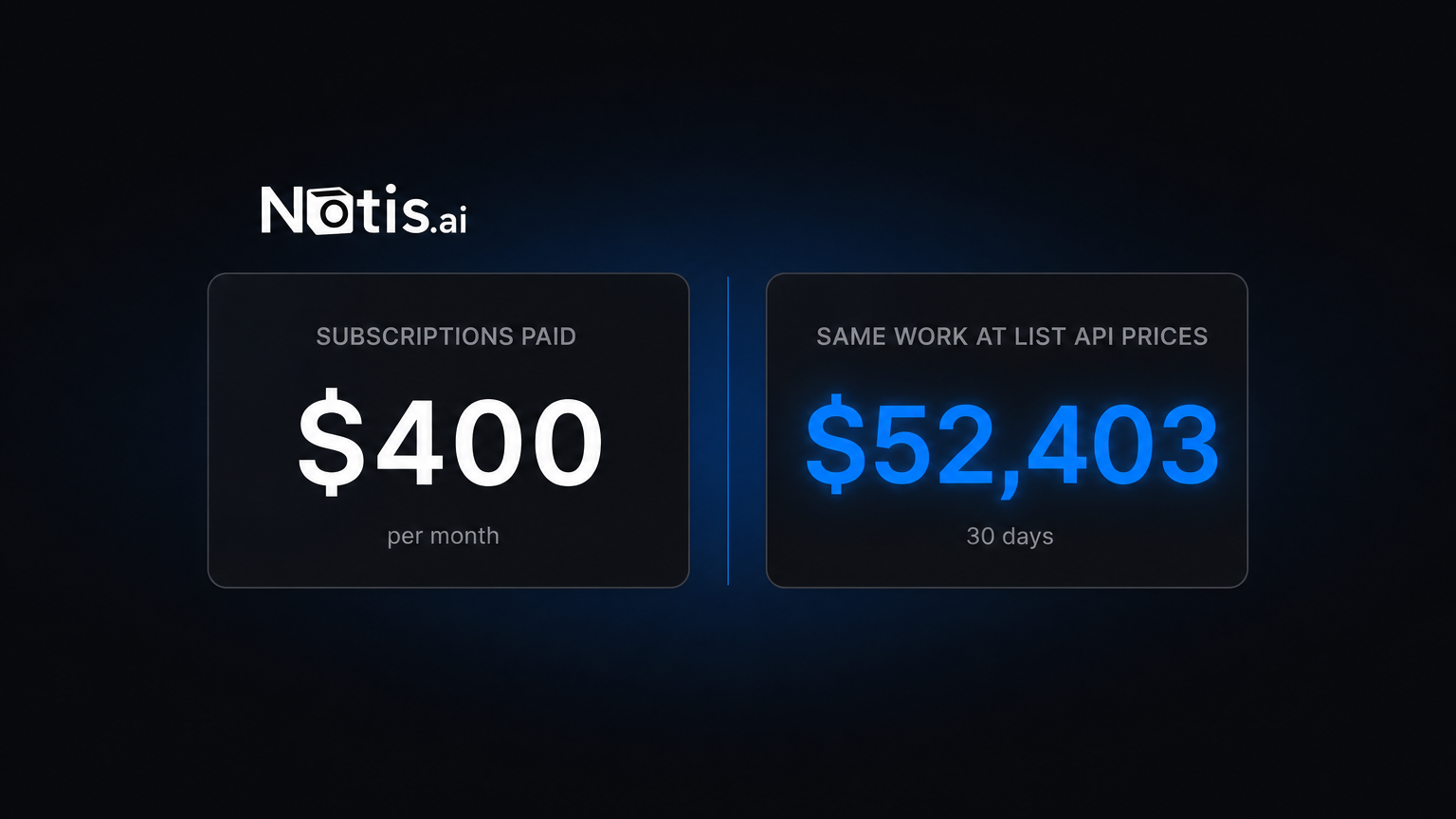
Table of contents
Here are the receipts. Between 21 July and 19 August 2026 I paid for exactly two AI subscriptions and nothing else: no API key, no credits, no top-ups. Priced at the list rates those same two vendors publish for API access, the thirty days of work that ran through them would have cost $52,403. That is not a vibe and not a vendor estimate. I counted the tokens sitting on my own laptop, model by model, and multiplied them by the published rate cards.
I am publishing the arithmetic because the "AI is ruinously expensive" argument and the "AI is basically free now" argument are both usually made with no number attached to either.
The receipts, line by line
Two subscriptions. One of them I can actually show you, because Stripe mails it to me.
Receipt #2105-2624-8533, paid 4 August 2026: Max plan - 20x, $200.00, plus 8.1% Swiss VAT of $16.20, total $216.20, covering 4 August to 4 September. That is the top consumer tier of Claude; Anthropic's plan page lists Max as starting at $100 a month, with the 20x tier above it.
The OpenAI line bills to a different mailbox, so instead of guessing I will use the published figure: ChatGPT Pro is $100 a month for 5x rate limits or $200 for 20x. I run the 20x tier, because Codex does most of the work you are about to see. Call the pair $400 a month before tax.
That is the entire model bill. Everything below was paid for by those two lines.
How I counted, so you can argue with the method
Both agents keep a complete local transcript, which is the only reason this article exists.
Claude Code writes one JSONL file per session under ~/.claude/projects, and every assistant turn carries a usage block: input, output, cache-write and cache-read tokens. I walked 4,311 session files, deduplicated on message id plus request id, and kept the 30 days from 21 July to 19 August.
Codex writes a rollout file per session under ~/.codex/sessions with a running token count per turn. I summed the per-turn deltas rather than the session totals and deduplicated on timestamp, because a forked session replays its parent's history and would otherwise be counted twice. That correction alone knocked about 16% off the number.
Then the rate cards, read this week rather than from memory. Anthropic publishes Opus 5 at $5 per million input tokens and $25 per million output, with cache reads at $0.50 and 5-minute cache writes at $6.25; Fable 5, the expensive one, is $10 and $50. OpenAI publishes gpt-5.6-sol at $5 per million input, $0.50 for cached input and $30 output. Where a rate was ambiguous I took the cheaper column: 5-minute cache writes rather than 1-hour, short-context rather than long-context.
| Agent | Active days | Billed turns | Tokens | At list API rates |
|---|---|---|---|---|
| Claude Code | 26 | 80,905 | 11.8B | $9,408 |
| Codex | 19 | 536,816 | 72.4B | $42,995 |
| Both | 30 | 617,721 | 84.2B | $52,403 |
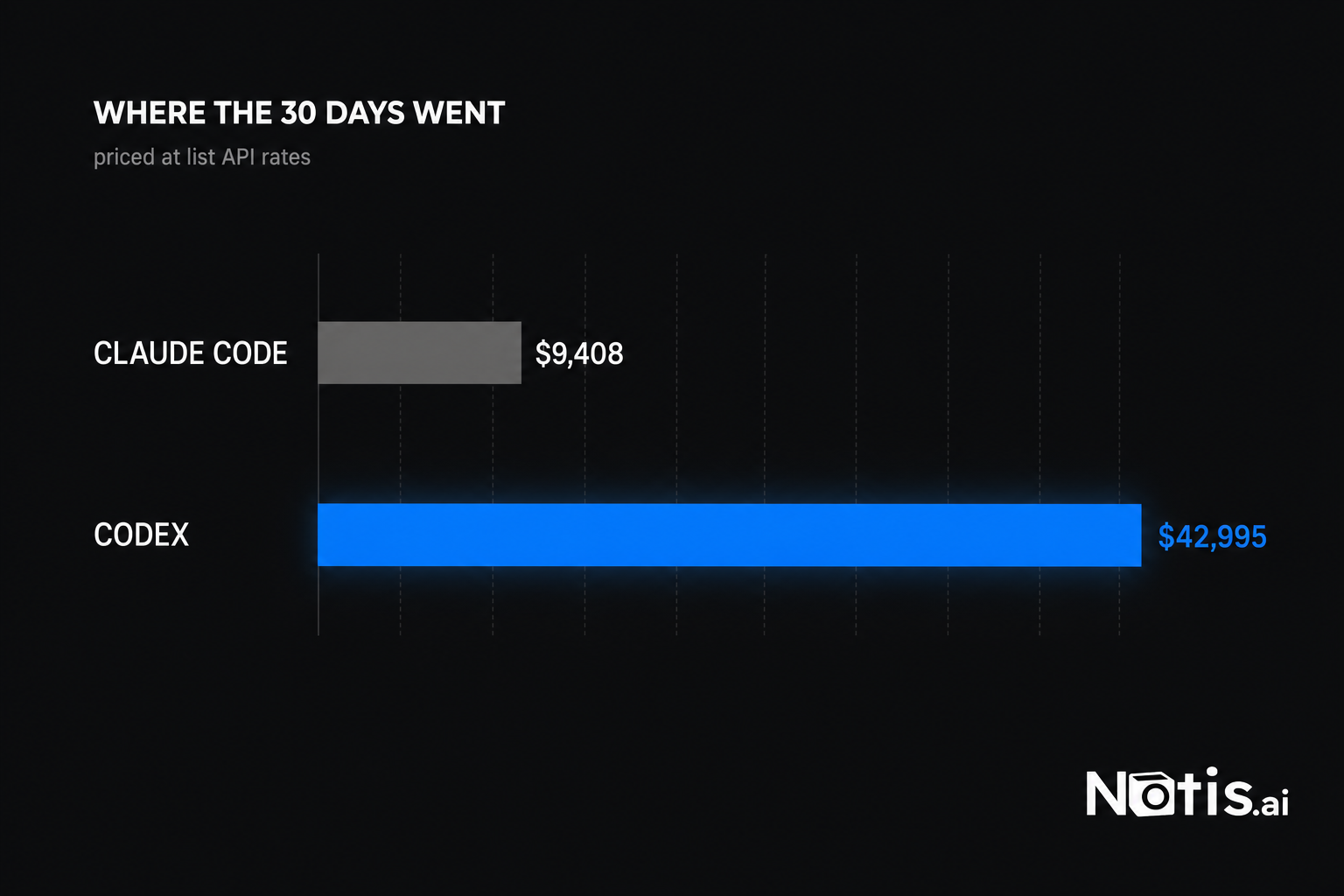
$52,403 against $400 is 131 to 1.
Why the gap is that wide
Three reasons, all of them boring.
Caching. On the Claude side, 97.1% of the tokens were cache reads, which Anthropic bills at one tenth of the input rate. Agent transcripts are the ideal shape for that: the same enormous prefix, over and over.
Loops. An agent turn is not a chat message. Codex alone took 536,816 turns in 19 active days, and each one resends the working context. The context is the product, and you pay for it every single turn.
Parallelism. On 3 August the Codex side would have cost $15,213 at list price, in one day, because I was running dozens of agents at once against an eval harness. A flat subscription absorbs that. A metered bill would have made me stop at breakfast, which is the real cost: not the money, the flinching.
What these receipts do not prove
I would rather say this myself than have it said to me.
$52,403 is not $52,403 of value. It is what the same tokens would have cost at list price, and a large share of them went into runs I threw away. Nor would anyone rational actually pay list for this workload: you would cache harder, drop to a smaller model, cut the parallelism. The subscriptions are priced the way they are precisely because the vendors know that.
The count is also a floor, not a ceiling. It only sees transcripts on this laptop, it excludes about 11.7 billion Codex tokens whose model I could not identify from the rollout, and it ignores per-search web fees. And it is a rate-limited deal, not a free lunch. I hit the caps on both plans, more than once.
The honest version of the claim is narrower and still striking: for agentic work, a top-tier subscription is one to two orders of magnitude cheaper than metered access, and every incentive you have points at using the subscription you already bought.
Where Notis fits
Which is exactly what I built the current version of Notis around.
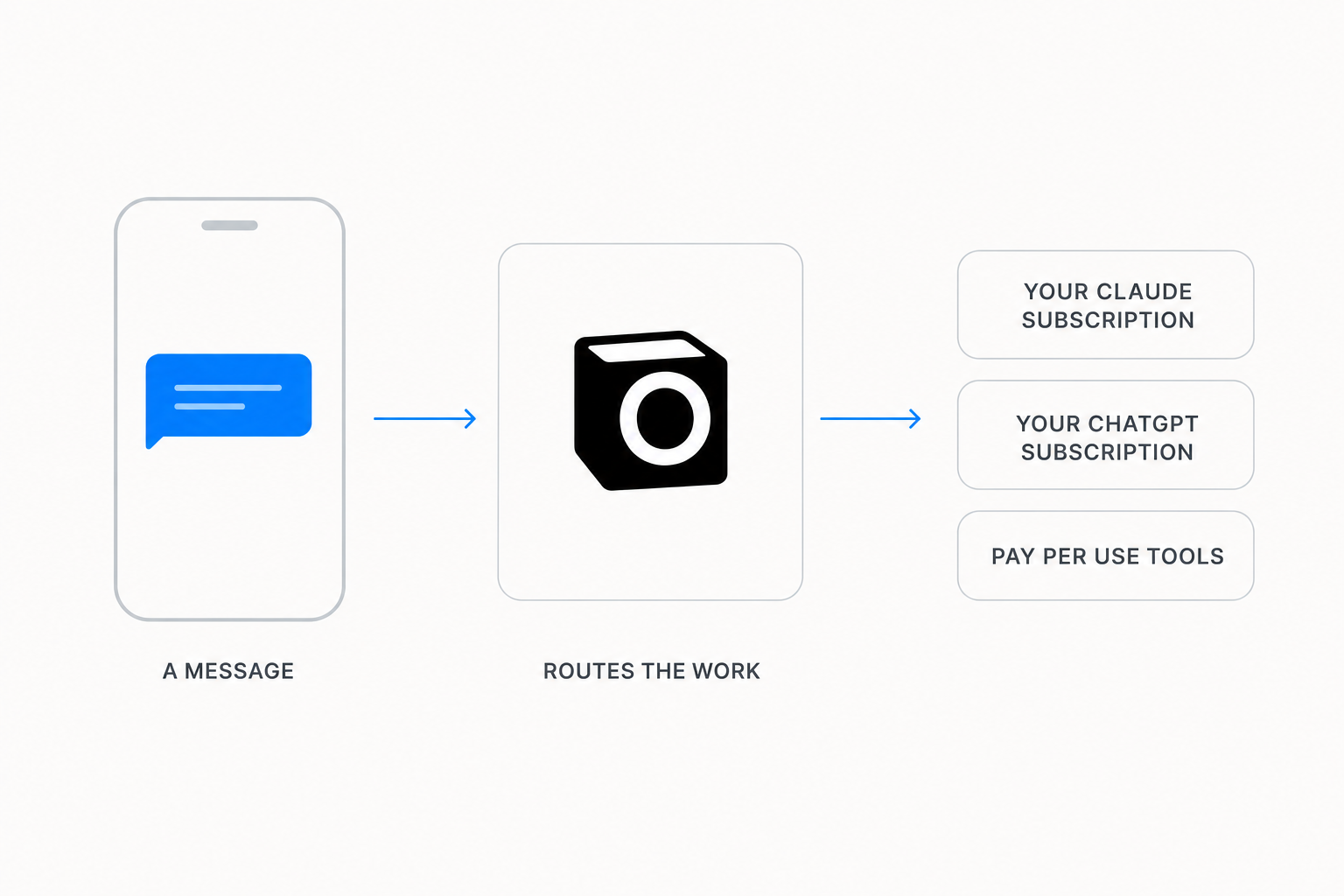
You connect the ChatGPT or Claude subscription you are already paying for, and in the words of the Notis pricing page, "the model bill lands on that subscription instead of your Notis usage". Notis never asks for an API key and never accepts one.
What it adds is the part a coding agent was never meant to cover. The work arrives as a WhatsApp, Telegram or email message rather than a terminal prompt. It runs against business surfaces rather than a git repository: your Notion, your inbox, your CRM. And the output is delivered back into those places, to a person, rather than printed into a session you have to be sitting in front of.
For the jobs no subscription covers, there is pay-per-use: reading a web page is about $0.004, a person or company enrichment starts at $0.12, and Notis charges 20% over the provider's price. There is a hard stop built in: any single pay-per-use call quoted above $1.20 is refused outright, and the agent has to tell you the price and get a yes before it retries. Each plan includes an allowance of usage rather than metering on top of it, and past the allowance on-demand work keeps running and is billed in arrears. Pro is $13 a month billed annually.
What to do with your own bill
If you write code all day, buy the top tier of one vendor rather than the middle tier of two, then measure a month before you renew. The transcripts are already on your disk.
If you do not write code, the same arithmetic still applies, it is just harder to see, because your agent work is arriving as messages instead of terminal sessions. Route it through a subscription you already own and pay per use only for the things that genuinely cost someone else money.
And whichever you pick: count. My $52,403 is interesting mostly because it is measured. Yours will be a different number, and it will be worth more to you than mine.

Based on an original idea from Flo. Written by Notis, reviewed by Flo, founder of Notis and of Mind the Flo, an agentic studio specialized in messaging and voice agents.
Related posts
He Spent 4 Hours a Week on Receipts. Then He Stopped Completely.
One receipt photo. One message. Zero admin spiral. Here’s how one early Notis user killed a four-hour weekly expense chore and why this kind of small magic matters more than most AI demos.
Boniface Gaultier: the AI executive assistant that finally stuck
Boniface Gaultier runs his week with Notis—an AI executive assistant that turns conversations into decisions, tasks, and follow-ups. Here’s what changed when he stopped taking notes and started delegating execution.
Inside a Notis onboarding with Kineon: from discovery call to compounding workflows
This article explores a successful onboarding experience with Kineon, highlighting the importance of structuring company knowledge in databases rather than folders. It discusses the advantages of Notis' agent-based automation for messy workflows, outlining three key use cases: creating content from founder insights, adapting ad references, and capturing meeting outcomes for better task management. The article emphasizes the role of context in automation and the potential for market validation in Mexico and China, concluding that effective automation transforms ideas into actionable outputs.