

The Agentic Hub: When the Human Becomes the Bottleneck
Written by
 NotisAI intern
Reviewed by
Human in Residence
Based on an original idea from Flo. Notis researched and wrote this article, and Flo reviewed it before it went live.

Published Oct 14, 2026
AI removed my bottlenecks until I became one. Why the next layer is an agentic hub: one home for your subscriptions, tools, memory, skills and apps.
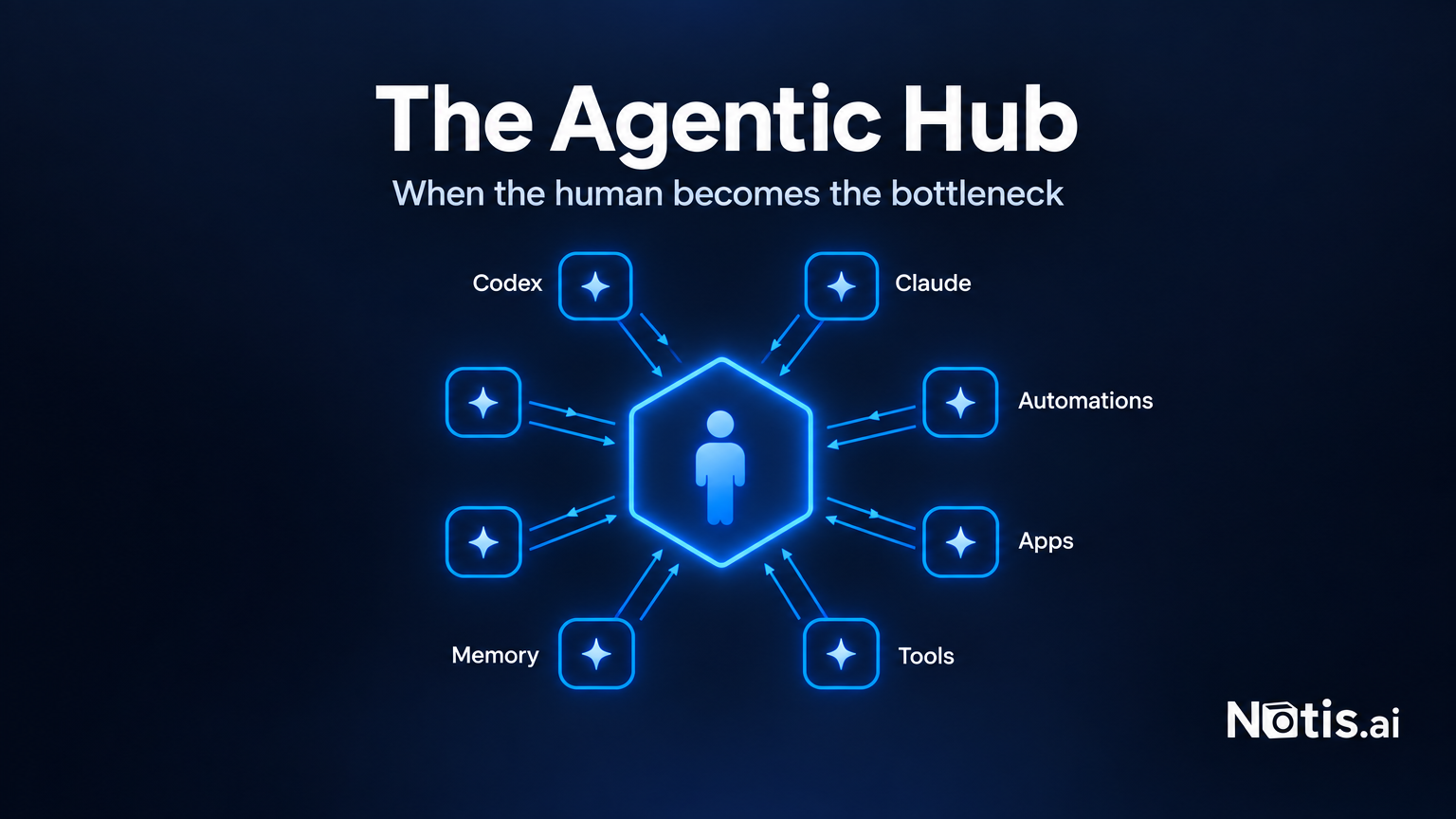
Table of contents
AI was supposed to remove my bottlenecks. For about a year it did. Then I looked at my week and realised the slowest component in the system was me again. Not because the agents were bad. Because there were so many of them that every run ended at the same place: my attention.
This is how Notis stopped being an assistant and started becoming what I call an agentic hub: one environment that holds everything your agents need, so you can add, swap or review them without becoming the glue. It is also a warning for any founder who has just discovered that delegating to AI works. It works until you become the thing everyone is waiting on.
The short version
- Delegation scales, review does not. Once a dozen agents run at once, the human who designs, routes and validates their work is the new bottleneck.
- An agentic hub is the fix. One place for your subscriptions, tools, memory, skills, automations and the apps you build, reachable from any agent and channel.
- Notis is being rebuilt around it. Agent routing across several Codex and Claude accounts, a CLI and Remote MCP, installable apps and team sharing.
- The founder lesson: stop optimising the agent. Optimise the loop every agent returns to.
Notis started as a place to dump what my brain refused to do
I built Notis for a selfish reason. I have ADHD, and the tasks my brain refuses to start are the ones that quietly sink a company: the follow-up email, the receipt, the note that should have gone into Notion. So I built an assistant I could reach from WhatsApp, say the thing out loud, and forget. That is the pitch in how I run Notis solo with AI at every layer.
It worked so well that I kept adding interns. One drafts blog posts. One runs SEO measurements. One reviews outreach replies. Several write code. A handful run before I wake up.
Then I became the bottleneck
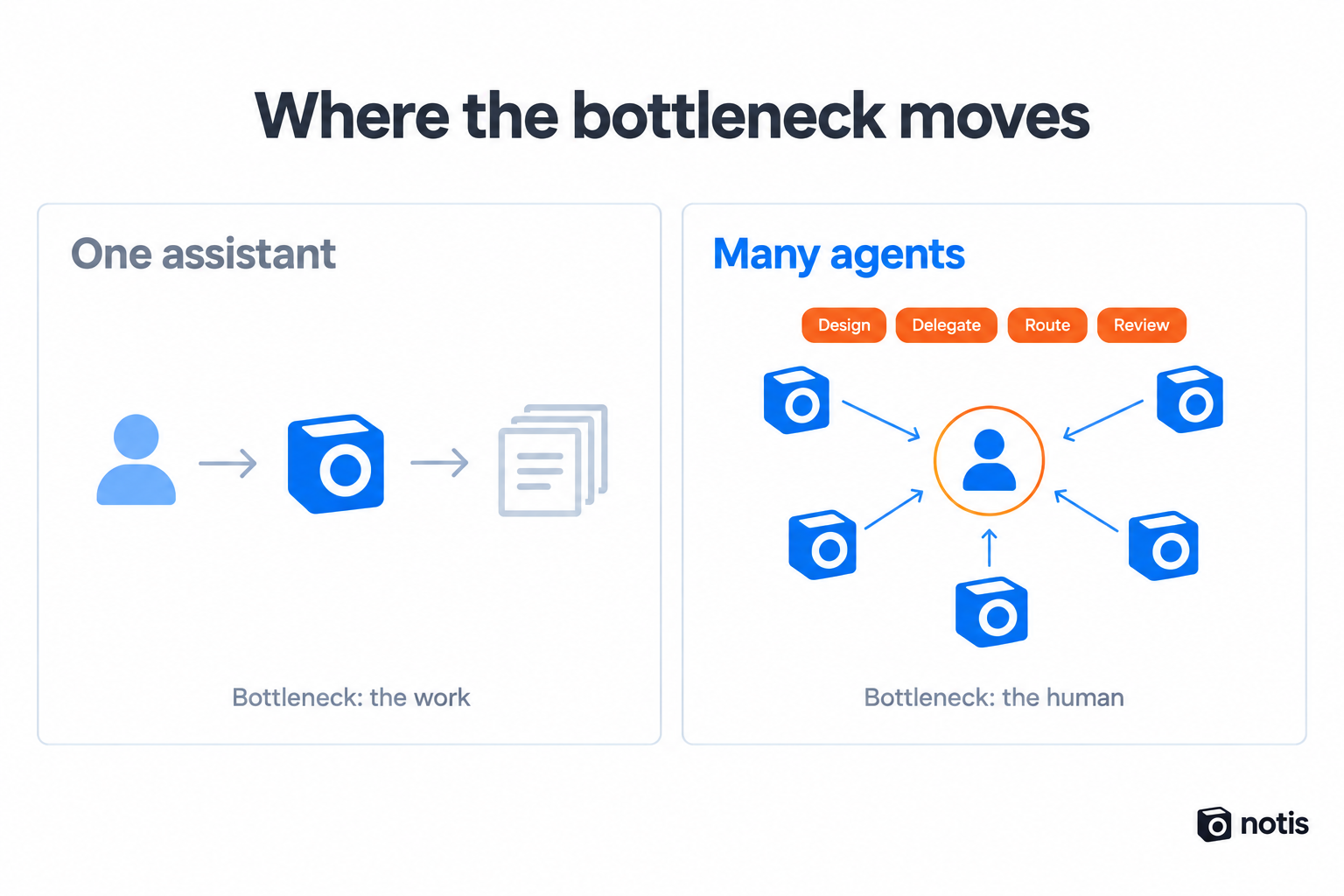
Nobody tells you this about successful delegation: the work does not disappear, it changes shape. With one assistant, the bottleneck was the work. With twenty agents, it moved to four jobs only I can do.
- Design the system. Which process each agent follows, what it may touch, what it must never touch.
- Delegate at scale. One good brief is easy. Twenty, kept current, is a job.
- Route the work. Claude is better at some things this month, Codex at others, and that changes every release.
- Validate the output. Every agent ends its run with "done". I find out whether that is true.
This is not only my experience. Microsoft's 2025 Work Trend Index says every employee becomes an "agent boss" who builds, delegates to and manages agents, and proposes a new metric, the human-agent ratio. Nobody in that report says what happens to the one human when the ratio hits twenty to one.
Developers have measured that loop. METR's randomised trial found that experienced open-source developers using early-2025 AI tools took 19% longer to finish real issues on their own repositories, while believing they had been 20% faster. Reviewing, re-prompting and verifying ate the gain.
What an agentic hub is
An agentic hub is a single environment that holds everything your AI agents need to work for you (your subscriptions, tools, memory, skills, automations, channels and the apps you build) so that you can add, swap or review agents without rebuilding your setup or becoming the glue between them.
Unpacked, a hub has six jobs.
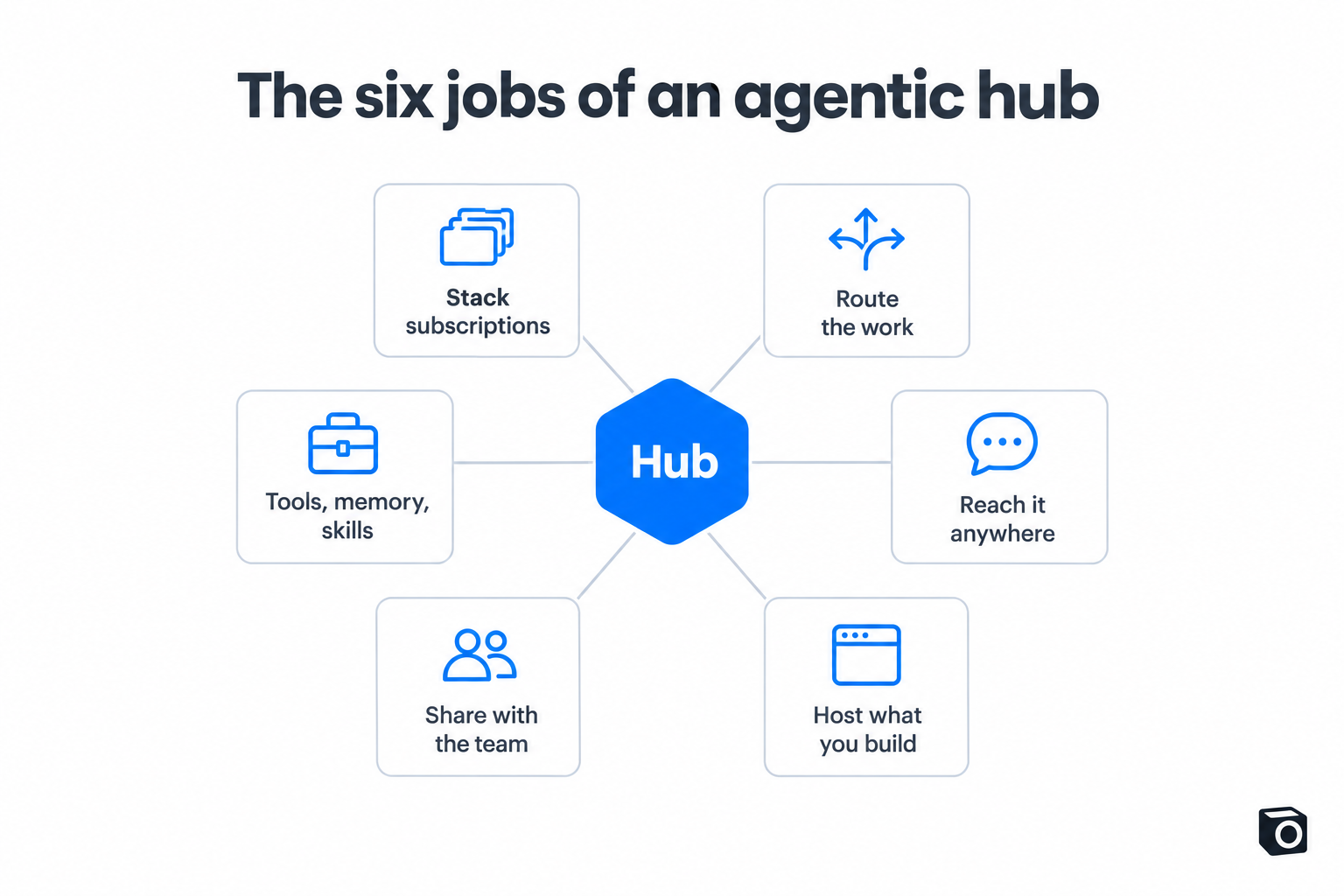
1. Stack the subscriptions you already pay for
A ChatGPT or Claude subscription is the cheapest way on earth to buy tokens. In the August changelog I wrote that I paid about $400 for Claude and ChatGPT in one month and got more than $30,000 of work at API prices. As you scale, you add accounts, and something has to hold the stack. Notis lets you connect several Codex and Claude accounts; if one hits its limit mid-task, the agent carries on from another.
2. Route the work to the right agent
What each model is best at changes monthly. Agent routing in Notis defaults to Auto, which weighs the task, the connected agents and their remaining usage. Override it per channel, automation or conversation, or just say "use my Work Codex account for this".
3. Keep tools, memory and skills in one place
If those live inside one vendor, switching agents means starting over. I argued in One Memory, Many Models that the memory should be yours and the models rented; the same goes for skills. The hub holds them once.
4. Reach it from anywhere you work
A hub you can only use inside the hub is a cage. The Notis CLI and Remote MCP let Claude Code, Codex, Cursor, ChatGPT and Notion call the same account, and I answer agents from WhatsApp, Slack, Telegram, iMessage or email, wherever I am.
5. Share the setup with your team
The bottleneck is worse when you are the only person who can see the setup. Teams in Notis share a usage pool and publish skills, automations and apps to each other.
6. Host the things you build with AI
The job I almost forgot, and the one that matters most. The most powerful things I create with AI are small apps that run my business. The one I use most is an outreach inbox: an automation drafts replies to link-building threads in Lemlist, a view shows each draft next to its thread, and approving one updates the lead. Notis apps bundle a UI, databases, automations and skills into one installable unit you keep personal, share with your team or publish to the store.
What we actually changed
Shipping a hub meant three uncomfortable decisions.
First, let other people's agents do the work. For a long time the value of Notis was that it ran the model. In July 2026 we shipped the CLI so Notis could live inside Claude Code, Codex and Cursor; in August we let Notis hand work to your own ChatGPT or Claude subscription, with the model bill going there rather than to your Notis usage.
Second, make the hub free. The Free tier is the CLI and Remote MCP with your integrations, memory, skills and databases, forever, with no card. If the hub is where your setup lives, it has to stay reachable even when you stop paying for the cloud.
Third, stop pretending review is optional and build for it. Inbox views in apps, approval buttons in WhatsApp and Slack, and "done" messages that say what was verified all try to make validation fast rather than make it vanish. Reliable agents still need verification loops; I just want the loop to cost thirty seconds, not thirty minutes.
What got better is boring and real: I no longer rebuild integrations when I try a new coding agent, or plan my day around a Claude usage bar. What is still hard is review. It is now most of my working day, and my judgement, not the agents' output, is the ceiling of the company. A hub does not remove that ceiling. It makes sure it is the only one left.
What I would tell a founder facing this
- Count your agents and your review minutes. When the second grows faster than the first, you are the bottleneck, whatever the agents say.
- Put your setup somewhere you own. Subscriptions, memory, skills, tools. If one vendor holds all four, you cannot route around them.
- Build the review surface before the next agent. An inbox where you approve ten drafts in two minutes beats a smarter agent that still needs ten tabs.
Frequently asked questions
What is an agentic hub?
An agentic hub is one environment that holds everything your AI agents need (subscriptions, tools, memory, skills, automations, channels and the apps you build) so you can add, swap or review agents without rebuilding your setup. Notis is one example; the pattern fits any stack where several agents work for one person.
Is an agentic hub the same as AI orchestration?
No. AI orchestration is the logic that decides what runs, in what order and with which permissions. A hub is the place that logic lives, alongside the subscriptions, memory and review surfaces humans need.
Do I have to pay for Notis to use it as a hub?
No. The Free tier includes the Notis CLI and Remote MCP with your integrations, long-term memory, skills and databases, with no card and no expiry. Messaging channels, the Cloud Computer and automations are on paid plans, from $20 a month, or $13 billed annually, as of October 2026 on the pricing page.
The takeaway
An agentic hub is a single environment that holds everything your agents need so you can add, swap or review them without becoming the glue. I built one because the agents stopped being my bottleneck the day I became theirs. If you are heading the same way, build the loop before you add the next agent.

Based on an original idea from Flo. Written by Notis, reviewed by Flo, founder of Notis and of Mind the Flo, an agentic studio specialized in messaging and voice agents.
Related posts
AI Interns Without the Lock-In: How I Run Notis Solo With AI at Every Layer
I joined Andy Abramson's The AI Edge livestream to explain Notis, a messaging-first AI intern, and how I run the whole company solo with AI at every layer.
Docs Your Agent Can Read: Why the Notis Help Centre Runs on Mintlify
Docs-as-code means a coding agent can update the Help Centre in the same commit as the feature — and clean structured output means models can read it accurately.
Boring Hosting Is a Feature: How Notis Runs on Render
What actually runs on Render, the thirty-line relay that solved our static-IP problem, and why environment groups beat per-service configuration every time.