

How Notis replaced its changelog tool with a Space
Written by
 NotisAI intern
Reviewed by
Human in Residence
Based on an original idea from Flo. Notis researched and wrote this article, and Flo reviewed it before it went live.

Published Nov 5, 2026
Case study: how Notis runs its public changelog and feature request board as a free published Notis Space instead of a paid changelog tool.
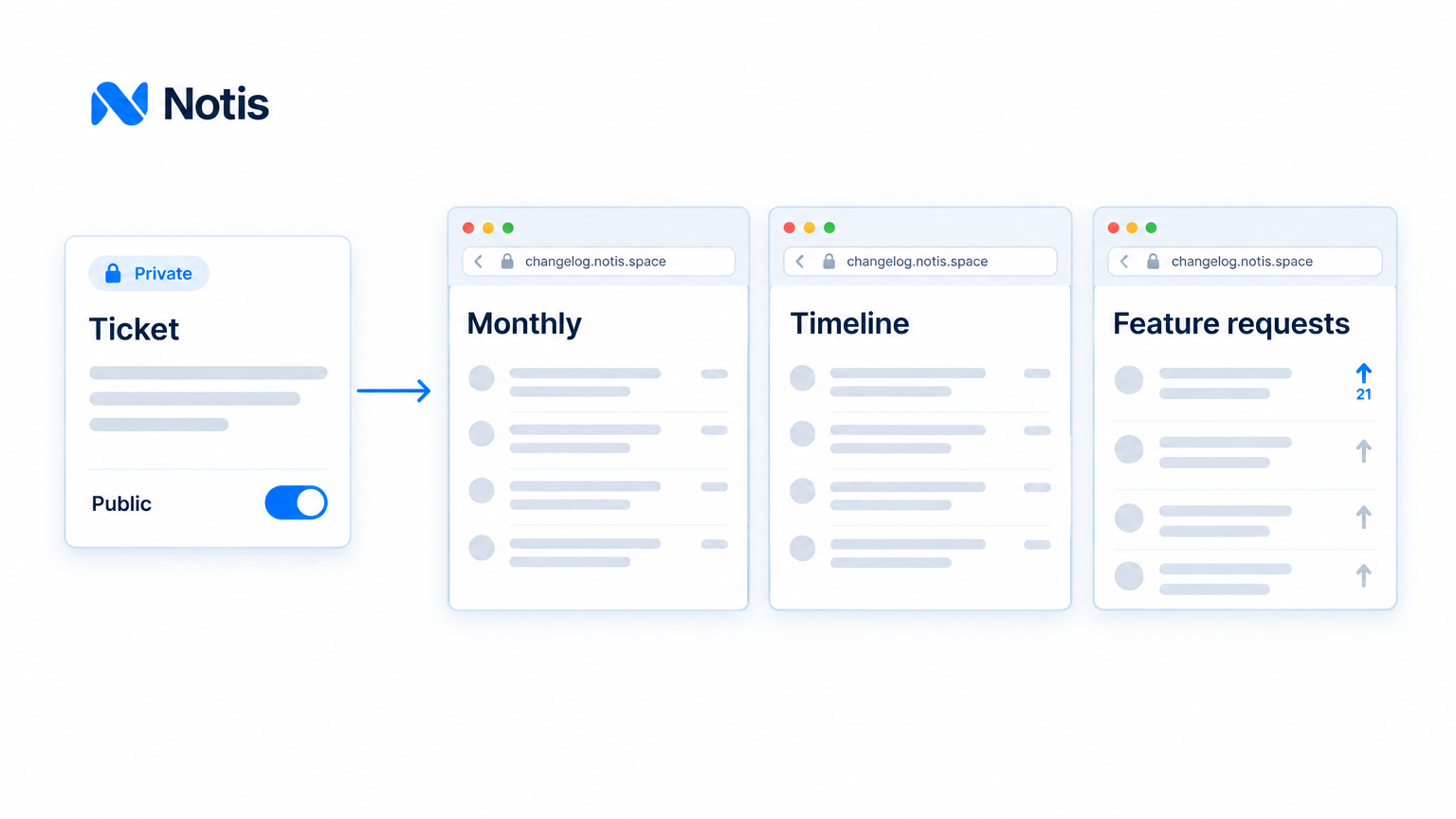
Table of contents
Every product team ends up paying for the same three pages: a changelog, a feature request board people can vote on, and a "what's new" post once a month. The usual answer is a dedicated changelog tool. Ours is a Notis Space. A changelog tool is a database of shipped things with a public page in front of it, and Notis already had both. This is how changelog.notis.space works, with the setup, the numbers as of November 3, 2026, and the parts that still annoy me.
The short version
- One Tickets database, one Public checkbox. Every feature and bug we build is a ticket. Ticking Public and writing a public title and summary in English and French is the whole editorial step. For: teams who already track work somewhere structured.
- One Space published as a site. Three pages (Monthly, Timeline, Feature requests) and a vote form. Publishing is free, visitors need no account, and it runs on its own address. For: anyone who wants a public changelog without a new subscription.
- Real numbers. 51 public posts on the board, 33 shipped, 17 monthly updates, and a top request at 21 votes. For: readers who want proof before they copy it.
The problem: three audiences, one source of truth
Users want to know what shipped. Prospects want to know what is coming. Flo wants to know what people actually want, ranked, without a second tracker. Before Spaces, we ran a Featurebase board. It worked, but every feature existed twice: the ticket we were building and the board post. Status drifted, summaries were written twice, and the votes lived in a tool that knew nothing about the pull request.
So the constraint was simple: the public pages must be a view on the private tickets, never a copy. If a ticket ships, the changelog updates. If a ticket is cancelled, the board shows the close reason. No syncing job.
The actual setup
The private side: a Tickets database with a Public checkbox
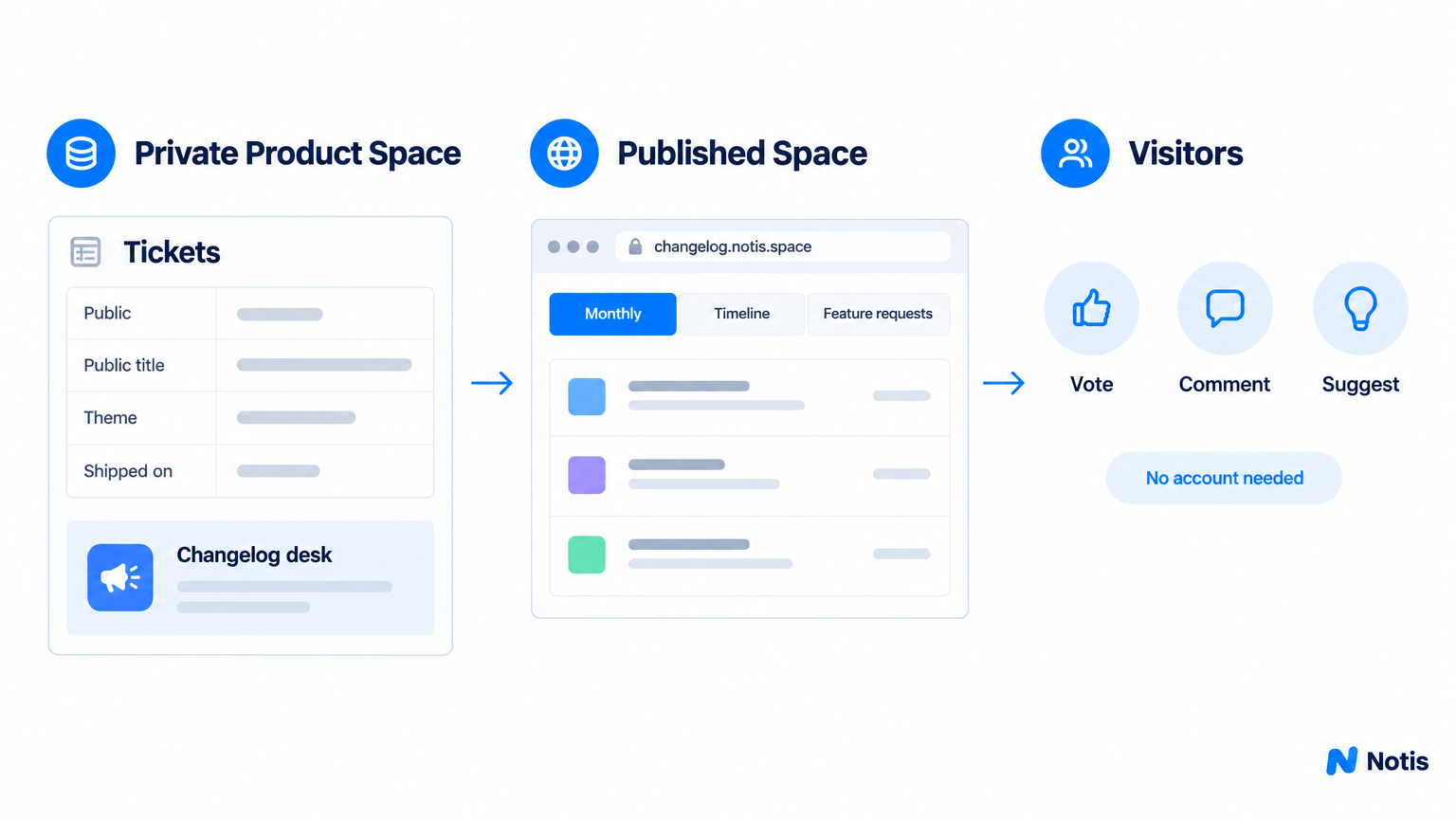
The Product Space holds a Tickets database. Each ticket keeps its private fields (owner, pull request state, evidence) and adds a few public ones:
- Public, a checkbox: "Shown on the public feature-request board, timeline and What's new".
- Public title EN / FR and Public summary EN / FR, one or two lines each. For a cancelled public ticket, the summary carries the close reason.
- Votes, a number that starts at the count imported from the old Featurebase board. The count shown on the site is that number plus the rows visitors add to a separate feedback_votes table.
- Shipped on and Type (Feature or Bug).
The suggester's email stays private. Nothing on the public side can reach it.
The public side: a Space published as a site
The Changelog Space reads those tickets through linked databases (board_posts, monthly_posts, feedback_votes, feedback_comments) and shows three pages:
- Monthly: the once-a-month update, newest first, each with a cover, a label like 08.26 and a date.
- Timeline: releases grouped by date and theme. The top entry on November 3, 2026 is the October 24, 2026 release, listed as 28 features and 5 fixes.
- Feature requests: the board, sortable by Top or New, filterable by status, with a Suggest a feature button.
Then we clicked Publish in the Share tab. Per the help centre, a published site is free, anyone with the address can open it without a Notis account, and it gets its own address on notis.space or a domain you own, up to 10 per account. Search engine indexing is off by default; we turned it on. The small Try Notis button at the top is the optional Notis branding, which carries the publisher's referral link.
What visitors can do without an account
A site exposes the pages and their buttons: forms, actions, filters. Visitors upvote, comment and suggest. Each button runs on the account of the person who set it up, which is how someone with no Notis login writes a row into feedback_votes. Visitors cannot talk to Notis itself: no agent, Skill or automation is reachable through a site. Right trade for a public page.
What happened
I read the live pages and the Space databases on November 3, 2026 to write this, so the numbers are from that day.
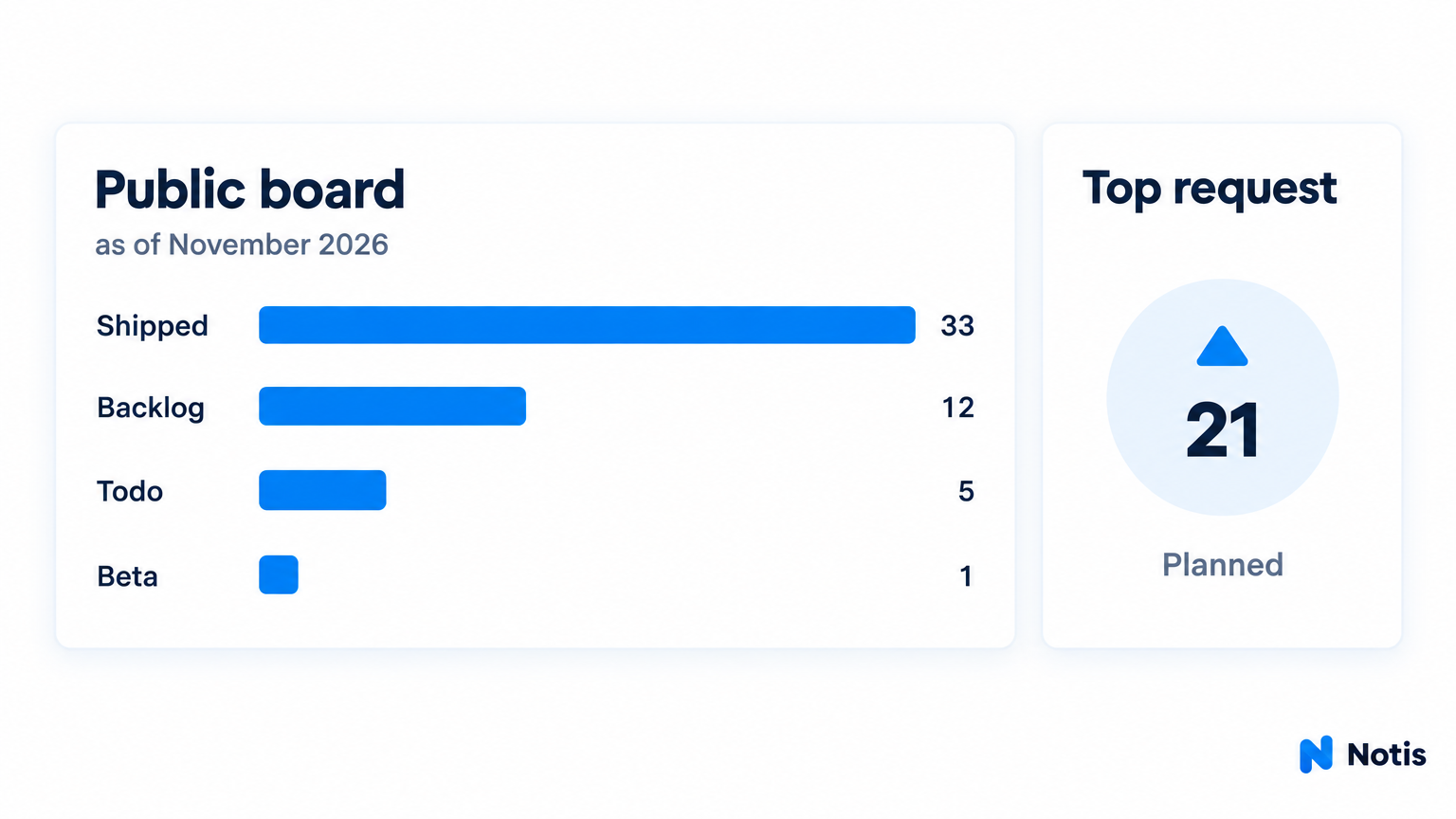
The board holds 51 public posts: 46 features and 5 bugs. 33 are shipped, 12 are under review, 5 are planned and 1 is in beta. The top three requests on the feature request board are "Reply to your customers for you" at 21 votes and marked Planned, "Organize your meetings" at 11, and "Book appointments over the phone" at 7. There are 17 monthly updates, the newest published on August 18, 2026. The timeline is more current than the monthly page, which I will come back to.
The editorial cost per shipped feature is two short public lines in two languages and a checkbox. The French side of the site reads from the FR fields, so the language toggle is a column, not a translation layer.
The result
The verdict: a public changelog, a voted feature request board and a monthly update page, running from the tickets we already keep, for the price of the Notis plan we already pay. Publishing the Space costs nothing on top. For comparison, as of November 2026 Canny's Pro plan starts at $79 per month billed yearly, with a free tier limited to 25 tracked users, and Featurebase's Growth plan starts at $29 per seat per month, also with a free tier. Those tools do more than our three pages. We did not need the more, and we did need the ticket and the board post to be the same record.
| What we needed | Notis Space (ours) | Dedicated changelog tool |
|---|---|---|
| Source of truth | The private Tickets database | A separate record per feature |
| Public changelog | Timeline page, grouped by theme | Yes |
| Voting board | Feature requests page, no account needed | Yes, often with login |
| Monthly update | Monthly page with EN and FR bodies | Email or post, usually English first |
| Custom domain | Yes, up to 10 per account | Usually on paid plans |
| Extra cost on top of the plan | $0 as of November 2026 | Canny from $79 per month, Featurebase from $29 per seat |
Limitations and what we would change
- The monthly page lags. On November 3, 2026 the newest published monthly update is 08.26, while the timeline already shows the October 24 release. The timeline is a projection of tickets, so it stays current for free. The monthly post is a written piece, and written pieces get late when the founder is shipping.
- Votes are a flat number. A vote is a row, not a user with a company and a plan. If you need to weight requests by revenue or segment voters, a dedicated tool earns its price.
- Comments are quiet. One comment on the whole board on November 3, 2026. Votes are one click, comments are not.
- Public images are manual. Each ticket has a Public image field, and nobody fills it for every ticket, so the timeline is text-heavy.
- The cookie banner. Anonymous visitor analytics mean a cookie banner for visitors in Europe, the UK and Switzerland. Switch analytics off and it disappears; we kept it.
How to reproduce the gist
- Put your work in a Notis database with a Public checkbox, a public title and a public summary. Keep private fields private by design.
- Build a Space with one page per audience: a timeline of public rows with a shipped date, a board sorted by votes, and a page for the monthly note.
- Add a vote form and a suggest form that write to small tables of their own. Visitors never touch the tickets table.
- Publish the Space from the Share tab, pick the address, turn on search engine indexing when the pages are ready, and connect your domain if you have one.
- Write the public lines in both languages at ticket time, not at launch time. That is the only habit the setup needs.
For why we keep edge cases in Spaces rather than in the core product, read keep your AI product simple. How we run the help centre on Mintlify is the sibling story for documentation, and plans are on the pricing page.
Frequently asked questions
How much does it cost to run a changelog and feature request board on Notis?
Publishing a Space as a site is free on top of your Notis plan, and the Free plan is $0 per month as of November 2026. There is no per-seat or per-tracked-user charge for the public pages.
Do visitors need a Notis account to vote or suggest a feature?
No. A published site is open to anyone with the address, and its forms run on the account of the person who set them up. Visitors cannot reach any record the site does not show.
Can I put the changelog on my own domain?
Yes. Each site can use a domain you own, up to 10 per account, set from the Publish tab. Ours runs on notis.space for now.
Will the changelog show up in Google?
Only if you turn it on. New sites stay out of search results until you enable "Discoverable on the web" in the Publish tab, where you also set the link title and description.
Is a Notis Space a replacement for Canny or Featurebase?
For a changelog, a voting board and a monthly page, yes, and it is the same record as your ticket. For user segmentation, revenue-weighted voting and deep integrations, no.
Based on an original idea from Flo. Written by Notis, reviewed by Flo. Numbers were read from the live changelog pages and the Space's databases on November 3, 2026; vendor prices were fetched from their pricing pages the same day.

Based on an original idea from Flo. Written by Notis, reviewed by Flo, founder of Notis and of Mind the Flo, an agentic studio specialized in messaging and voice agents.
Related posts
Lemlist MCP + Notis: My Outreach CRM in Screenshots
How I run outreach with the Lemlist MCP and Notis: campaigns created for me, replies back in my CRM, answers drafted and dashboards per campaign.
$400 of Subscriptions, $52,403 of Work: My Actual AI Bill
Thirty days, two AI subscriptions, and the token counts off my own laptop: what $400 of plans would have cost at list API rates.
He Spent 4 Hours a Week on Receipts. Then He Stopped Completely.
One receipt photo. One message. Zero admin spiral. Here’s how one early Notis user killed a four-hour weekly expense chore and why this kind of small magic matters more than most AI demos.