

5 Best Ways to Orchestrate AI Agents at Scale
Five practical AI agent orchestration patterns, when each works, where it breaks, and how to keep humans, memory and tools in the loop.
Scaling AI agents is not the same as adding agents. I learned this the mildly expensive way: give five capable agents the same broad objective and you do not get a tiny executive team. You get five interns confidently researching the same thing in different tabs.
The useful question is not “How many agents can I run?” It is “What coordination pattern matches this job?” Below are five ways to orchestrate AI agents at scale, ordered from simplest to most complex. Start as high on the list as you can. Complexity is a tax, not a badge.
Quick comparison
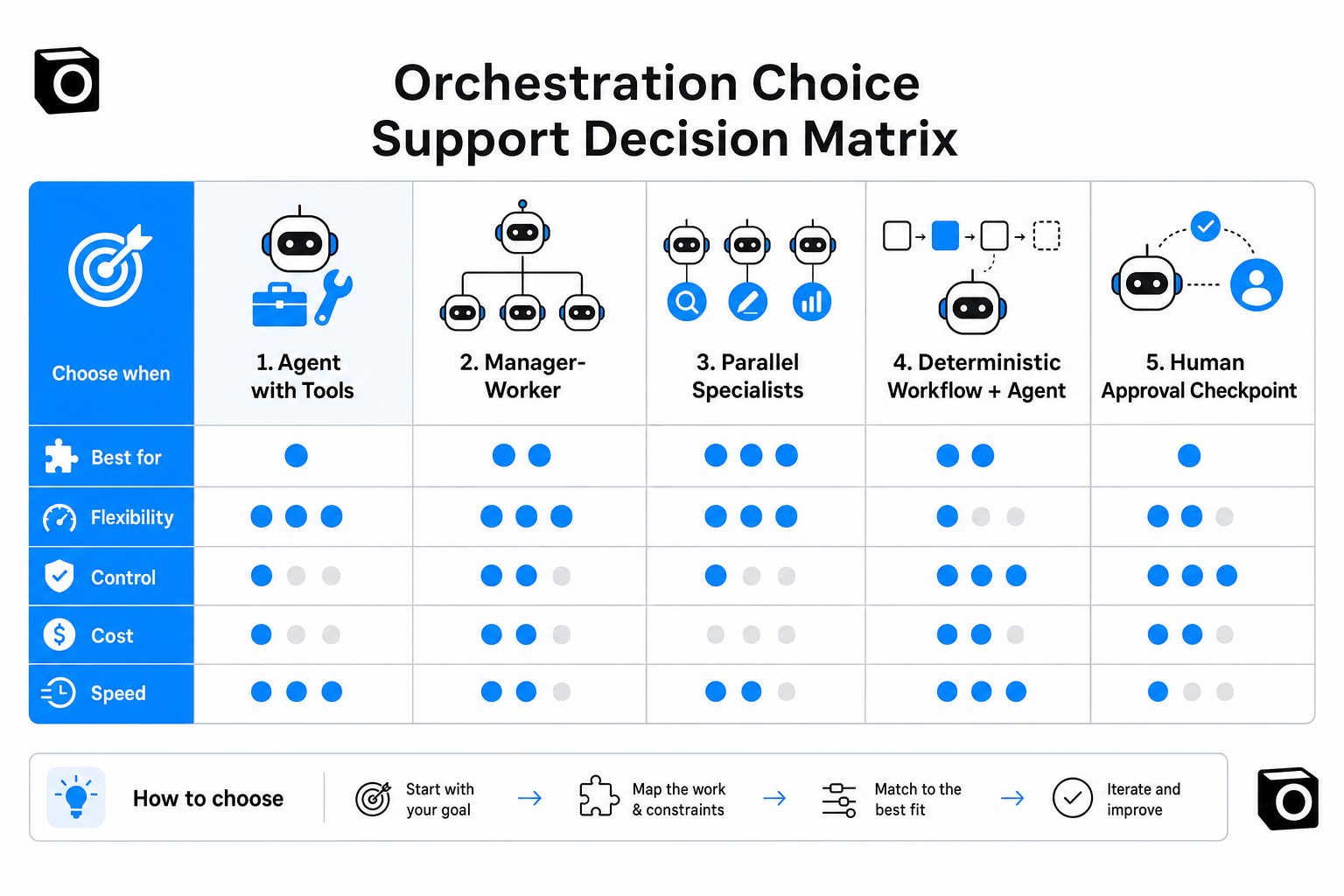
| Pattern | Best for | Main risk | Human checkpoint |
|---|---|---|---|
| One agent, many tools | Most operating workflows | Tool sprawl | Before consequential writes |
| Manager and workers | Research and decomposable projects | Weak delegation | Review the manager's synthesis |
| Parallel specialists | Independent workstreams | Duplicate or conflicting output | Compare before merging |
| Workflow plus agent | Repeatable operations with judgment | Brittle boundaries | At exception paths |
| Human-in-the-loop control plane | High-stakes or cross-system work | Approval overload | Central inbox |
1. One agent with several tools
This is the underrated default. One agent keeps the full context and chooses among email, calendar, CRM, database, browser or file tools. OpenAI's agent-building guide recommends an incremental approach and distinguishes this single-agent tool loop from multi-agent orchestration. That is good advice.
Use it when the task has one clear owner and the tools are the specialists. “Read the meeting notes, create my tasks and draft the follow-up” does not require three personalities. It requires one agent with bounded access to notes, tasks and email.
The scaling move is not another agent. It is better tool descriptions, explicit permissions, durable state and a clear stopping condition. MCP helps here by standardizing tool discovery and invocation; its tool specification also recommends visible tool use and human confirmation for sensitive operations.
2. A manager agent with bounded workers
Use a manager-worker pattern when the objective can be decomposed into genuinely separate parts: research three markets, audit four competitors, or inspect independent modules of a codebase. The manager plans and assigns. Workers return narrow outputs. The manager synthesizes.
Anthropic uses this pattern in its multi-agent research system. The important lesson is not “spawn more.” It is to give every worker an objective, scope, source rule and output format. Vague delegation creates duplication; bounded delegation creates compression.
A good worker brief fits on one screen:
- One question to answer
- The tools and sources it may use
- What it must not touch
- The evidence it must return
- The condition for stopping
If the manager cannot write that brief, it has not understood the task well enough to delegate it.
3. Parallel specialists with an explicit merge rule
Parallel orchestration is valuable when workstreams do not depend on each other. A technical auditor, market researcher and risk reviewer can work simultaneously. Three agents editing the same launch plan cannot.
The merge rule is the part people skip. Decide before work starts whether outputs will be selected, compared, voted on, reconciled by a reviewer or merged by a deterministic schema. Otherwise “parallel” just means the collision happens later.
This pattern is expensive by design. Anthropic reports that multi-agent research consumes substantially more tokens than ordinary chat, so reserve it for work where breadth or speed justifies the bill. For a single fact or sequential task, one agent is usually better.
4. A deterministic workflow with agentic steps
This is the pattern I trust most for recurring operations. Put dates, routing, validation, deduplication and writes in a workflow. Put synthesis, classification, drafting and exception handling in the agent.
For example, a weekly content system can deterministically fetch the reporting window, refuse duplicates and route an approval. The agent can analyze performance and propose next week's angles. Notis automations support schedule, webhook and integration triggers, while skills carry reusable execution instructions.
This hybrid is less cinematic than a swarm and far easier to debug. When something fails, you can see whether the data step, model judgment or write step was responsible.
5. A human-in-the-loop control plane
At scale, human approval cannot be a pop-up scattered across five agent interfaces. It needs a queue. The orchestrator should gather exceptions, show the proposed action and evidence, then let a human approve, revise or reject without reconstructing the whole task.
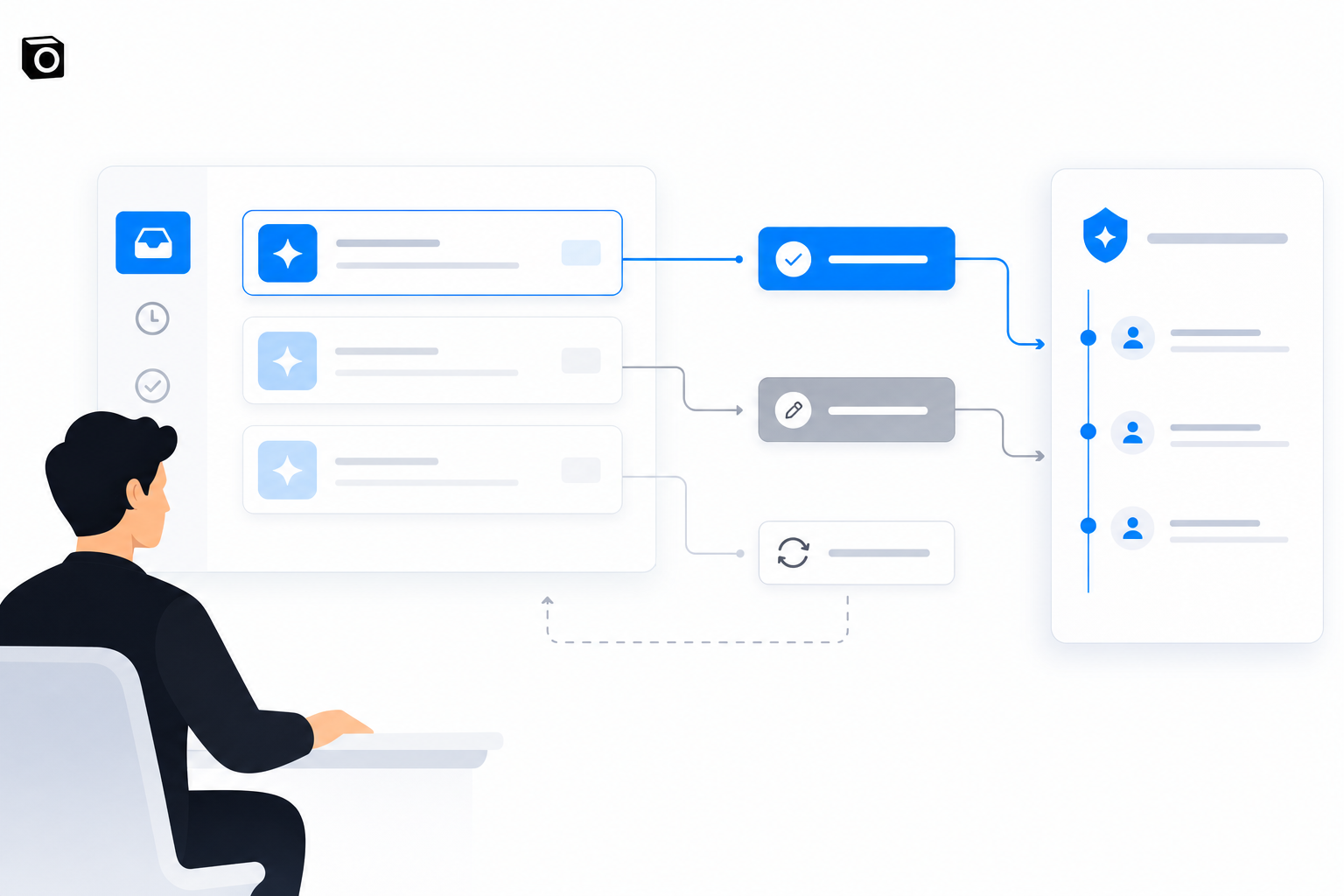
Notis's desktop and web manager acts as a unified inbox for conversations across channels and exposes the agent's activity. Requests can arrive by messaging, email, desktop or voice, but the human does not have to chase the approval back through the originating surface.
Use this pattern for external messages, destructive actions, ambiguous writes, financial decisions and anything where “the agent seemed confident” is not evidence. The trick is to approve by exception. If every harmless lookup needs a click, humans become the bottleneck and start approving blindly.
The stack underneath every pattern
Whichever pattern you pick, scaling requires the same boring foundations:
- Channels: a request should enter from where work happens, not only from a special dashboard.
- Integrations and MCP: tools need explicit schemas, scopes and revocation paths. Notis documents connected accounts and custom MCPs in its integrations guide.
- Memory: durable preferences and project context should survive a channel switch; Notis long-term memory is shared across supported surfaces.
- Observability: store tool results, retries and final evidence.
- Budgets: set limits on agents, time, tool calls and spend.
- Humans: define the actions that require review before the first run.
My recommendation
Start with one agent and several good tools. Add a deterministic workflow when the process repeats. Add workers only when the task truly decomposes. Run specialists in parallel only when their context and writes do not collide. Put one human review inbox around the whole thing before you call it scale.
Notis is designed to be that agent-agnostic operating layer: it can sit around supported ChatGPT- and Claude-backed work, messaging and voice channels, desktop review, automations, skills, integrations, memory, CLI and MCP connections. You keep the specialist agents. Notis coordinates how their work reaches the real world.
The best orchestration pattern is the least complex one that completes the job, produces evidence and fails somewhere you can see it. Everything else is an architecture hobby.

Flo is the founder of Mind the Flo, an Agentic Studio specialized into messaging and voice agents.
Related posts
Turn Every Circleback Meeting Into Finished Work with One Notis Automation
Wire Circleback's webhook step to a Notis automation: after every meeting, tasks land in Notion, notes get filed, and a draft post is waiting for review.
How to Orchestrate ChatGPT and Claude at Scale
A practical tutorial for coordinating ChatGPT and Claude through shared channels, tools, memory, automations and human approval.
How to Back Up Your ChatGPT Conversations Automatically
The manual ChatGPT export in six clicks, the fine print that breaks it, and how to make the backup happen weekly without you remembering.