

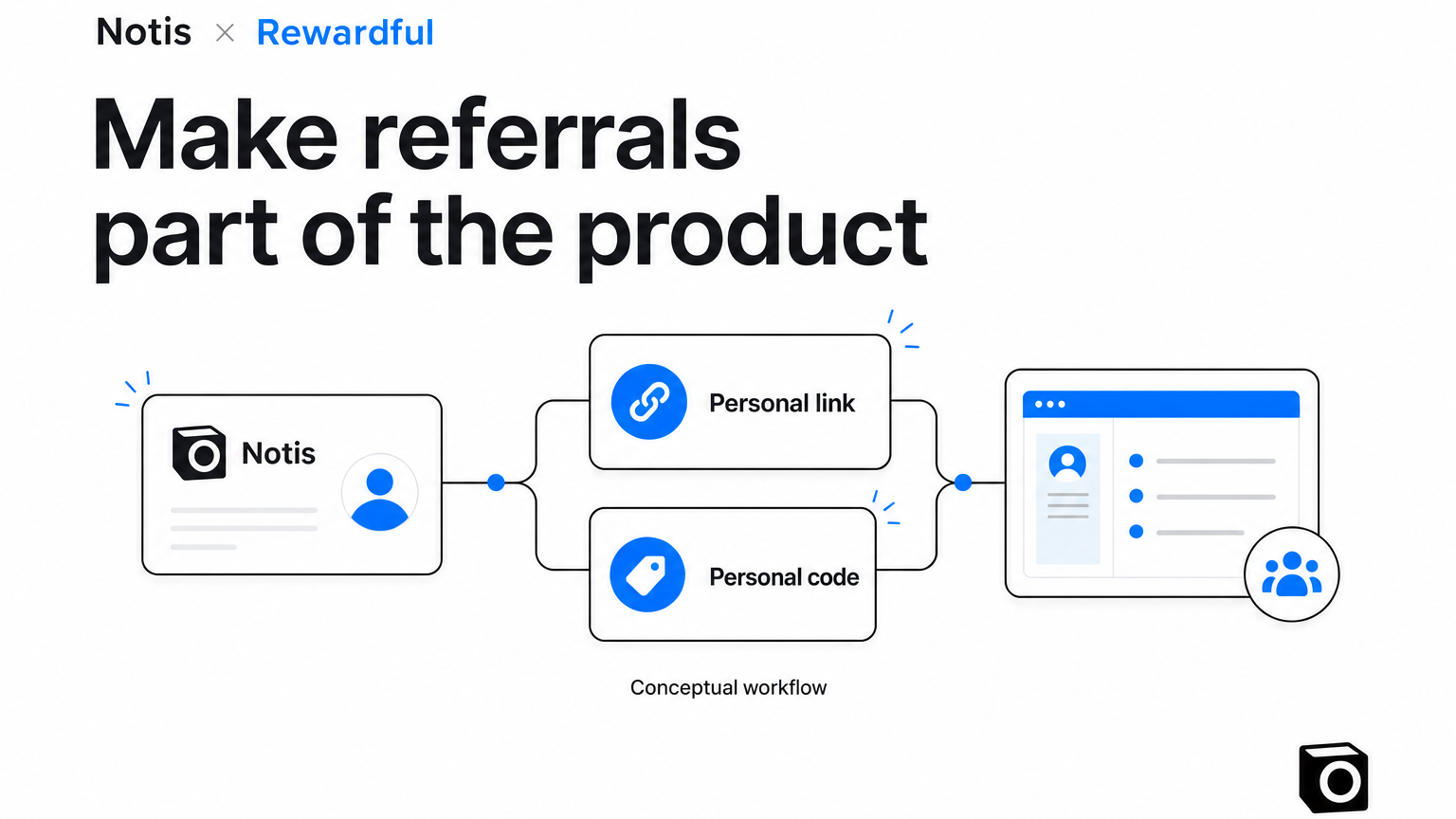
How We Built Notis’s Referral Experience with Rewardful
How Notis connects Rewardful to personal referral links, codes, and partner dashboards, with practical lessons on identity and checkout.
A referral program becomes a product problem the moment somebody asks, “Where is my link?”
You can explain the offer beautifully and still make it awkward to use. The person needs their link, a way to share it, a way to see what happened, and confidence that the account on the other side belongs to them.
At Notis, we use Rewardful for affiliate links, promotion codes, commissions, and partner dashboard access. We have built the account connection and referral experience into our own product. This is how that division of responsibility works, and what I would pay attention to if I were building it again.
There is no affiliate-revenue victory lap here. The useful story is the implementation: making the program available where customers already manage their account, while leaving the affiliate system with clear ownership of affiliate data.
Put the referral experience near the account
Notis is an AI assistant that works through messages, voice, a desktop and web app, and connected tools. Account settings already bring together the things a person needs to manage their relationship with the product.
That is a sensible place for a personal referral link and code. The user should not have to reconstruct an onboarding email to find them. Our August release introduced that experience publicly, alongside access to a partner dashboard.
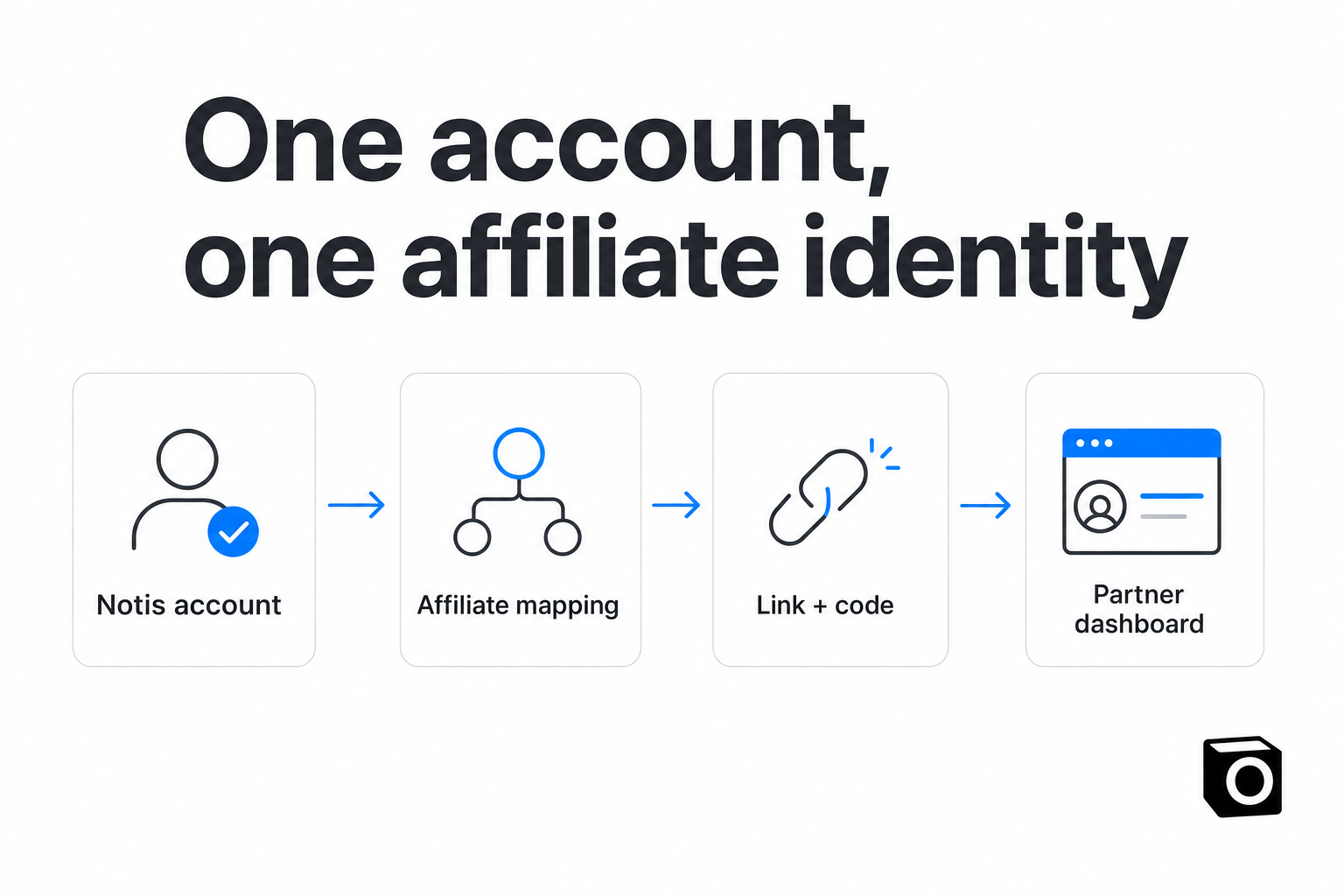
Behind the interface, we need to connect a Notis account to the right Rewardful affiliate. That sounds like a small lookup. It becomes more interesting when people have email aliases, existing affiliate accounts, or several requests happening at once.
My first implementation lesson is to start with identity, before worrying about the colour of the copy-link button.
Decide which system owns which facts
Rewardful is our source of truth for affiliate information. Notis stores the durable mapping needed to find the right affiliate and display the relevant personal link and code.
The distinction prevents us from accidentally building a second affiliate platform inside our own database. We do not need to own the commission ledger to provide a useful referral screen. We do need to know which remote record belongs to the person opening that screen.
Rewardful’s affiliate creation API supports creating affiliates within an application workflow. In our implementation, the backend handles that work and keeps provider credentials away from the browser.
The design question I would ask another founder is: if these two systems disagree tomorrow, which one wins? Write that down for each kind of data. A vague “we sync them” is an invitation to confusing edge cases later.
Match existing people before creating new records
Our mapping flow looks for existing affiliates using the primary email, then considers a unique verified alias. Ambiguous matches are held for review rather than resolved by a guess.
That matters because affiliate identity is attached to somebody’s money and reputation. A convenient match is not necessarily the correct match. Renaming or merging an existing partner record to make an onboarding flow look tidy would be a poor trade.
For new affiliates, our implementation also coordinates concurrent provisioning. Signup and the referral page can both try to ensure an affiliate exists. A shared claim prevents those workers from independently deciding to create another record for the same account.
You do not need our exact mechanism to use the lesson. Ask what happens when a request is repeated, when the browser refreshes, and when two workers run simultaneously. If every retry can create a new person, the integration needs more thought.
A link and a code solve different sharing problems
A personal link is convenient when somebody can click it. A promotion code is useful when a recommendation travels through a conversation, a screenshot, or another place where the original link is missing.
Our Portal shows both when the affiliate mapping and code are available. The code is associated with the affiliate, rather than being a generic discount that loses the relationship we are trying to preserve.
Rewardful documents coupon-code tracking as a way to handle referrals where link attribution is not practical. In Notis, links and manually entered codes reach checkout through different paths, so their validation and provider handling should not be described as identical.
That is the useful product lesson: give people options for sharing, then understand how each option gets credited. Do not add a second input to the interface and assume the backend semantics are automatically the same.
Verify the referral before promising the benefit
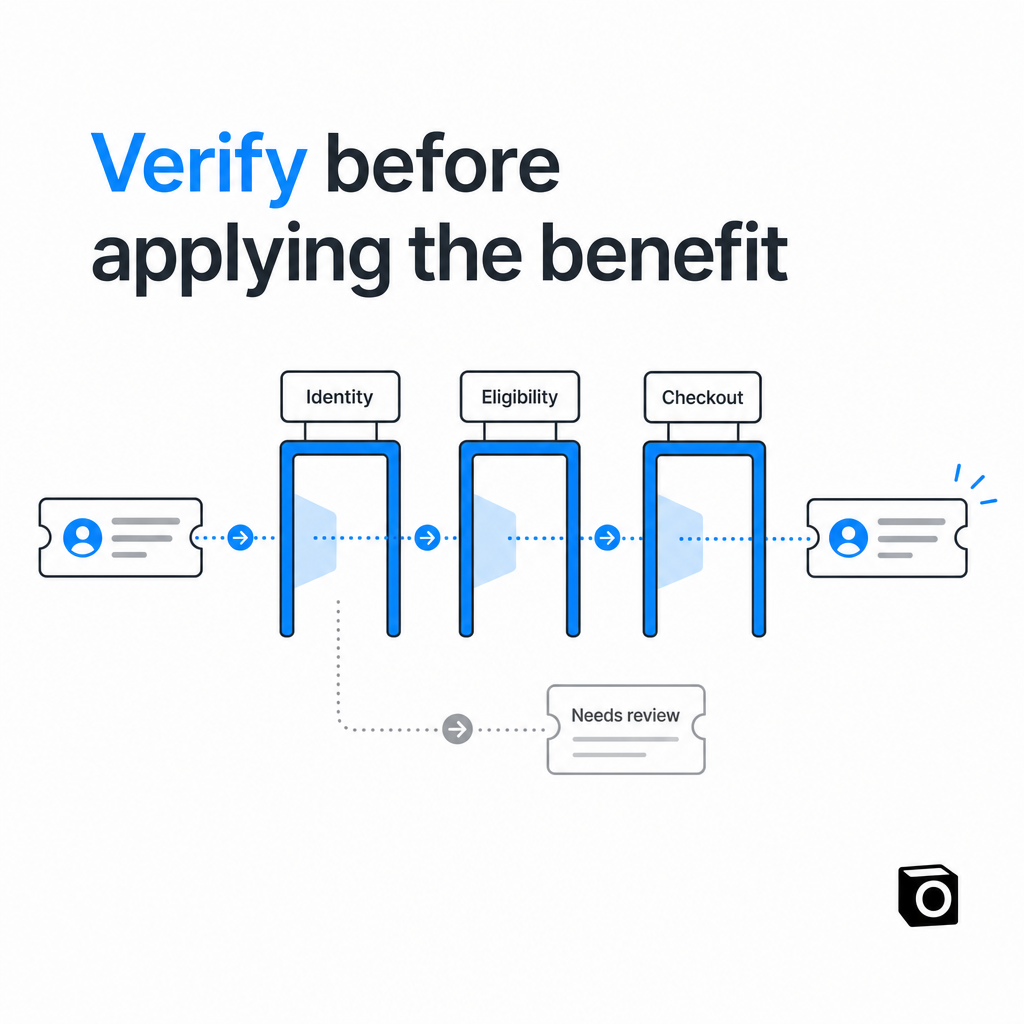
In our explicit link-referral checkout path, the backend verifies the referral remotely, checks eligibility, rejects self-referrals, and applies the configured discount only when the relevant conditions are satisfied.
If verification is temporarily unavailable, that path returns a retryable error rather than quietly continuing at a different price. The principle is straightforward: once the experience has promised a referral benefit, a hidden integration failure should not silently change the bargain at checkout.
Provider calls also need shared rate handling. A backfill and an interactive customer request can hit the same provider account. We coordinate requests across workers so background provisioning does not ignore the constraints the rest of the application has to respect.
These are implementation choices, not evidence of a measured reduction in support tickets or fraud. I can explain why we made them without pretending we have proved every hoped-for outcome.
Dashboard access should follow the current account state
We use Rewardful single sign-on to provide partner dashboard access from Notis. The URL is generated when needed rather than treated as a permanent link to store and pass around.
We also refresh the affiliate state for Portal reads and dashboard access. A previously valid mapping should not become a loophole that keeps working after the provider’s record changes.
For the user, the intended experience is uncomplicated: open referrals, find the personal details, and reach the dashboard. The checks sit behind that interaction. Good integration work often means doing the awkward coordination so the visible task can stay small.
Build the ordinary paths and the awkward ones
If I were scoping a referral integration from scratch, I would test an existing affiliate, a new affiliate, a repeated request, an ambiguous identity, a missing code, and a temporarily unavailable provider. I would also inspect the link and code paths separately.
That is how I think about Rewardful inside Notis. It owns the affiliate machinery; we connect it carefully to the product people already use. Start by making the right link reliably available to the right person. The growth story can wait until you have results worth reporting.

Flo is the founder of Mind the Flo, an Agentic Studio specialized into messaging and voice agents.
Related posts
How We Use Lemlist for Outreach That Starts with Evidence
How Notis structures Lemlist outreach around relevant pages, verified contacts, exact-message review, and honest campaign evidence.
How We Use Datafast to Inspect the Journey from Visit to Signup
Inside Notis’s Datafast setup: signup events, checkout handoffs, and the attribution checks we still need before trusting the revenue story.
How Notis Uses Mailgun for Threaded AI Email Replies
How Notis uses Mailgun’s EU API to return assistant work in email threads, with clear boundaries between replies and lifecycle notices.