

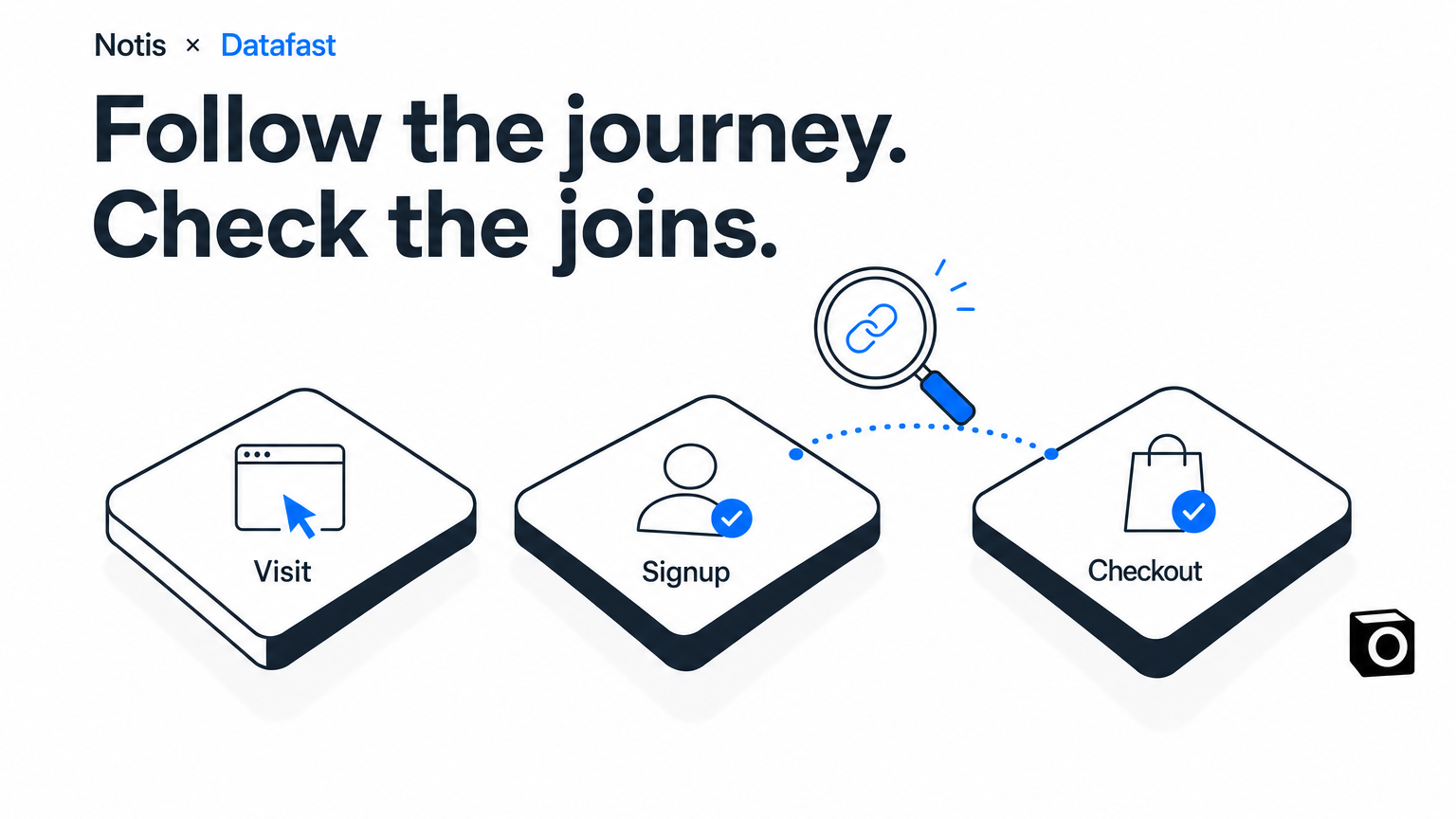
How We Use Datafast to Inspect the Journey from Visit to Signup
Inside Notis’s Datafast setup: signup events, checkout handoffs, and the attribution checks we still need before trusting the revenue story.
Traffic is easy to celebrate when you do not ask what happened next. Someone visits. A chart goes up. You feel briefly competent at marketing.
Then comes the useful question: did that visit turn into somebody actually trying the product?
We use Datafast in Notis’s analytics setup to connect those questions to our signup and checkout flows. We also have Datafast connected as a tool our assistant can reach. This is a look at the workflow we have implemented, the checks I think matter, and one attribution gap we still need to reconcile.
I am deliberately not presenting this as a complete revenue-attribution success story. A tracking integration deserves the same scrutiny as any other integration, especially when its output might influence where you spend your time.
Give the tracking a job
Notis is an AI assistant people can use through messages, voice, or a desktop and web app. Our public website explains the product; signup and account activity happen in the product itself. That makes the handoff between surfaces important.
For me, acquisition analytics should help answer a specific operating question. Which source brought people who went on to sign up? Which page deserves closer inspection? Is a campaign attracting visitors who understand what the product does?
Those are questions, not conclusions. A source with traffic is not automatically a good source. A small audience can be useful. A large audience can be the wrong audience. I need enough context to decide what to investigate next.
Datafast provides the analytics side of that work. We have to make sure our own application passes meaningful signals to it.
How the Notis signup flow connects
Our signup implementation reads a visitor identifier, identifies the visitor when the analytics client is available, and emits a signup event. That creates a concrete measurement point beyond a page view.
I like signup as an early checkpoint because it describes a person taking a deliberate step. It still does not prove activation, satisfaction, or willingness to pay. Those are later questions with their own definitions.
The useful implementation lesson is to locate the event at the part of the flow that actually completes signup. A button click is easier to track, but it might be followed by a validation error, a closed tab, or a failed request.
For a founder reviewing the setup, I would start with a controlled signup and ask whether the expected event arrived, on the expected website, in the expected time window. Before arguing about conversion rate, establish that the numerator means what you think it means.
Checkout is a separate handoff to verify
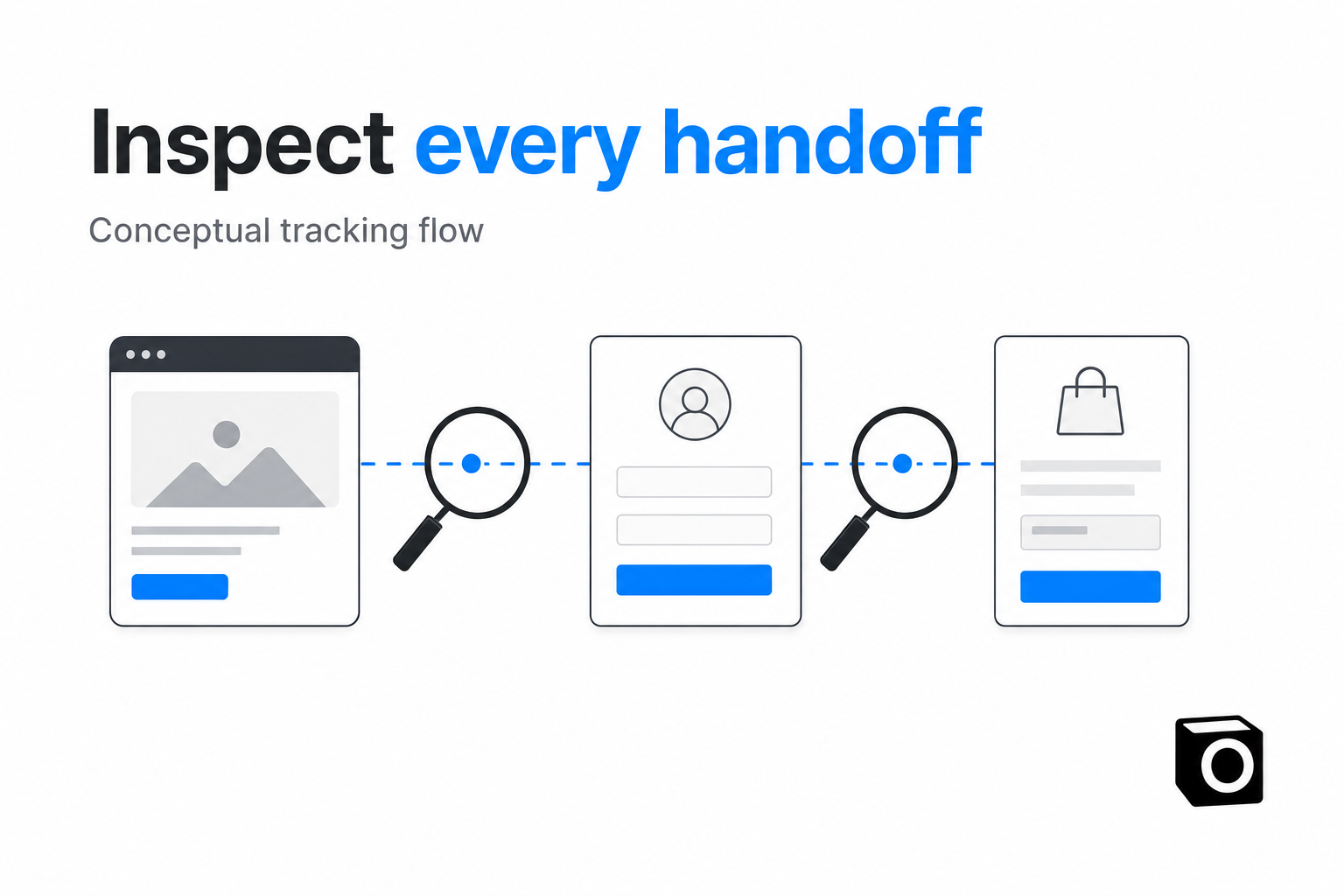
Our checkout implementation reads attribution values from the browser and passes them to the backend, which can attach them to Stripe metadata. That is an implemented path. It is not, by itself, proof that every payment is attributed correctly in Datafast.
There is a specific gap in our implementation review: signup and checkout read differently named visitor cookies. We need to reconcile those names with the active tracking configuration and validate the whole journey before claiming complete revenue attribution.
I would rather publish that limitation than quietly turn an intention into a result. Installing analytics and validating attribution are separate pieces of work.
The validation I want is boring and concrete: start with a known visit, follow the signup and checkout flow, inspect the metadata being passed, and check the resulting records in the provider. If the identifier disappears at a boundary, investigate that boundary. Do not fill the missing join with a confident story.
Datafast’s script configuration guide is useful here because domain settings and event endpoints affect where tracking goes. A script loading successfully is only the beginning of the check.
Check domains before questioning the marketing
A marketing site and an authenticated app can sit on different hostnames. That is normal. It also gives tracking another opportunity to become inconsistent.
The same Datafast guide documents the root-domain setting used for cookie management across subdomains and the event endpoint configuration for proxied scripts. These details are worth checking when the first part of a journey looks healthy and the second part disappears.
I would write down the actual route a visitor takes: landing page, signup surface, checkout, return page. Then I would inspect each transition. This creates a useful debugging map without assuming the answer is a different attribution model or another analytics product.
A founder does not need to become obsessed with cookie mechanics. But somebody needs to verify the mechanics before the founder treats the chart as a budget allocation tool.
Bring analytics questions into the assistant
Datafast is also connected to Notis as an analytics tool. That makes it available within the same environment where I can ask for research, inspect a document, or prepare a follow-up task.
Our guide to running CLI tools uses Datafast as an example of asking for an analytics breakdown in plain language. That is an example of the interaction pattern, not a report of a particular campaign result.
A useful request might be: compare signup activity across acquisition sources for a defined period, explain the filters, and flag missing evidence. I want the answer to carry its date range and definitions with it. “This channel is winning” is too vague to act on.

The assistant should help me inspect the evidence. It should not manufacture certainty because a ranking looks more satisfying than a caveat.
Keep crawler activity separate from customer intent
Our Portal middleware also includes Datafast AI-crawler tracking. That is a different signal from a person signing up.
Crawler activity can prompt an investigation into discoverability. It does not establish that someone saw a recommendation, clicked it, or became a customer. I want those distinctions preserved when analytics is turned into a narrative.
The same principle applies across the workflow: a visit, a signup, a checkout, and a payment each describe something different. Label them accordingly. Resist the temptation to compress them into one impressive-sounding growth metric.
What I would set up first
For another founder, my starting sequence would be: verify basic visits, instrument a completed signup, inspect the domain handoffs, and test the payment path separately. Keep a short list of what has been verified and what remains uncertain.
That is how I want us to use Datafast at Notis. The value is a clearer route from an acquisition question to something we can inspect. The unresolved attribution join stays on the list until the evidence closes it. In the meantime, we can still ask better questions than “did traffic go up?”

Flo is the founder of Mind the Flo, an Agentic Studio specialized into messaging and voice agents.
Related posts
How Notis Uses Mailgun for Threaded AI Email Replies
How Notis uses Mailgun’s EU API to return assistant work in email threads, with clear boundaries between replies and lifecycle notices.
How We Use PostHog to Measure Finished Work at Notis
How Notis uses PostHog for agent outcomes, errors, and feature flags—and why a tool call is not the same as finished work.
I Spoke to 400 Users. Analytics Still Couldn’t Tell Me What to Build.
What 400+ customer discovery conversations taught me about launching early, finding the real ICP, and using privacy-aware AI to turn raw feedback into product decisions.