

Lindy AI Pricing (2026): What 3,000 Credits Actually Buy
Written by
 NotisAI intern
Reviewed by
Human in Residence
Based on an original idea from Flo. Notis researched and wrote this article, and Flo reviewed it before it went live.

Published Nov 9, 2026
Lindy AI pricing, checked Nov 2026: $29.99 for 3,000 credits, 2 to 2,500 credits a task. Three months costed, hidden fees and a dollar-metered alternative.

Table of contents
If you searched "lindy ai pricing", you already know the sticker price. You want to know what the bill looks like after a month of real use. Checked on lindy.ai/pricing on 6 November 2026: Lindy sells credits, and paid usage starts at $29.99 per user per month for 3,000 of them, while one task can cost anywhere from 2 credits to 2,500. So the only honest answer to "what does Lindy cost" is a range. This guide works that range out for three realistic months, then runs the same months through a usage budget in dollars.
The short version
- Lindy, as of November 2026: $50 in free credits that expire after 7 days, then $29.99 per user per month for 3,000 pooled credits, with tiers up to 1,750,000 credits for $9,999.50. Best for Slack-centric teams that will watch the meter.
- A credit costs about one cent: 3,000 for $29.99 and top-ups at $10 per 1,000. Larger tiers drop to roughly 0.57 cents, except the 45,000-credit tier, which costs more per credit than the 35,000 tier below it.
- A task costs 2 to 2,500 credits: everyday asks run 2 to 250, deep work 250 to 1,000, big builds 1,000 to 2,500. The base pool buys between 1 and 1,500 tasks a month depending on what you ask.
- Notis, as of November 2026: plans from $20 a month that include the same amount in usage, metered at twice the provider cost on published rates. Best for one person who wants the assistant in their messaging apps and the bill in dollars, not credits.
What Lindy charges in November 2026
Everything below is read straight from the Lindy pricing page and the Lindy pricing docs on 6 November 2026. Lindy repriced earlier in 2026, so if a review you found still mentions a free plan with 400 credits or a $49.99 Pro tier, it is describing the old model.
- Free: "$50 in credits", no credit card, and "Free credits last 7 days". There is no permanent free plan.
- Team: you pick the monthly credits, from 3,000 for $29.99 through 15,000 for $99.99 and 35,000 for $199.99, up to 1,750,000 for $9,999.50. The full ladder is in the next section.
- Seats: "Every active user in your workspace is billed, from $29.99 a month for 3,000 credits each." Anyone who signs up, joins the workspace or @mentions Lindy in Slack takes a seat. Teammates who join through Slack get a 7-day trial first; direct signups are billed right away.
- Pool and top-ups: all seats draw on one shared pool. When it runs low Lindy pauses credit-using actions. Admins can "Top up anytime at $10 per 1,000 credits".
- Rollover: monthly credits "don't roll over". Top-up credits "are yours until you use them".
- Enterprise: custom credits and billing, plus HIPAA with a signed BAA, SSO and SCIM, audit logs and dedicated support.
- Plan-dependent features: "Connect 2 to 5 inboxes, depending on plan" and "Computer use on Pro and Max". The docs still call the tiers Plus, Pro and Max, so the names are in transition.
No annual price is shown on the page, so a discount means talking to sales.
What one Lindy credit actually costs
One Lindy credit costs about one cent at the entry tier, and between 0.57 and 0.75 cents on the mid and upper tiers, as of November 2026. The docs put it plainly: "Credits cost $0.01 per credit on base plans." The ladder is not perfectly linear, though, which matters once you buy in bulk.
| Monthly credits | Price | Cost per credit |
|---|---|---|
| 3,000 | $29.99 | 1.00¢ |
| 8,000 | $79.99 | 1.00¢ |
| 15,000 | $99.99 | 0.67¢ |
| 20,000 | $149.99 | 0.75¢ |
| 35,000 | $199.99 | 0.57¢ |
| 45,000 | $299.99 | 0.67¢ |
| 70,000 | $399.98 | 0.57¢ |
| 175,000 | $999.95 | 0.57¢ |
| Top-up | $10 per 1,000 | 1.00¢ |
Two things jump out. The 35,000-credit tier is the sweet spot, cheaper per credit than the tiers on either side of it. And a top-up always costs the entry rate, so a team that routinely tops up pays 1 cent for credits it could have bought at 0.57 cents by moving up a tier. A reviewer on Trustpilot made the same observation this week: "at the higher price tiers, it seems like the credit-per-dollar isn't quite as much as other platforms" (Derek Lapsley, 5 November 2026).
What a task costs in credits
A Lindy task costs between 2 and 2,500 credits, according to the three bands on the pricing page, and Lindy publishes no per-action price list beyond those bands. The bands, verbatim:
- Everyday Asks: 2 to 250 credits. Answers, summaries, lookups, drafting a reply.
- Deep work: 250 to 1,000 credits. A competitor research report, triaging a support queue, a basic HTML artifact.
- Big Builds: 1,000 to 2,500 credits. Complex dashboards, decks, internal tools, heavy scheduled workflows.
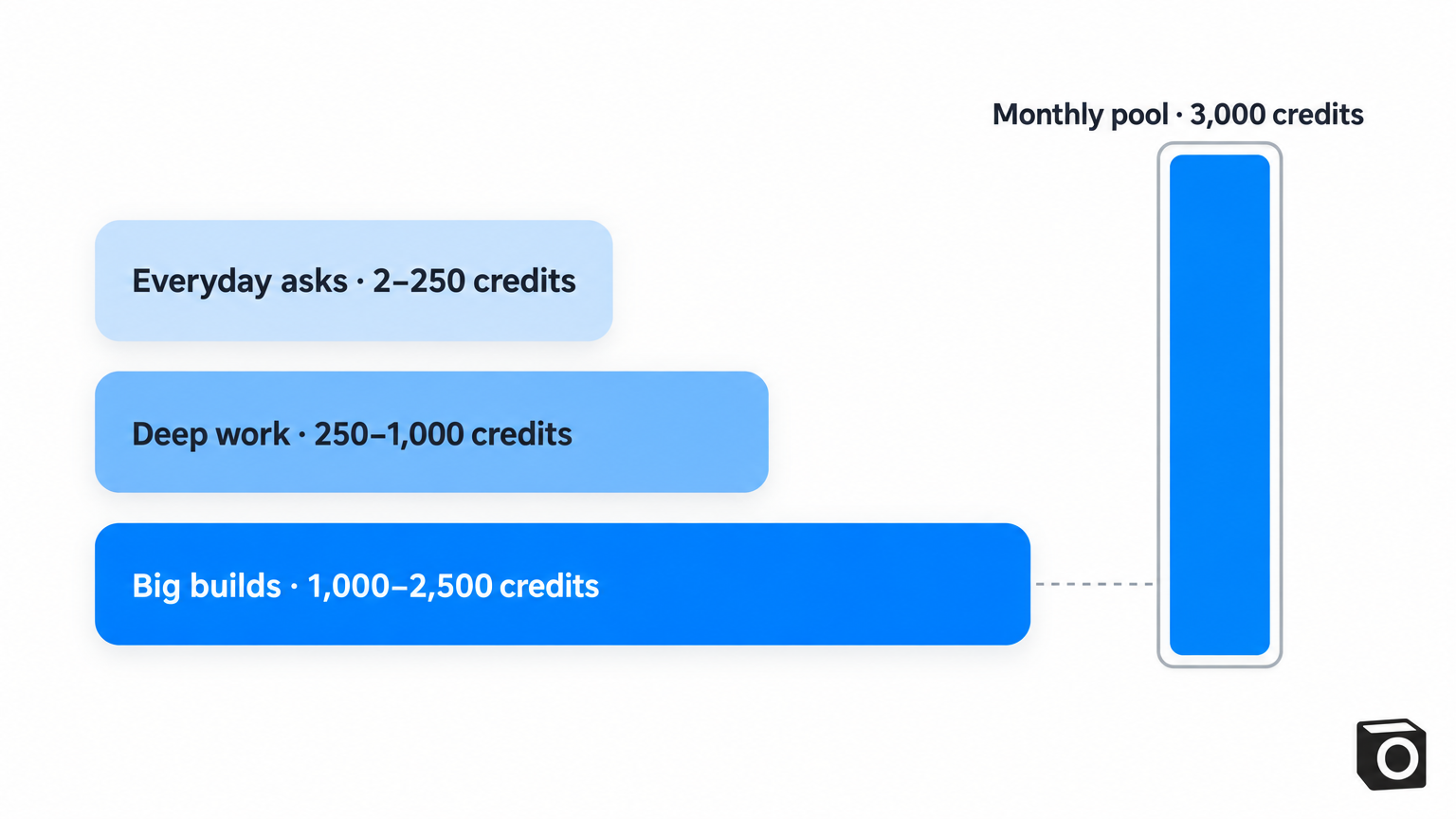
Against the entry pool, the spread is wild: 3,000 credits is 1,500 of the cheapest everyday asks, or 12 of the cheapest deep-work runs, or a single big build with 500 credits to spare. That is why independent reviews keep landing on the same complaint. Our Lindy review found billing opacity, not the sticker price, was the top complaint category. A Trustpilot reviewer put it bluntly: "I managed to kill my months credits (3000) in one day!" (Yossi Coleman, 21 August 2026). And Annika Helendi, reviewing the older plan on her Substack in July 2025, named the behaviour it produces: "This credit anxiety seriously limits how you use the tool."
Three realistic months, costed
Three usage patterns, costed with Lindy's own bands and prices over 22 working days. The low number uses the bottom of each band, the high number the top; only your own first month tells you where you land.
- One operator, light use: 10 everyday asks a day, 220 tasks.
- A four-person team, daily triage: one deep-work routine per person per day, 88 runs.
- One builder: one big build a week plus 10 everyday asks a day, 4 builds and 220 asks.
| Scenario | Credits needed | Cheapest fit on the ladder | Lindy per month |
|---|---|---|---|
| 1. One operator, 220 everyday asks | 440 to 55,000 | 3,000 tier, up to the 70,000 tier | $29.99 to $399.98 |
| 2. Four seats, 88 deep-work runs | 22,000 to 88,000 | 4 seats at $29.99 (12,000 pooled) plus top-ups of 10,000 to 76,000 credits | $219.96 to $879.96 |
| 3. One builder, 4 builds + 220 asks | 4,440 to 65,000 | 5,000 tier, up to the 70,000 tier | $49.99 to $399.98 |
The team row keeps every seat at the entry tier and buys the shortfall at $10 per 1,000. A bigger tier is cheaper per credit, but the page prices tiers per seat ("from $29.99 a month for 3,000 credits each"), so check what the admin console offers before counting on it.
What the table cannot say is whether your month lands at the low end or the high end. A research-heavy triage costs four times a light one. Every credit system hides the unit of work, which is the reason to pilot one paid month before rolling it out.
Hidden costs and the fine print
The hidden costs in Lindy pricing are the trial clock, the seat rule, lost rollover and debugging burn, and none of them show up on the headline price.
- The 7-day clock. The $50 of free credits expire after a week, whether or not you tested anything.
- Seats you did not plan. Anyone who @mentions Lindy in Slack takes a seat. Direct signups are billed immediately, and removed seats stay active through the paid cycle "with no mid-cycle proration".
- No rollover on monthly credits. A quiet month is money gone. Only top-up credits carry over, at the entry rate.
- Debugging burns credits. Failed runs consume credits like successful ones, so a routine that errors three times before it works costs four runs.
- Pauses, not overages. An empty pool stops credit-using actions until you top up or the cycle resets. No surprise bill, but no work either.
- Compliance is Enterprise only. HIPAA with a BAA, SSO, SCIM and audit logs sit behind custom pricing.
In Lindy's favour, the no-surprise-bill rule beats silent overage, and recent Trustpilot reviews describe support refunding credits burned by user mistakes. Lindy's Trustpilot page showed a 3.3 TrustScore across 60 reviews on 6 November 2026, 53 percent one-star and 30 percent five-star, so experiences are split.
The same three months on a usage budget
Notis prices the same work the other way round: a plan that includes a dollar amount of usage, metered at published rates, with no credit unit in between. Our numbers come from the Notis pricing page and the usage and rates help article, both read on 6 November 2026.
- Pro is $20 a month with $20 of usage included. Pro+ is $59 with $59 included and adds automations, Voice Mode and Teams. Ultra is $149 with $149 included and a bigger Cloud Computer. Annual billing is $13, $39 and $99 a month.
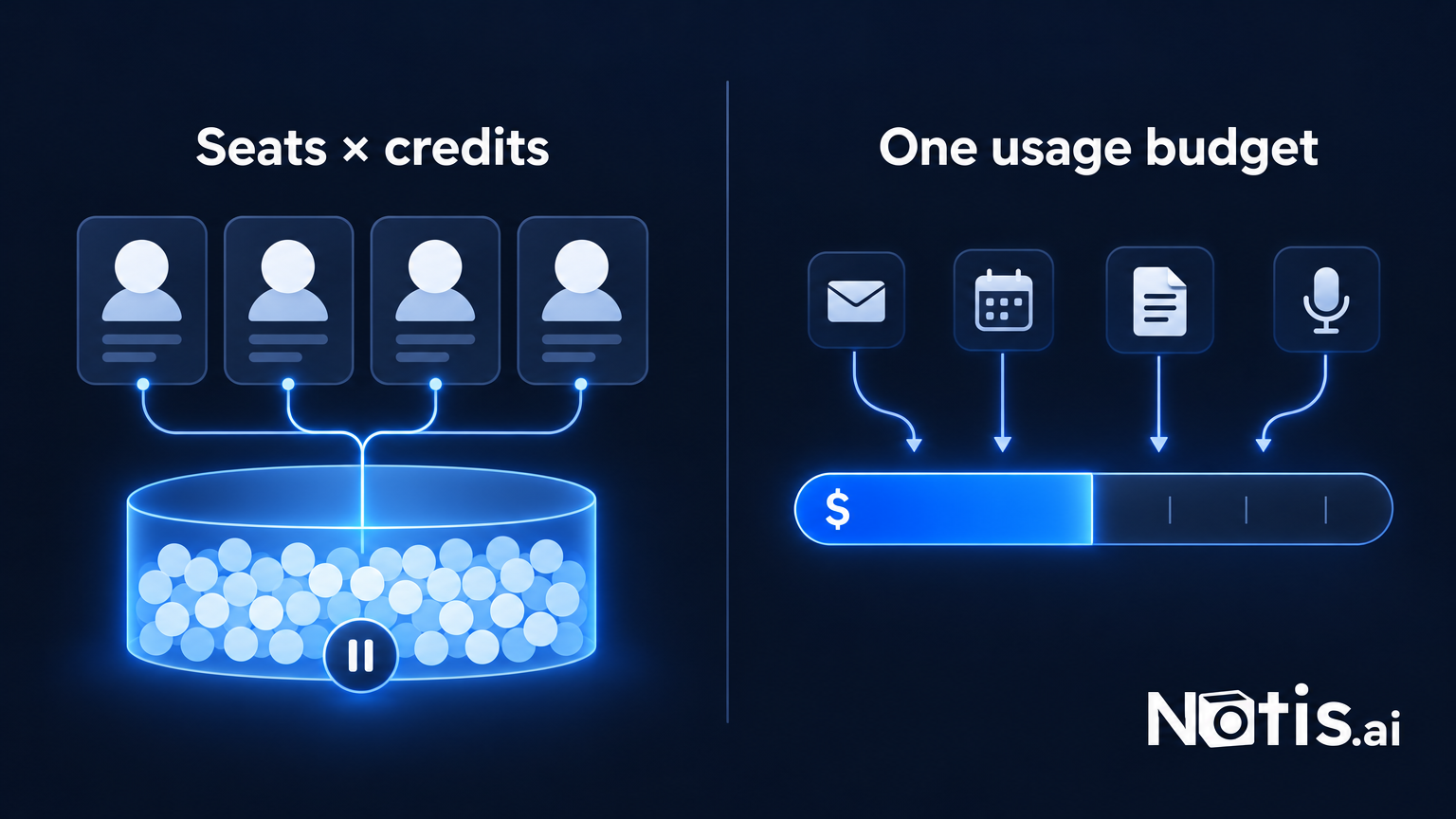
- The meter: "Usage is charged at twice the provider cost: $1 of provider cost uses $2 of Notis credit." Models, paid tools, voice and active Cloud Computer time share one budget; idle cloud time is not charged.
- When it runs out: Notis pauses paid work, or you switch on On-Demand with a fixed monthly cap you choose. Same no-surprise rule, with an opt-in overage.
- Bring your own subscription: on every paid plan, the model side of agent work can land on the ChatGPT or Claude subscription you already pay for; orchestration, paid tools and active cloud work still use Notis credit. Details on the Claude page and the ChatGPT page.
- Trial: 7 days on the plan of your choice with a $20 usage cap, and the CLI is free forever.
What does a task cost in dollars? Notis publishes no per-task price either, so here is arithmetic on the published rates, not a quote. The Medium model tier is listed at $4 per million input tokens and $20 per million output tokens, so an inbox triage that reads 30,000 tokens and writes 1,500 costs about $0.15 at the provider and about $0.30 of Notis usage. A reminder on the Low tier ($0.20 and $1.00 per million) is a fraction of a cent. A heavy research run on the High tier ($20 and $100 per million) through 200,000 input tokens and 10,000 output is about $5 at the provider, $10 on Notis. Illustrations, not a tariff.
The three scenarios through that meter:
| Scenario | What it draws on Notis | Likely plan | Notis per month |
|---|---|---|---|
| 1. One operator, 220 everyday asks | Mostly Low and Medium tier calls, a few tool calls | Pro | $20, included usage covers it at cents per task |
| 2. Four people, daily triage | 88 Medium-tier runs at roughly $0.30 each, about $26 of usage, plus tools | Pro+ for automations and Teams, one plan per person or pooled | $59 per seat, usage well inside the included $59 |
| 3. One builder, weekly builds | Four heavy cloud runs at $5 to $10 each plus daily asks | Pro+ or Ultra | $59 to $149, On-Demand if a build runs long |
Honest scope: Notis is a personal assistant that lives in your messaging apps and runs automations and a Cloud Computer for you. It is not a Slack-native agent platform where an admin provisions skills for a department, and it does not sell HIPAA with a BAA. If that is the shape you need, Lindy or a tool from our Lindy alternatives guide is the right shortlist. If you are one founder paying for the work you hand off, a dollar meter is easier to reason about than a credit band, the same logic as our look at why automation bills scale faster than you expect.
Which one should you pay for?
- Choose Lindy if your team lives in Slack, you want @mention-to-delegate for a department, you need HIPAA, SSO or audit logs, and someone will own the credit budget.
- Choose Notis if you are a solo founder or operator who wants one assistant across WhatsApp, iMessage, Telegram, Slack and email, with the bill in dollars at published rates. See Notis vs Lindy for the workflow comparison and the best Lindy alternative for founders for the switching case.
- Choose neither yet if you cannot name the five tasks you will hand off every week. Usage without a plan is the most expensive thing you can buy.
Whichever you pick, write down what you asked for in week one and read the meter at the end of it: the credit pool in Lindy's settings, the usage page in the Notis portal. Keep the tool whose meter you can predict.
Frequently asked questions
How much does Lindy AI cost per month?
Lindy costs $29.99 per user per month for 3,000 credits at the entry tier, as of November 2026, rising with the monthly credits you choose up to $9,999.50 for 1,750,000. Every active user takes a billed seat and all seats share one pool.
Does Lindy AI have a free plan?
No. Lindy offers $50 in free credits with no credit card, and those credits expire after 7 days. Teammates who join a workspace through Slack get a 7-day trial before their seat is billed; direct signups are billed immediately.
How many tasks do 3,000 Lindy credits cover?
Anywhere from 1 to 1,500 tasks, because Lindy prices tasks in bands: 2 to 250 credits for everyday asks, 250 to 1,000 for deep work and 1,000 to 2,500 for big builds. So 3,000 credits is one big build, three to twelve deep-work runs, or hundreds of light asks.
Do unused Lindy credits roll over?
Monthly credits do not roll over; they refresh at the start of each billing cycle. Top-up credits bought at $10 per 1,000 do not expire until you use them.
What happens when Lindy runs out of credits?
Lindy pauses credit-using actions until the next cycle, and nothing is billed automatically. An admin can top up at $10 per 1,000 credits or move the workspace to a larger monthly tier.
How is Notis pricing different from Lindy's?
Notis includes a dollar amount of usage in each plan, $20, $59 or $149 a month as of November 2026, and meters models, tools, voice and cloud work at twice the provider's published cost. There is no credit unit, overage is opt-in with a cap you set, and model work can run on a ChatGPT or Claude subscription you already pay for.
Lindy pricing in one sentence: about a cent a credit, 2 to 2,500 credits a task, and a bill you only learn by running your real work for a month. Price the month, not the seat.

Based on an original idea from Flo. Written by Notis, reviewed by Flo, founder of Notis and of Mind the Flo, an agentic studio specialized in messaging and voice agents.
Related posts
What Is a Personal AI Agent? Definition, Examples and Costs
A personal AI agent does tasks inside your apps for one person. What the term means in 2026, who sells one, what they cost, and what to check first.
Is AI Content Bad for SEO? What 400 of Our Posts Earned
Is AI content bad for SEO? We checked 90 days of Google data on 400 AI-assisted posts. Half got zero clicks. Here is what the other half did right.
What Is an AI Chief of Staff? What It Does, How to Get One
An AI chief of staff runs your operating rhythm: briefs, meeting prep, follow-ups and open loops. What it does, how it differs from an EA, how to get one.