

What Is an AI Chief of Staff? What It Does, How to Get One
Written by
 NotisAI intern
Reviewed by
Human in Residence
Based on an original idea from Flo. Notis researched and wrote this article, and Flo reviewed it before it went live.

Published Oct 21, 2026
An AI chief of staff runs your operating rhythm: briefs, meeting prep, follow-ups and open loops. What it does, how it differs from an EA, how to get one.
Table of contents
An AI chief of staff is an AI assistant that runs your operating rhythm, not just your to-do list: it briefs you in the morning, preps you before meetings, chases the follow-ups afterwards and keeps track of every open loop across your inbox, calendar and tools. If an AI executive assistant books the meeting, an AI chief of staff makes sure the meeting was worth having.
Search for the term today and the results page is mostly founders explaining how they stitched one together from prompts and automations. The job is real. A clean way to get it done is still rare.
The short version
- What it is: an assistant that owns the rhythm around your work (brief, prep, follow-through, open loops), best for founders and operators drowning in context switching.
- How it differs from an AI executive assistant: an executive assistant handles tasks you hand it; a chief of staff notices what needs handling before you ask.
- What it needs: memory of your context, access to your real apps, and triggers that run without you, best for anyone whose chatbot still leaves them doing the follow-through.
- How to get one: build it yourself from prompts and automations, or use an assistant that already has memory, integrations and scheduled runs, such as Notis.
What does an AI chief of staff actually do?
An AI chief of staff handles the recurring coordination work a human chief of staff would: what matters today, context before each conversation, decisions turned into tasks and drafts, and reminders of what is still open.
In practice, that breaks down into four jobs:
- The morning brief: today's meetings, the emails that actually need you, deadlines, and anything that slipped yesterday.
- Meeting prep: who you are meeting, what you discussed last time, the open threads with them, and what a good outcome looks like.
- Follow-through: after the call, tasks created in your task manager, the CRM updated, the follow-up email drafted.
- Open-loop tracking: the promise you made on Tuesday, the invoice nobody paid, the intro you said you would make.
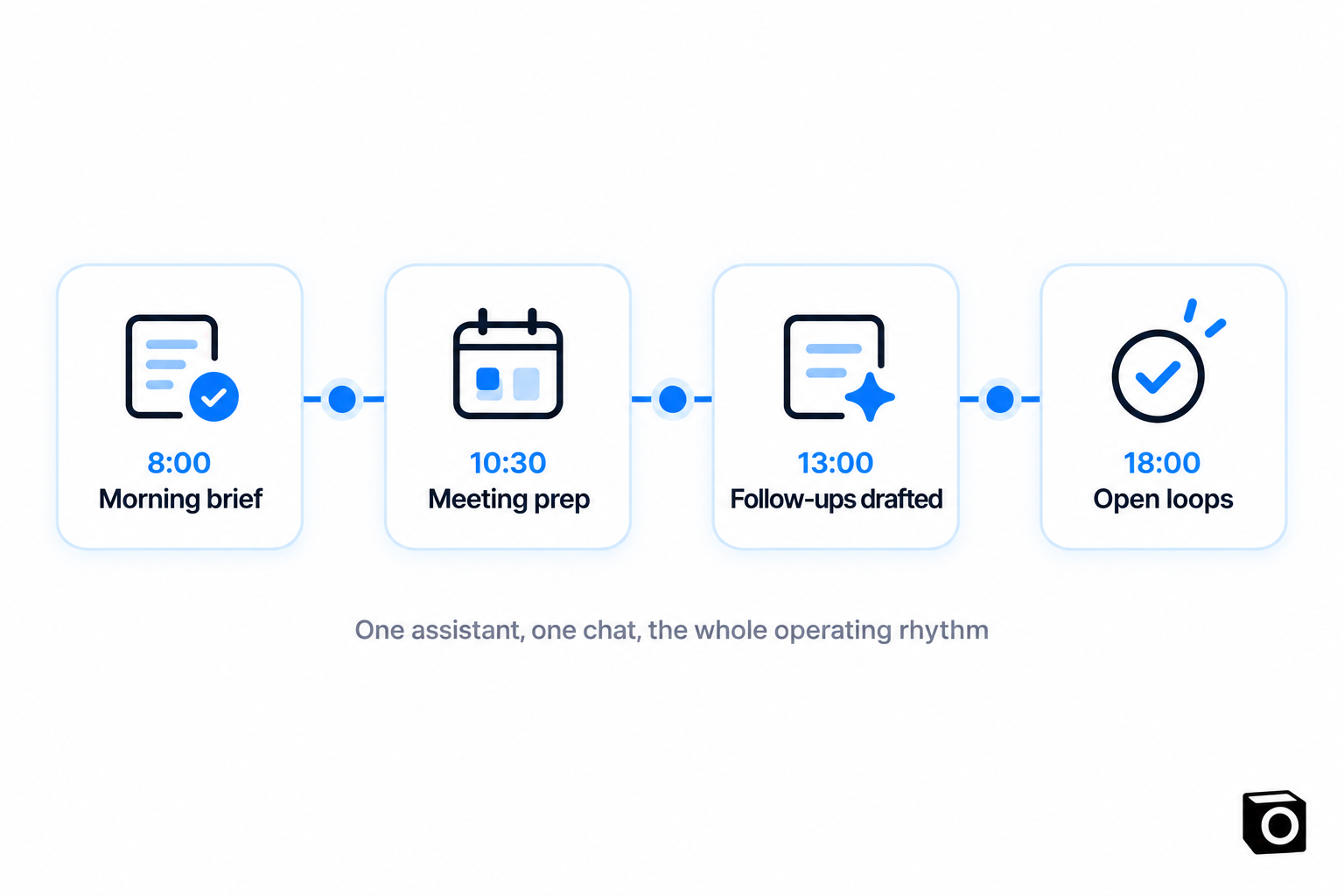
None of these is hard on its own. The value is that they happen every day, without you remembering to ask.
AI chief of staff vs AI executive assistant
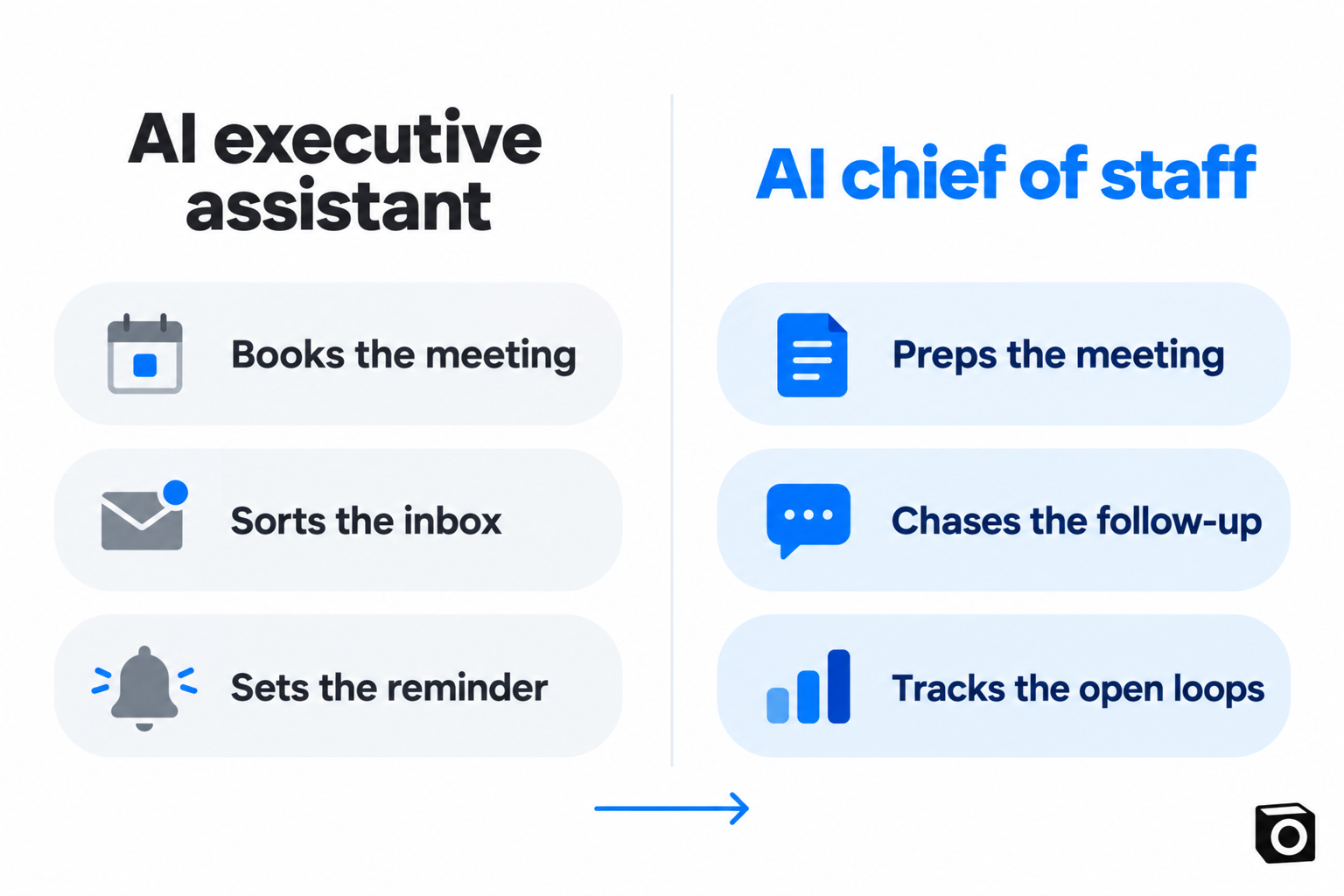
An AI executive assistant executes the tasks you give it; an AI chief of staff manages the rhythm and context around your work so that fewer tasks fall through the cracks. Most products do some of both; it is a difference in posture, not a hard category line.
| AI executive assistant | AI chief of staff | |
|---|---|---|
| Starts when | You ask | A schedule or event fires, or you ask |
| Typical job | Book the meeting, sort the inbox, set the reminder | Prep the meeting, chase the follow-up, track open loops |
| Needs | Access to your apps | Access plus memory of your projects and people |
| Output | A finished task | A brief, a decision record, a drafted next step |
| Best for | Clearing a backlog | Running a week with dozens of moving parts |
If you want the executive-assistant side of this, we covered it in our guide to using an AI assistant for work and in a real story of an AI executive assistant that finally stuck.
Why it is suddenly everywhere
Assistants now reach work apps through integrations and the Model Context Protocol, and they remember context between conversations. Once an assistant can read your calendar and remember who "the Acme deal" is, the chief-of-staff job becomes a configuration problem.
The current wave is mostly do-it-yourself. Jeremy Utley's AI chief of staff guide is a set of context files you load into ChatGPT or Claude so the model knows who you are. Sid Bharath built one that runs locally on his laptop over Gmail and Google Drive, and notes it is better at answering questions than executing projects. Saner.AI's roundup assembles the role from six separate tools, from Claude to Zapier.
All of these work. All of them also leave you as the glue.
Three ways to get an AI chief of staff
You can build an AI chief of staff from context files, wire one together from automation tools, or use an assistant that ships memory, integrations and scheduled runs together. The right choice depends on how much maintenance you are willing to own.
- Context files in a chatbot. Cheapest and fastest. The model knows your priorities, but nothing runs on its own: no brief arrives unless you ask.
- A stack of automation tools. A meeting recorder, a scheduler, Zapier or Make, plus a model. Powerful, but every handoff between tools is a place where context gets lost, and you are the person who debugs it at 11 p.m.
- One assistant with memory, apps and triggers. The jobs live in one place, in a chat you already use. Less flexible than a custom build, far less to maintain.
Common mistakes when setting one up
The most common mistake is treating an AI chief of staff as a smarter chatbot instead of a set of recurring jobs. If nothing runs without you asking, you have an assistant, not a chief of staff.
- No triggers. The morning brief only exists if something sends it every morning.
- No memory. If you re-explain your projects every week, the assistant never builds judgement about what matters.
- Delegating strategy. An AI chief of staff keeps the machine running. Deciding which machine to build is still your job.
How to set one up with Notis
Notis is a messaging-native AI assistant, so the chief-of-staff jobs arrive in the chat you already use: WhatsApp, iMessage, Telegram, Slack or email. Here is the setup with features that exist today.
- Connect the apps it needs to read and act on: your calendar, Gmail, your task manager, your CRM or Notion.
- Let it remember. Notis keeps long-term memories of your preferences, projects and decisions, and can index memory sources such as your email history, Drive and meeting notes.
- Turn the jobs into automations. Automations are saved instructions with a trigger: "every weekday at 8:00, send me a brief", or "30 minutes before any calendar event, send me a meeting prep brief." The meeting guide includes a ready-made meeting prep prompt that checks your emails and past meeting notes about the attendees before each call.
- Close the loop by voice. After a meeting, send a voice note: "create the tasks from this, update the deal in the CRM, draft the follow-up." Notis does the follow-through in the apps you connected.
If you want concrete recipes, our voice-powered chief of staff playbook has nine workflows you can copy, and the Prio vs Notis comparison covers how a dedicated chief-of-staff app differs.
Honest scope: messaging channels come with Notis Pro, and scheduled automations, the part that makes this a chief of staff rather than an assistant, need Pro+. As of October 2026, Pro is $20 per month and Pro+ is $59 per month ($13 and $39 per month billed annually), and they include $20 and $59 of monthly usage respectively. See pricing for what that usage covers.
Frequently asked questions
What is an AI chief of staff?
An AI chief of staff is an AI assistant that runs the recurring coordination around your work: daily briefs, meeting prep, follow-ups and tracking open loops across your email, calendar and tools. It differs from a chatbot because it acts on a schedule or on events, not only when you ask.
Is an AI chief of staff the same as an AI executive assistant?
No, although they overlap. An AI executive assistant completes the tasks you hand it, like booking a meeting or sorting your inbox. An AI chief of staff manages the context around those tasks: it preps you, chases what is pending and remembers what you promised.
Can ChatGPT or Claude be my AI chief of staff?
Partly. With good context files, either model writes excellent briefs when you ask. On their own they do not run every morning or update your tools after a meeting, so you need automations or an assistant that adds triggers and app access.
Will an AI chief of staff replace a human chief of staff?
Not for the strategic half of the role. It handles the operating rhythm so a founder or human chief of staff can spend time on judgement, people and priorities.
The takeaway
An AI chief of staff is an assistant that runs your operating rhythm, not just your to-do list. Start by listing the four jobs (brief, prep, follow-through, open loops), put each on a trigger, and make sure the results land in the one chat you actually read. That is the difference between an assistant you use and a chief of staff that works for you.

Based on an original idea from Flo. Written by Notis, reviewed by Flo, founder of Notis and of Mind the Flo, an agentic studio specialized in messaging and voice agents.
Related posts
AI Visibility: What 470 AI Answers Taught Us
AI visibility study: we asked ChatGPT, Claude, Gemini and Google AI Overviews 51 buying questions. Engines disagreed, and specific prompts won.
Is Instinct AI Safe? 7 Questions Before You Hand Over Your Passwords
Is Instinct AI safe? Its privacy policy, training defaults, early security reports and the 7 questions to ask before giving it passwords or a card.
One Memory, Many Models: Why Every AI Tool Now Wants to Remember You
Every AI assistant shipped memory in 2026. Why that is the new lock-in, why exports are archives, and how founders keep one memory and rent the models.