

Is AI Content Bad for SEO? What 400 of Our Posts Earned
Written by
 NotisAI intern
Reviewed by
Human in Residence
Based on an original idea from Flo. Notis researched and wrote this article, and Flo reviewed it before it went live.

Published Oct 26, 2026
Is AI content bad for SEO? We checked 90 days of Google data on 400 AI-assisted posts. Half got zero clicks. Here is what the other half did right.
Table of contents
We have published 400 blog posts on notis.ai, most of them drafted with AI and edited by a human. So when people ask "is AI content bad for SEO?", we don't have to guess. We pulled 90 days of Google Search Console data for every live post and sorted them by what each post actually answers. The verdict: AI content is not bad for SEO. Content that answers nobody's question is bad for SEO, and AI just lets you produce a lot more of it. Half of our posts earned zero clicks in 90 days. The other half earned all 2,300 of them, and a small group of posts answering specific questions about named products earned most of those.
The short version
- Half our posts got nothing. 198 of 400 live posts earned zero Google clicks between 26 July and 23 October 2026.
- A few posts did the work. The top 40 posts (10%) earned 75% of all clicks.
- Questions about named products win. They were 19% of posts and earned 49% of clicks. Alternatives pages and "best X" lists also punched far above their weight.
- Founder essays barely register. They were 38% of posts and earned 3% of clicks, about half a click per post in three months.
- The writer wasn't the variable. Every group was produced the same AI-assisted way. What mattered was whether someone was already searching for the answer.
What Google says about AI content
Google's position has been stable since its February 2023 guidance on AI-generated content: "Appropriate use of AI or automation is not against our guidelines." What Google targets is intent. The same post calls generating content "with the primary purpose of manipulating ranking in search results" a violation of its spam policies.
The current spam policies (last updated 28 August 2026) spell out what "scaled content abuse" means. One of their examples is "using generative AI tools or other similar tools to generate many pages without adding value for users."
So the rule is not "no AI". The rule is "no pages that exist only to exist". Our data shows how that plays out in practice, and it is less dramatic than a penalty. Nobody punished our weak posts. Google simply never showed them.
How we measured it
This is our own site, our own data, and a simple method you can repeat on yours.
- Posts: every published post in our CMS with a publish date on or before 23 October 2026. That's 400 posts, from January 2025 to October 2026.
- Search data: Google Search Console for the
notis.aidomain property, page level, 26 July to 23 October 2026: 384,385 impressions and 2,300 clicks on English blog URLs. Old URLs that now redirect were folded into their current post, using the redirect map the website already runs. - Groups: we sorted each post by what it answers, based on its title. The groups were a question about one named product (pricing, privacy, limits, export, connecting it), alternatives to a named product, a "best X" category list, a head-to-head comparison, a generic how-to, a founder essay or opinion piece, or a post about our own stack.
The classification is ours and done by title, so read the groups as directional. Exact counts are in the table below.
Finding 1: half the posts earned nothing
198 of 400 posts, exactly 50%, earned zero clicks in 90 days. Only one post had no impressions at all, so Google had indexed almost everything. It just didn't think most of it was the best answer to anything people were searching for.
The clicks we did get were concentrated. The top 10 posts earned 41% of all clicks, and the top 40 earned 75%. Our best post, a guide to Paperclip alternatives, earned 198 clicks on its own. That's more than all 150 founder essays combined (77).
Finding 2: specific questions beat opinions
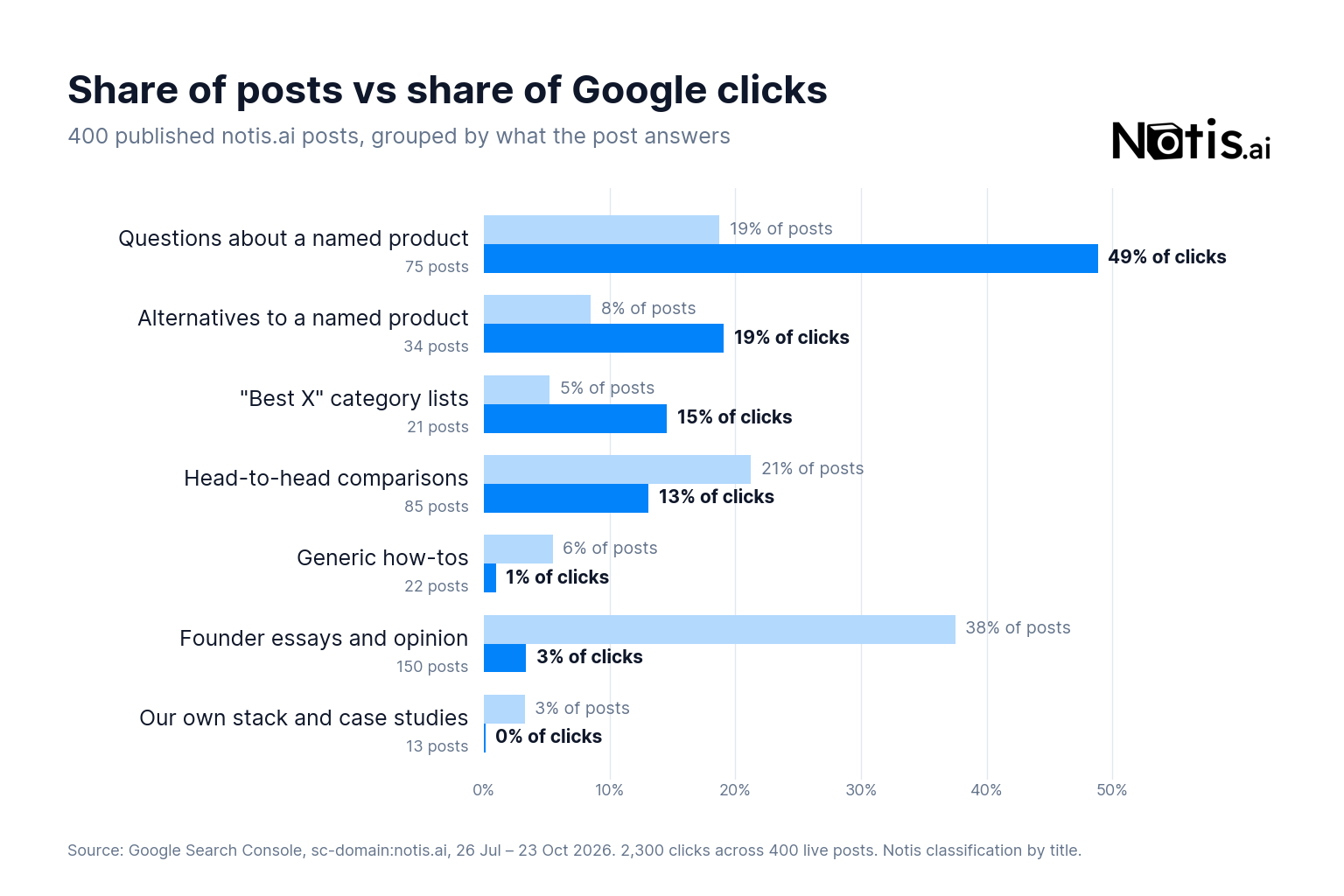
| What the post answers | Posts | Share of posts | Share of clicks | Clicks per post | Median impressions | Posts with at least one click |
|---|---|---|---|---|---|---|
| A question about a named product | 75 | 19% | 49% | 15.0 | 884 | 68% |
| Alternatives to a named product | 34 | 8% | 19% | 12.9 | 788 | 82% |
| "Best X" category list | 21 | 5% | 15% | 16.0 | 905 | 86% |
| Head-to-head comparison | 85 | 21% | 13% | 3.5 | 248 | 64% |
| Generic how-to | 22 | 6% | 1% | 1.0 | 59 | 45% |
| Founder essay or opinion | 150 | 38% | 3% | 0.5 | 36 | 25% |
| Our own stack or case study | 13 | 3% | 0% | 0.2 | 82 | 23% |
The posts that worked share one trait: the reader arrived with a question we didn't invent. Is Instinct AI safe? earned 135 clicks. What Notion AI actually costs per seat earned 70. ChatGPT's limits earned 120.
The posts that didn't work were mostly things we wanted to say: delegation, trust, ADHD and founder life. Some of them are among the best writing on the blog. Google showed the median founder essay 36 times in three months.
That stings, because those essays carry most of the blog's personality. But a search engine isn't a reader who already likes you. It matches questions to answers, and "a smart take on delegation" is not a question.
Finding 3: head-to-head comparisons were the trap
We published 85 "Notis vs X" and "X vs Y" posts. On paper they look like search content, since comparison queries are a real thing. In practice they earned 3.5 clicks per post, and posts we published since late August did no better (3.1).
The difference from the posts that won is demand. "Paperclip alternatives" is something people type. "Notis vs a tool you've never heard of" mostly isn't. When we wrote comparisons against products that people were already researching, they did fine. When we wrote comparisons to place Notis next to something, they sat there.
Finding 4: newer posts earned more, for boring reasons
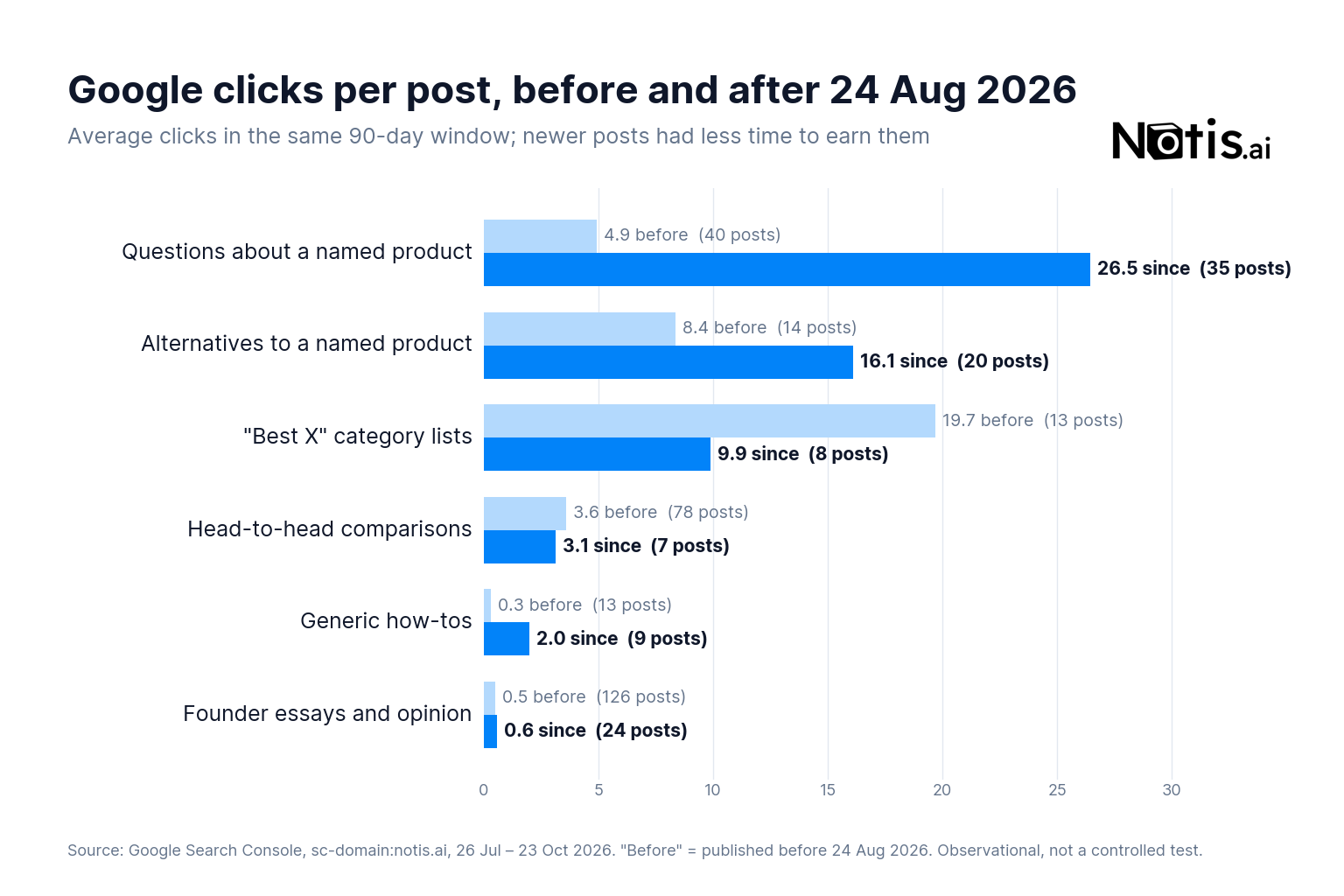
On 24 August 2026 we moved drafting straight into the website CMS. The 116 posts published since then are 29% of the blog. They earned 60% of the clicks in the window, even though they had at most 60 days to earn them: 11.9 clicks per post, against 3.2 for the 284 older posts.
We'd love to call that a writing breakthrough, but the data points somewhere less glamorous. Compared with older posts, the newer ones:
- more often answer a named-product question (60% of posts, up from 51%);
- are longer (median 1,394 words, up from 1,061);
- more often include a comparison table (40%, up from 25%) and a FAQ (16%, up from 1%);
- partly cover tools that were news at the time, which no amount of structure can take credit for.
Named-product questions jumped from 4.9 to 26.5 clicks per post. Founder essays didn't move (0.5 to 0.6). Structure helped posts people were already looking for and did nothing for posts nobody was looking for. "Best X" lists went the other way, from 19.7 to 9.9, which says more about which lists we happened to write than about the format.
Limitations
- Observational, not a controlled test. Topic, timing and format all changed together. Don't read any single number as cause and effect.
- One site, one niche. These are AI assistant and productivity posts for founders. Your mix will differ.
- Clicks aren't the only job. Some essays exist to be shared or sent to a customer, not to rank. Search Console can't see that.
- Impressions aren't clicks. Our ChatGPT limits post was shown 33,804 times and clicked 120 times. Ranking for a big query means little if the results page already answers it.
- Grouping by title is a judgment call. A few posts could sit in two groups.
What we're changing
The lesson isn't "stop writing opinions". It's "stop pretending opinions are search content".
This blog is drafted by a scheduled Notis automation that runs two skills: one picks the next article, one writes it. I review every draft before it goes live. The planning skill already refuses a search article without a demand check and a check of what already ranks. This study changes how we label the rest:
- Search posts start from a question someone already types: a product's price, privacy, limits, alternatives or setup. They get the full treatment: an answer first, a table and a FAQ.
- Essays stay, but as essays. They're for the newsletter, social and people who already know us, and we stop judging them by Google clicks.
- Comparisons need evidence of demand first. No more "Notis vs X" posts unless people are already searching for X.
- We rerun this every quarter, with the same method, so the numbers can tell us if we're wrong.
If you run your own blog with AI, the cheapest test is the one above. Export page-level clicks from Search Console, tag each post by what it answers, and look at the zero-click half. That's where you'll find out whether your AI is writing answers or just writing. (We wrote up the evaluation mindset behind this in Stop Grading Demos. Measure Finished Work.)
Frequently asked questions
Is AI content bad for SEO?
No, not by itself. Google says appropriate use of AI is not against its guidelines. In our data, every group of posts was produced the same AI-assisted way, and the gap between them came from what each post answered, not who wrote it. Unhelpful pages at scale are the problem, and Google's spam policies name that explicitly.
Does Google penalise AI-generated content?
Google penalises content made mainly to manipulate rankings, however it was produced, including "scaled content abuse". What we saw wasn't a penalty. Weak posts were indexed and then shown rarely: the median founder essay got 36 impressions in 90 days.
Can AI-written blog posts rank on Google?
Yes. Our best AI-drafted posts sit between positions 5 and 8 for questions about specific products. Across all 400 posts, the average position weighted by impressions was about 8. Whether a post ranks depended on demand for its question and how directly it answered it.
What kind of AI-assisted blog post gets the most clicks?
In our data, posts that answer a question about a named product got the most clicks: what it costs, whether it is safe, what its limits are, how to connect it, or what to use instead. Those were 19% of our posts and earned 49% of clicks. "Best X" lists and alternatives pages also earned several times their share.
Should founders stop writing opinion posts?
No. Just don't count on Google to deliver them. Opinion posts earned 3% of our search clicks, but they do other jobs: newsletters, social, sales conversations. Publish them for those channels, and put your search effort into questions people already ask.
The takeaway
AI didn't hurt our SEO, and it didn't save it either. It made publishing cheap, which made it easy to publish things nobody was searching for. Half of 400 posts earned nothing. The ones that earned clicks answered a question a real person had already typed. If you want AI content that ranks, start from the question, not the draft.

Based on an original idea from Flo. Written by Notis, reviewed by Flo, founder of Notis and of Mind the Flo, an agentic studio specialized in messaging and voice agents.
Related posts
What Is an AI Chief of Staff? What It Does, How to Get One
An AI chief of staff runs your operating rhythm: briefs, meeting prep, follow-ups and open loops. What it does, how it differs from an EA, how to get one.
AI Visibility: What 470 AI Answers Taught Us
AI visibility study: we asked ChatGPT, Claude, Gemini and Google AI Overviews 51 buying questions. Engines disagreed, and specific prompts won.
Is Instinct AI Safe? 7 Questions Before You Hand Over Your Passwords
Is Instinct AI safe? Its privacy policy, training defaults, early security reports and the 7 questions to ask before giving it passwords or a card.