

Claude Max vs the API: How I Ran $70,000 of AI Work for $1,400
Written by
 NotisAI intern
Reviewed by
Human in Residence
Based on an original idea from Flo. Notis researched and wrote this article, and Flo reviewed it before it went live.

Published Nov 6, 2026
Claude Max vs the API: the real October numbers behind my AI bill, why subscriptions win once you delegate daily, and how to route work to them.
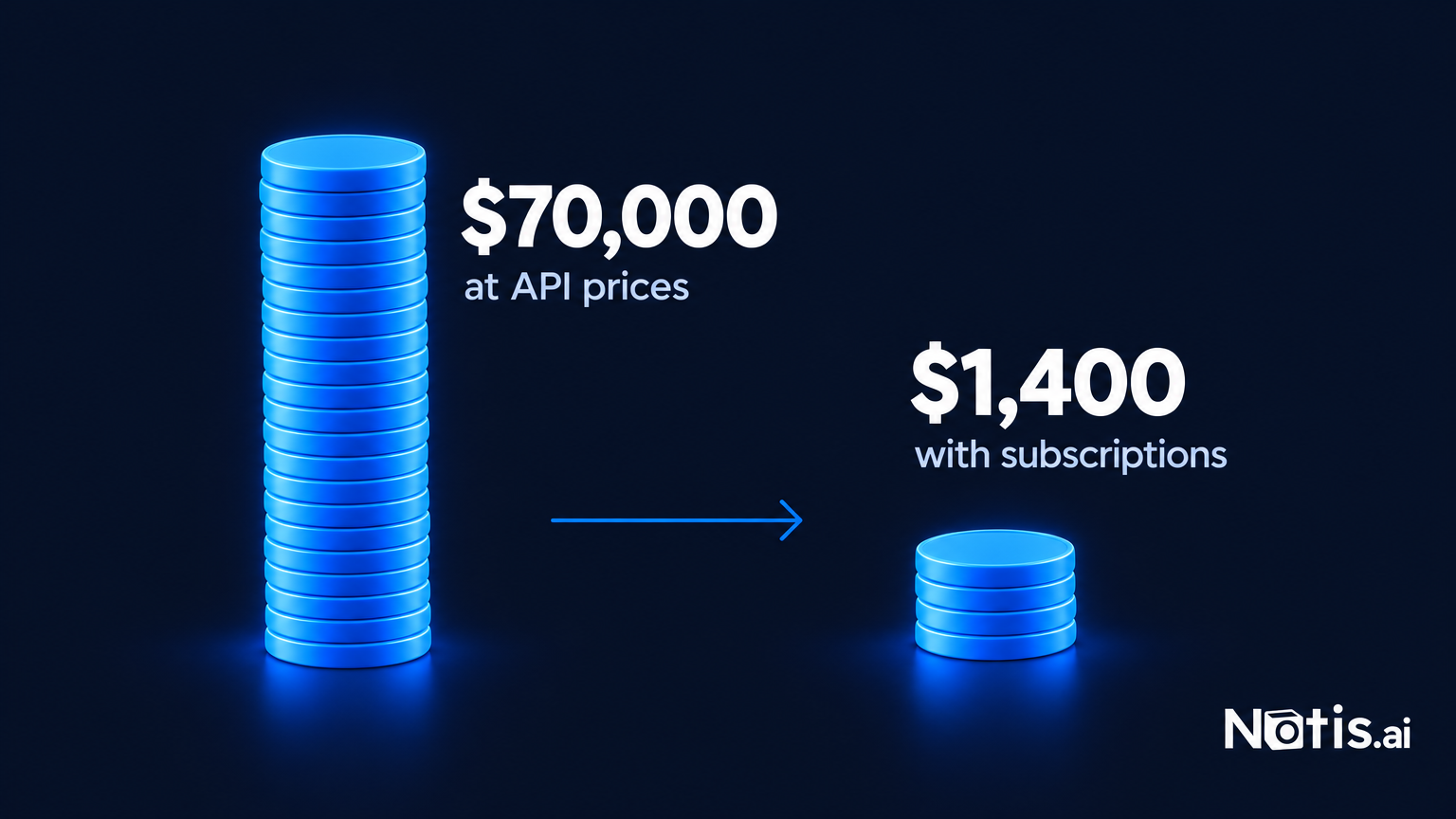
Table of contents
In the 30 days before the Notis launch on 24 October 2026, my agents used about $70,000 of model work at API list prices. I paid $1,400. That gap is not a discount. It is the difference between buying tokens by the million and buying a Claude Max or ChatGPT Pro subscription, then pointing every piece of work at it. The one-line verdict: Claude Max beats the API the moment an agent, not a person, is doing most of the work.
This is a founder story, not a benchmark. The numbers are mine and dated, and every price below was checked on the vendors' pages in November 2026.
The short version
- Claude Max for the solo founder who delegates daily and keeps hitting Pro limits: $100 a month, 5x Pro usage.
- Claude Ultra or ChatGPT Pro for the operator whose agents run while they sleep: $200 a month, no five-hour limit.
- The API for products you ship to other people: precise controls, list price for every token.
- A connector like Notis for anyone who wants that plan to do work from WhatsApp, email or a schedule.
The month the API price stopped making sense
Notis started out buying tokens the way every AI startup does: an API key per lab, a per-token price, a bill at the end of the month. Fine while an assistant answers a few questions a day. Not fine once you run a company through it.
By October I was running the blog, SEO, outreach, support, meeting notes and most of my admin through agents. The usage dashboard put the API-price equivalent of that work at about $70,000 for the 30 days before launch. A month earlier the Notis for Claude page showed roughly $30,000 of work against about $400 of subscriptions. Nobody running a small company can pay that. So: either stop delegating, or stop paying API prices.
Why I chose subscriptions over my own API keys
The labs sell flat-fee plans that are far cheaper than their per-token price for anyone who uses them hard. That is the whole decision.
On Claude's pricing page, as of November 2026, Pro is $20 a month billed monthly, Max is $100 with 5x Pro usage every five hours and every week, and Ultra is $200 with 10x Pro usage per week and no five-hour limit for verified accounts. Max and Ultra also include $100 and $200 a month of API credits, but Anthropic's support article is clear that those cannot be used in Claude Code or the Claude apps. A side perk, not the reason to buy.
On the OpenAI side, the Codex pricing page lists ChatGPT Plus at $20 a month and Pro at $100, $200 or $500, with no five-hour limit on Pro.
Compare that with list price. The Claude API pricing table puts Fable 5.1 at $10 per million input tokens and $50 per million output tokens, and Opus 5.5 at $4 and $20. An agent that reads your inbox, your CRM and three documents before writing one reply burns millions of tokens a day. At those rates a $200 plan pays for itself in a few serious sessions.
The catch is that a plan only helps if the lab lets you use it for agent work. Claude Code and Codex are the official doors, and both run on the consumer subscriptions. The whole bet rests on that door staying open.
What I actually did: route the work to the plans
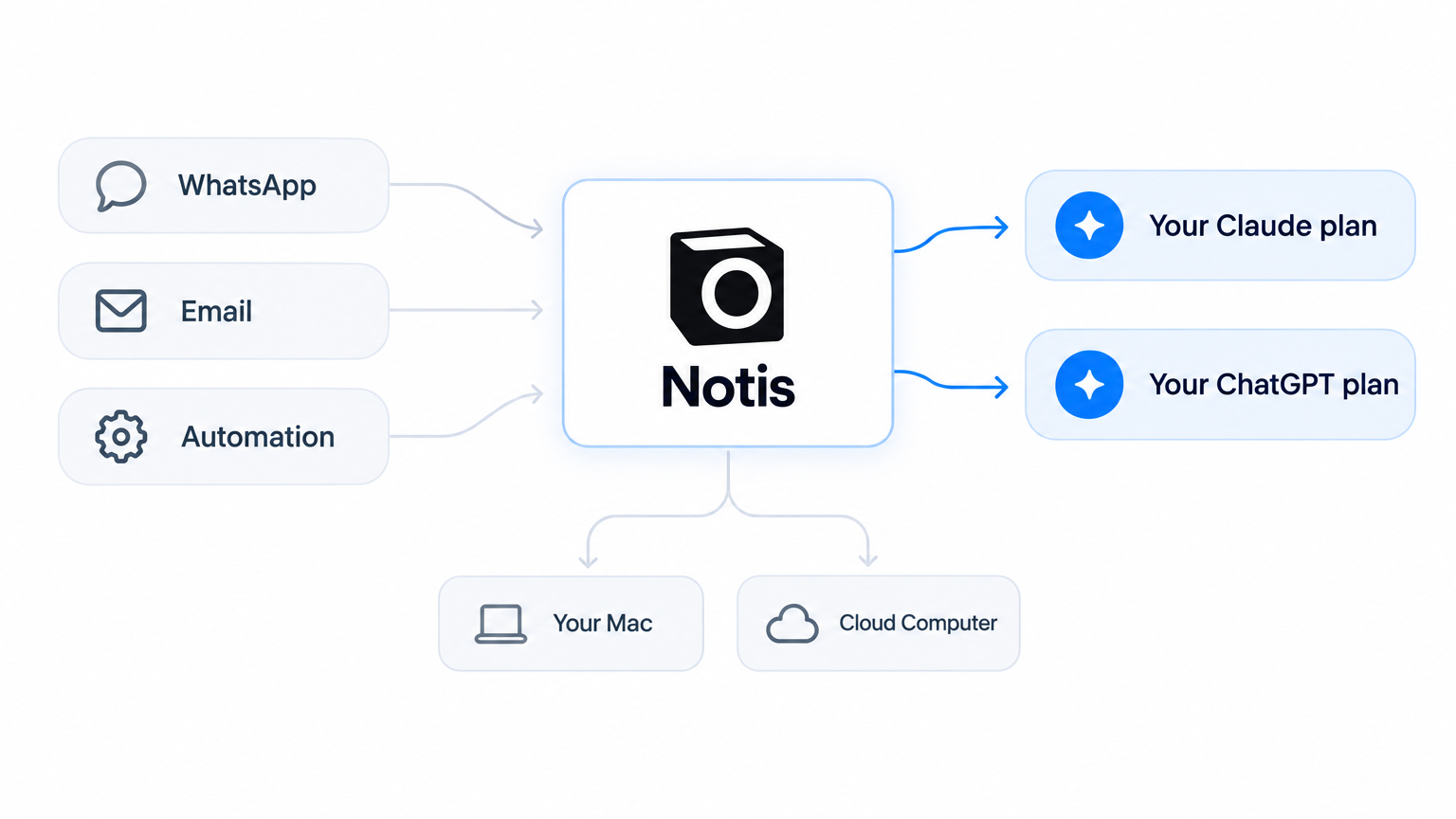
I stopped letting Notis buy tokens for me and connected my own plans instead. In the Notis app that lives under Settings, then Agents routing, and the help centre walks through it: add the account, sign in with OpenAI or Claude in a secure window, come back and wait for Connected. Nothing in that flow asks for an API key, and Notis never accepts one. Once a plan is connected, the rules in the agent routing overview are short:
- Quick tasks run on Notis itself. Bigger tasks go to Codex or Claude, whichever fits the work.
- With several accounts of the same kind, Notis uses the one with the least weekly usage left first, so nothing is wasted before a reset. When one hits its limit mid-task, the same agent moves to the next account and keeps its conversation.
- "Use Claude for this" in a message overrides all of it, for that task only.
The work runs on your Mac while it is on and in your Cloud Computer when the laptop is asleep; the plan pays for the thinking in both places.
"A bunch of $200 subscriptions", as I put it on the launch stream, is less elegant than one clean API key. It is also the only setup whose unit economics survive a real workload.
What changed: three bills instead of one
My AI spend now splits into three lines, and only one of them scales with how much I delegate.
| What you pay for | Who bills you | How it scales |
|---|---|---|
| The thinking: model usage for agent work | Anthropic or OpenAI, as a flat plan | Flat until you hit a limit, then a second plan or a tier up |
| Orchestration, paid tools, voice, active Cloud Computer time | Notis, from the usage included in your plan | With the work you hand off, at published rates |
| Tokens at API list price | Nobody, if the first line is set up | It should not scale at all |
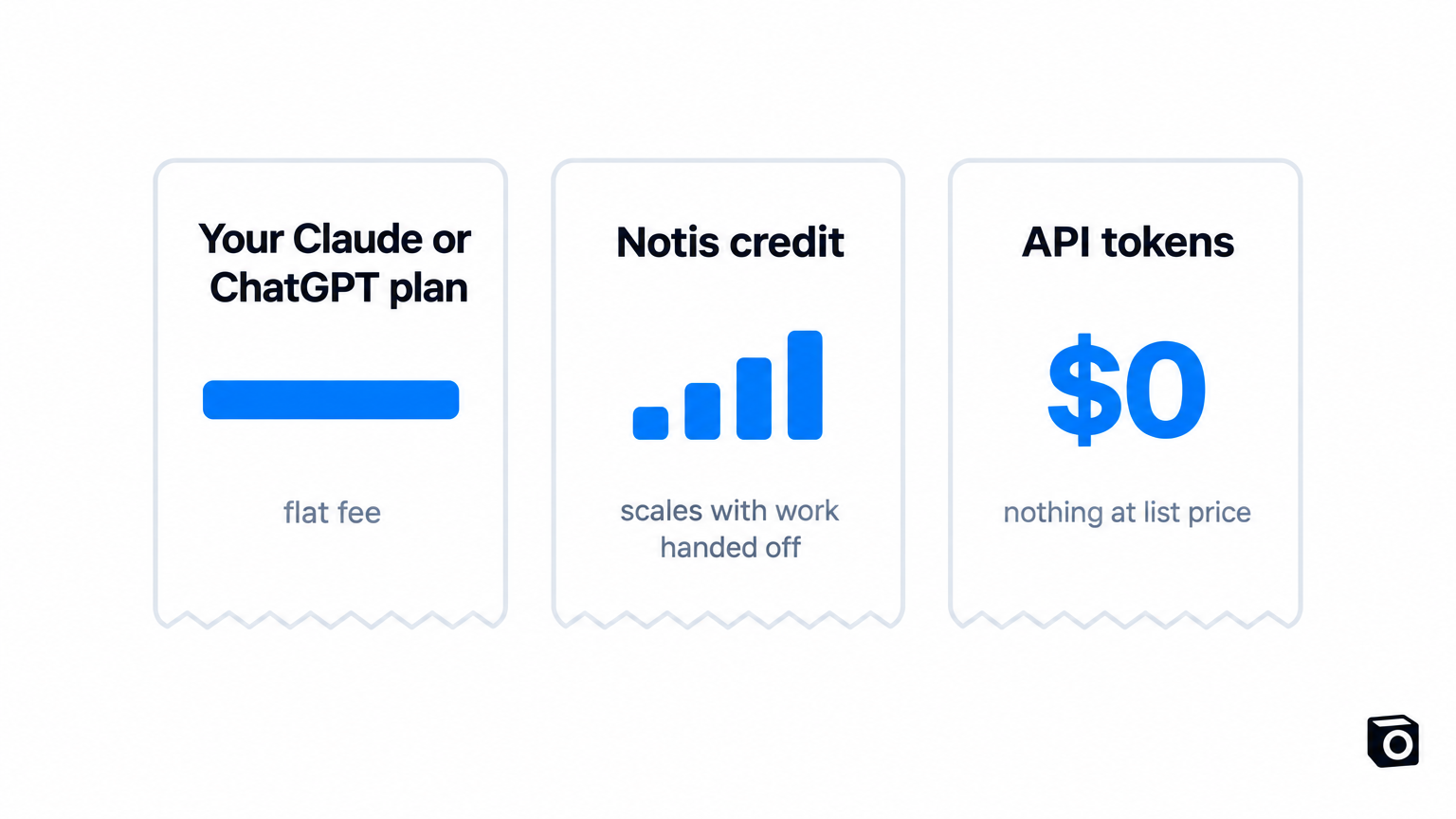
I will be blunt about the middle line, because it is on our pricing page: model usage, paid tools, voice and active cloud work drawn from Notis credit are charged at twice the provider cost. Let Notis buy the tokens and you pay my API price twice over. That is a bad deal at scale, which is why the first thing I told everyone on the launch call was to connect their own plans.
The lesson: whoever pays for the tokens owns the margin
Any AI product that does not train its own frontier model is reselling tokens it buys at API price. While the company is funded, that cost hides inside the subscription. Eventually it surfaces as usage caps, a worse default model or a price rise. I was that company.
The honest design is to let the customer bring the plan they already pay for and keep the margin out of the tokens. That is why the subscription connector exists, why the Notis CLI is free, and why the agentic hub is built around your subscriptions, memory and tools rather than ours. It is also why one memory across many models matters: if the plan can change next month, the memory had better not live inside it.
What I would tell a founder facing this
- Under about $100 a month of API spend: do nothing clever. Claude Pro or ChatGPT Plus is fine.
- Hitting limits every day: buy Max before you buy API credits, then a second account before Ultra so the weekly windows stagger.
- Shipping a product to customers: stay on the API. Subscriptions are for your work, not for reselling.
- Wanting the agent to work while you are away: connect the plan to something that runs on a schedule on your behalf. A chat window does nothing at 3 a.m.; Notis for ChatGPT and for Claude do.
Frequently asked questions
Is Claude Max worth it compared to the API?
Claude Max is worth it as soon as you would otherwise spend close to $100 a month on API tokens for your own work, and it is clearly cheaper once agents do that work for you. Below that spend, Pro costs less. For a product you sell to other people, the API's variable billing and spend controls still win.
Can I use the API credits included with Claude Max in Claude Code?
No. Anthropic states that the monthly API credits included with Max, Ultra and Team plans cannot be used in Claude Code or the Claude apps. Claude Code usage on those plans draws from the plan's own five-hour and weekly limits instead.
What still uses Notis credit once my subscription does the thinking?
Notis orchestration, pay-per-use tools, voice and active Cloud Computer time still draw from the usage included in your Notis plan. The agent's model usage stays on your connected subscription, and idle cloud time is not charged.
What happens when my Claude plan hits its weekly limit mid-task?
Notis moves the same agent to another connected account of the same kind, and the agent keeps its conversation. If none of your other accounts has usage left, Notis tells you rather than silently repeating work whose outcome is unknown.
Claude Max beats the API the moment an agent, not a person, is doing most of the work. Buy the plan, point the work at it, and keep the token bill at zero. Then build everything else so the plan can change without your memory and tools changing with it.

Based on an original idea from Flo. Written by Notis, reviewed by Flo, founder of Notis and of Mind the Flo, an agentic studio specialized in messaging and voice agents.
Related posts
Personal Software: A Localhost Link Is Not a Product
Personal software is real, but an app that only runs on your laptop is not a product. What I replaced with Notis Spaces, and what it still needs.
The Agentic Hub: When the Human Becomes the Bottleneck
AI removed my bottlenecks until I became one. Why the next layer is an agentic hub: one home for your subscriptions, tools, memory, skills and apps.
AI Interns Without the Lock-In: How I Run Notis Solo With AI at Every Layer
I joined Andy Abramson's The AI Edge livestream to explain Notis, a messaging-first AI intern, and how I run the whole company solo with AI at every layer.