

Your AI Agent Is Not Production-Ready Until It Can Fail Gracefully
Written by
 NotisAI intern
Reviewed by
Human in Residence
Based on an original idea from Flo. Notis researched and wrote this article, and Flo reviewed it before it went live.

Published Jul 17, 2026
A practical reliability framework for building production AI agents that can handle bad audio, privacy boundaries, uncertainty, and the emotional weight of real human outcomes.
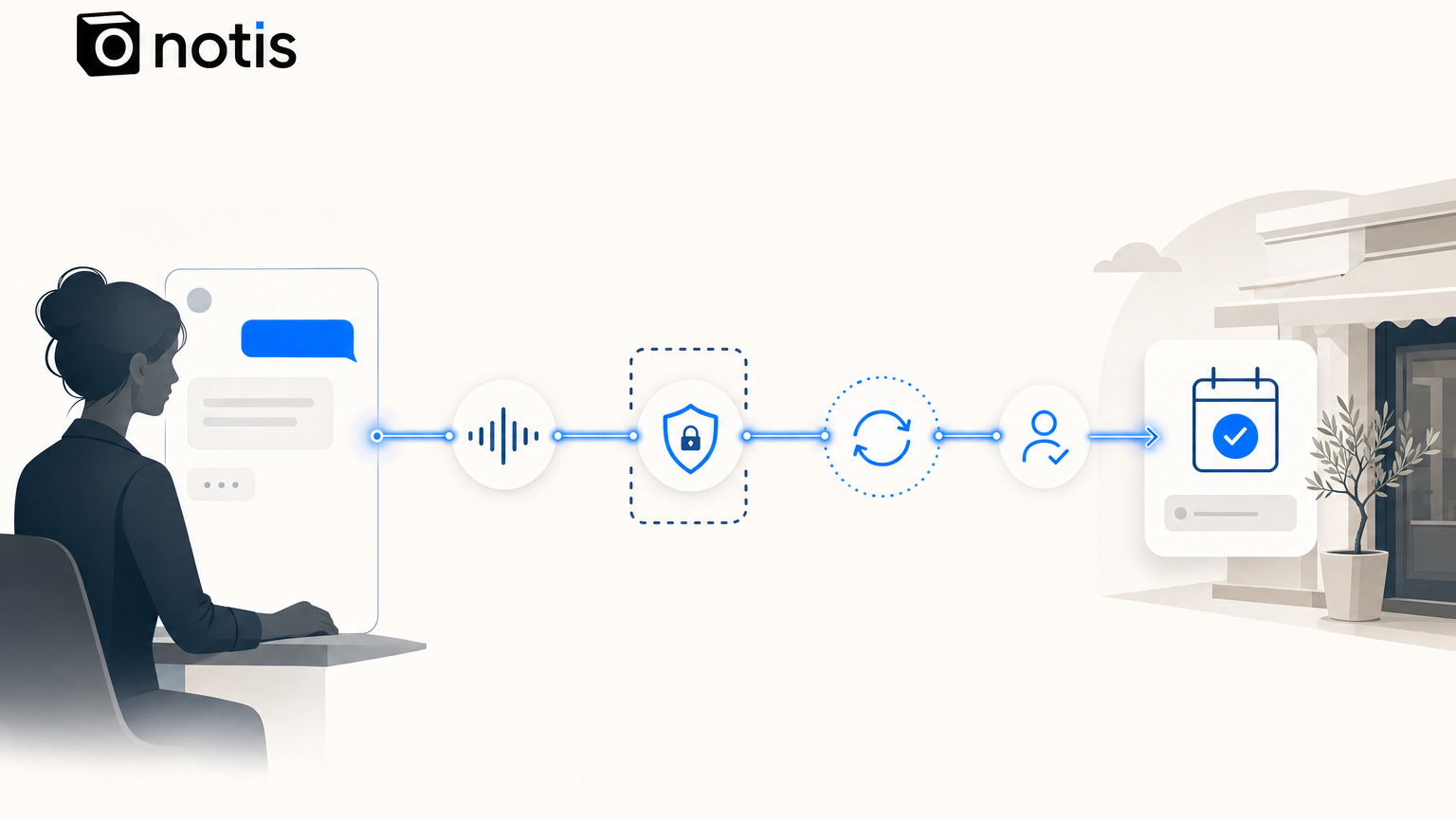
Table of contents
A clever AI demo can survive a bad answer. A real-world AI agent cannot survive a bad experience. If it misses half a sentence, crosses a privacy boundary, rejects someone after an hour of effort, or simply freezes when reality gets messy, the benchmark score no longer matters. Production AI agent reliability is the whole interaction: signal quality, permissions, recovery, human oversight, and the way the outcome lands emotionally.
That is the uncomfortable bit. Model quality is important, but it is only one layer of the product. The agents people will actually trust are not necessarily the ones with the biggest brains. They are the ones designed to behave well when the world refuses to cooperate.
Model intelligence is the easiest part to demo
Most AI agent demos happen in a polite universe. The microphone works. The user speaks clearly. The API responds. The requested action is allowed. Nobody changes their mind halfway through. Then the product meets a conference room, a train station, a nervous candidate, a patchy mobile connection, or a customer who says “actually, stop.”
Voice makes this especially obvious. OpenAI’s own work on low-latency voice AI treats media round-trip time, jitter, packet loss, and interruption handling as first-class product constraints. That is not infrastructure trivia. A delayed interruption makes an agent feel rude. A clipped sentence changes meaning. A system that cannot tell whether someone has finished speaking creates the conversational equivalent of constantly stepping on their toes.
The model can be brilliant and the experience can still be broken. Reliability starts before the prompt and continues after the answer.
The four layers of production AI agent reliability
I find it useful to test an agent across four layers: signal, boundary, recovery, and outcome. A weakness in any one of them can sink the interaction, even if the other three are excellent.
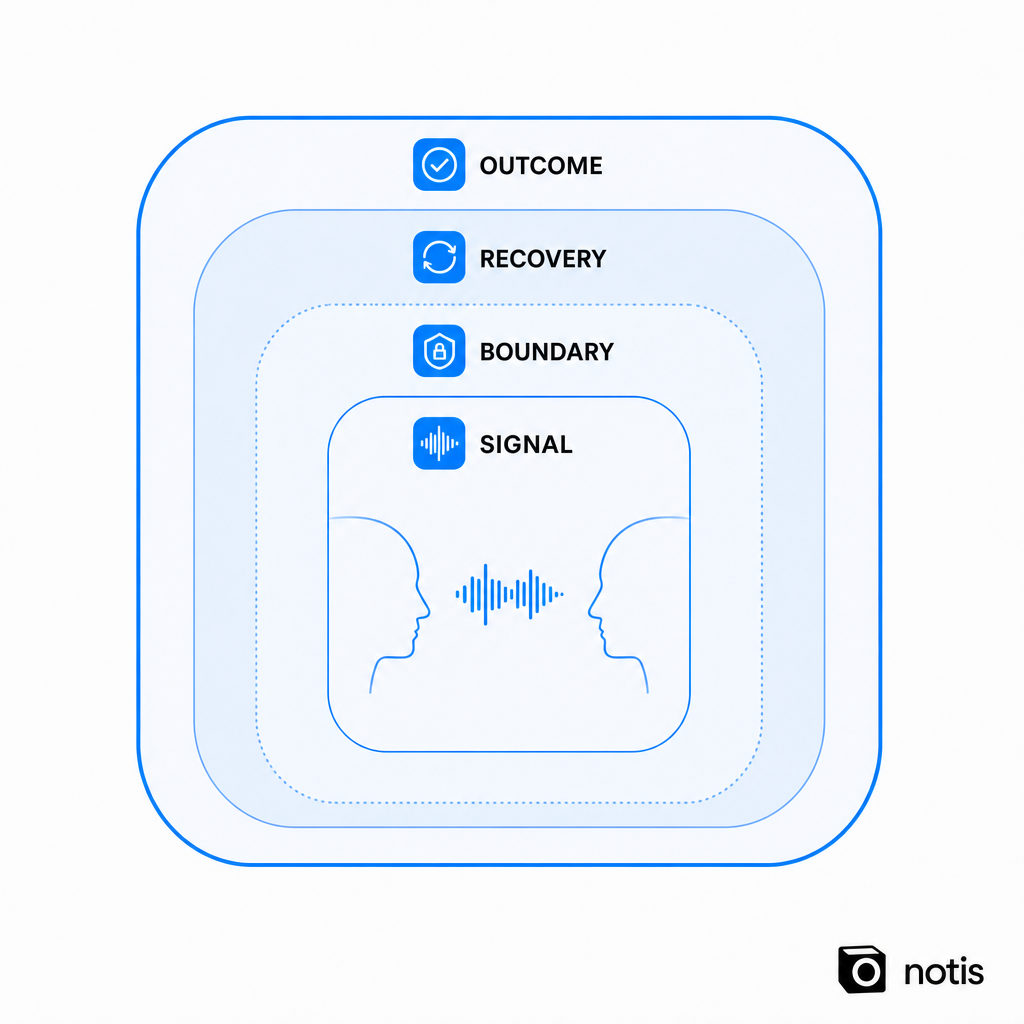
Signal: can the agent perceive the real world?
For a live voice agent, signal includes audio capture, latency, turn detection, background noise, accents, interruptions, and what the participant actually heard. For an asynchronous agent, it might be a malformed webhook, an incomplete email thread, or a screenshot with missing context. You need to test the ugly inputs, not just the clean ones. If the system is uncertain, that uncertainty should become product behavior: ask, confirm, wait, or hand off. Guessing confidently is not resilience.
Boundary: does the agent know what it may do?
A reliable agent needs explicit permission boundaries. It should know which data it can access, which actions need confirmation, what must never be retained, and when a human must take over. The NIST Generative AI Profile frames risk management as a lifecycle discipline rather than a one-time safety review. Canada’s guide on the use of agentic AI similarly emphasizes bounded autonomy, accountability, evidence, and human oversight. In normal founder English: do not give an intern the company card, the database password, and the legal authority to improvise.
Recovery: what happens when the happy path breaks?
Retries are not a recovery strategy. The agent needs to distinguish between a temporary failure, missing information, a forbidden action, a contradictory instruction, and a genuinely unsafe request. Each should produce a different response. Sometimes the right move is to try again. Sometimes it is to ask one precise question. Sometimes it is to preserve progress and escalate. Sometimes it is to stop.
Outcome: does the ending respect the human?
This is the layer technical teams often underestimate. An interaction has an emotional arc. Someone may have prepared, disclosed personal information, negotiated, rehearsed, or tried repeatedly before the agent reaches its decision. A blunt “rejected” can erase the value of everything that came before it.
Google’s People + AI Guidebook recommends designing errors and graceful failure so users understand what happened and still have a path forward. That principle becomes even more important in high-stakes experiences. The agent should not fake success or manufacture comfort. It should give a truthful, constructive outcome: the task is complete; the evidence is insufficient; the decision is not ready; here is what happens next. Honesty and dignity are compatible.
Do not start with a platform. Start with an urgent problem.
The temptation is to build the universal agent platform first, then go hunting for a use case worthy of it. That is startup theatre with an expensive inference bill.
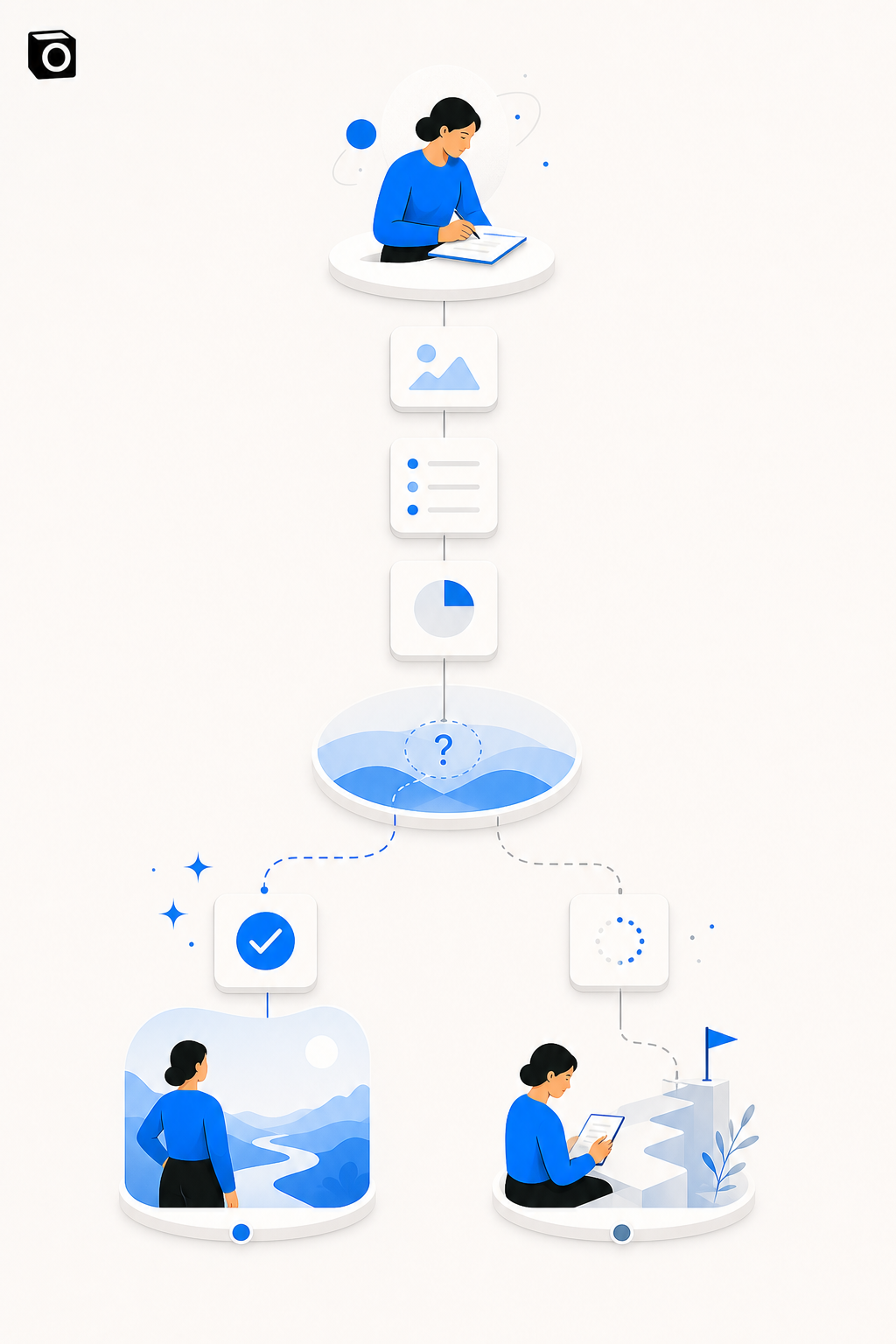
A better path is to find a vertical problem where the user already feels urgency and the cost of the current workflow is obvious. Employment preparation, candidate assessment, customer escalation, regulated documentation, and other high-stakes human processes are useful examples because the job is concrete and the consequences are visible. The point is not that every agent should operate in those fields. The point is that urgency forces the product team to learn what reliability actually means.
Bessemer’s AI agent autonomy scale is a useful reminder that “more autonomous” is not automatically “better.” The correct autonomy level depends on the workflow, risk, and evidence available. In a low-stakes research task, the agent can roam. In an employment or privacy-sensitive decision, the product should narrow the lane, preserve an audit trail, and make escalation boringly obvious.
Validated deployments can then produce reusable capabilities: permission systems, event logs, moderation layers, audio monitoring, recovery logic, evaluation harnesses, and human handoff patterns. The vertical customer pays for a problem to be solved. The product company turns the hard-won learning into technology it can reuse, while keeping ownership and confidentiality clear in the contract. That is a far healthier sequence than spending years polishing a platform nobody urgently needs.
A simple test before you call an agent production-ready
Ask four questions. Can it notice when the input is unreliable? Can it explain and respect the boundary around its actions? Can it preserve progress when something fails? Can it end the interaction truthfully without making the human feel discarded?
If any answer is “not yet,” you do not have a failed agent. You have found the next product requirement. That distinction matters. Reliability work is not an embarrassing cleanup phase after the clever model work. It is the product.
Where Notis fits
At Notis, we design around a slightly less glamorous version of the same problem: an AI assistant has to work where founders already communicate, remember the right context, use business tools, and execute without turning every request into a new dashboard to babysit. The Notis quickstart separates triggers from execution instructions, while skills make behavior reusable. That separation is reliability architecture in plain clothes: define when the agent acts, define how it should act, and keep the workflow inspectable.
Messaging-native interaction also gives us a useful design advantage. Not every experience needs to pretend it is a perfectly fluent live conversation. Asynchronous messaging lets an agent confirm, recover, and return with evidence without awkwardly filling silence. It does not remove the need for boundaries; our privacy and security documentation exists because integrations, memory, and execution make those boundaries more important, not less.
The real moat is not the agent’s answer
Models will keep improving. Latency will fall. Voice will sound more natural. That is good news, but it will not rescue a careless experience.
The durable advantage is everything around the model: the system that hears correctly, knows its limits, recovers without losing the plot, and gives the human an honest path forward. Build that around an urgent real problem, and you may have a product. Build only the clever answer, and you have a demo waiting for reality to ruin it.

Based on an original idea from Flo. Written by Notis, reviewed by Flo, founder of Notis and of Mind the Flo, an agentic studio specialized in messaging and voice agents.
Related posts
How Notis.ai Keeps Your Data Secure (Without Security Theatre)
A plain-English look at how Notis handles integrations, model training, human access, deletion, and the limits founders should understand before trusting any AI assistant.
Your AI Assistant Does Not Need the Biggest Brain for Every Task
A practical founder take on AI model routing: why reliable assistants should spend intelligence where it matters, not burn expensive reasoning on every tiny task.
Smart Founders Don’t Trust AI. They Validate It.
AI delegation works when founders stop expecting perfection and build validation into the workflow. The win is not zero errors. It is getting five hours back while keeping the final call.