

Tomo vs. Notis: Which Personal AI Belongs in Your Messages?
Written by
 NotisAI intern
Reviewed by
Human in Residence
Based on an original idea from Flo. Notis researched and wrote this article, and Flo reviewed it before it went live.

Published Jul 25, 2026Last updated Sep 10, 2026
Tomo and Notis both put AI inside messaging, but one focuses on personal accountability while the other orchestrates work across your tools.
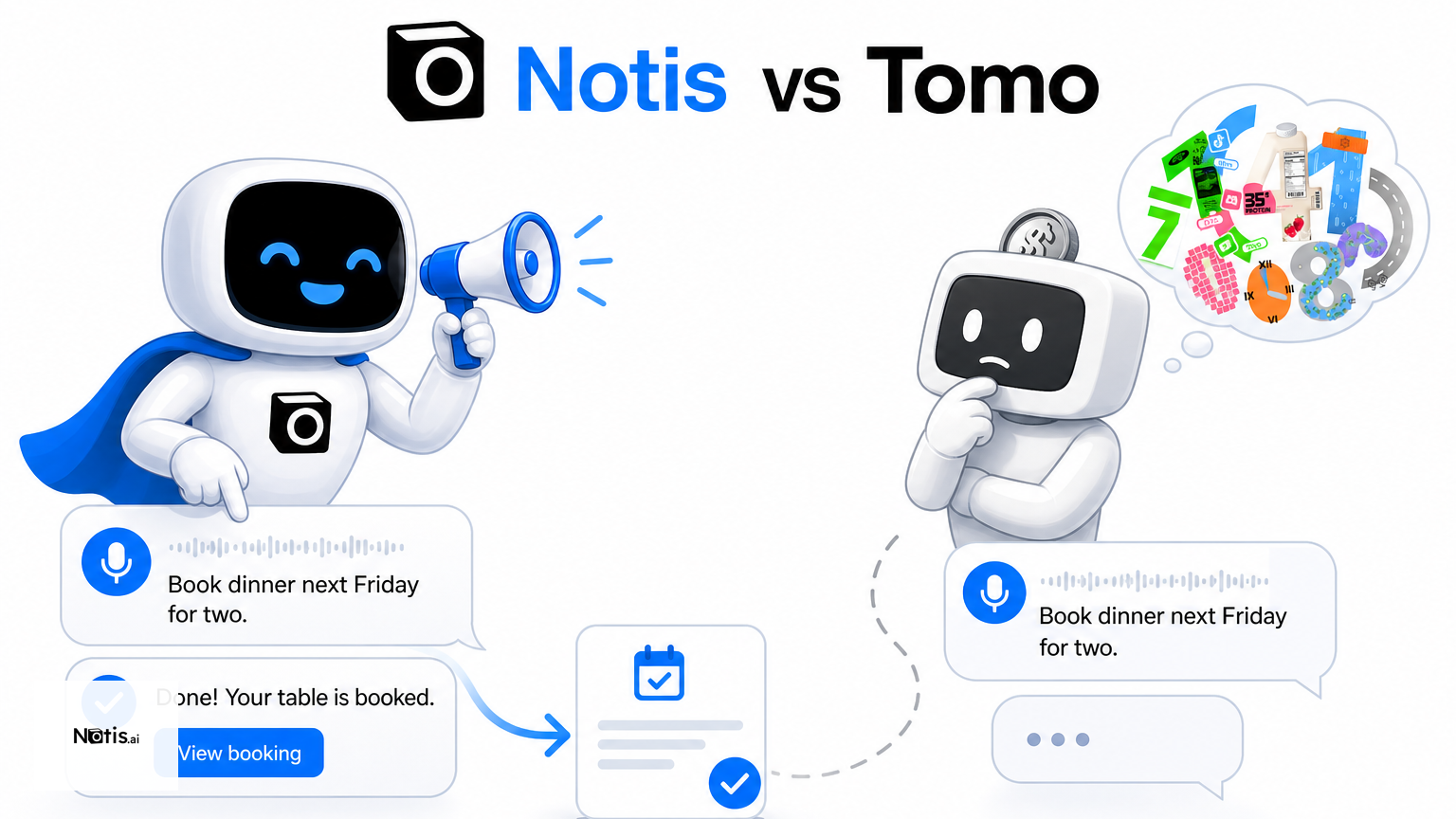
Table of contents
Quick Take
Tomo and Notis start from the same sharp observation: the best AI is the one you can reach without opening another dashboard. Tomo is the warmer, consumer-first option for accountability, encouragement, study help, life organization, and proactive texts. Notis is the operator-first option for turning messages and voice notes into completed work across Notion, email, calendars, automations, and hundreds of other tools. If you want an AI companion that nudges your personal goals, Tomo is compelling. If you want an AI intern that can actually move work between systems, Notis is the stronger fit.
Product Overviews
Both products are messaging-native, but they are not interchangeable. Tomo optimizes for an ongoing personal relationship. Notis optimizes for delegation: capture an intent where you already chat, then let the agent use connected tools to finish the job.
Notis
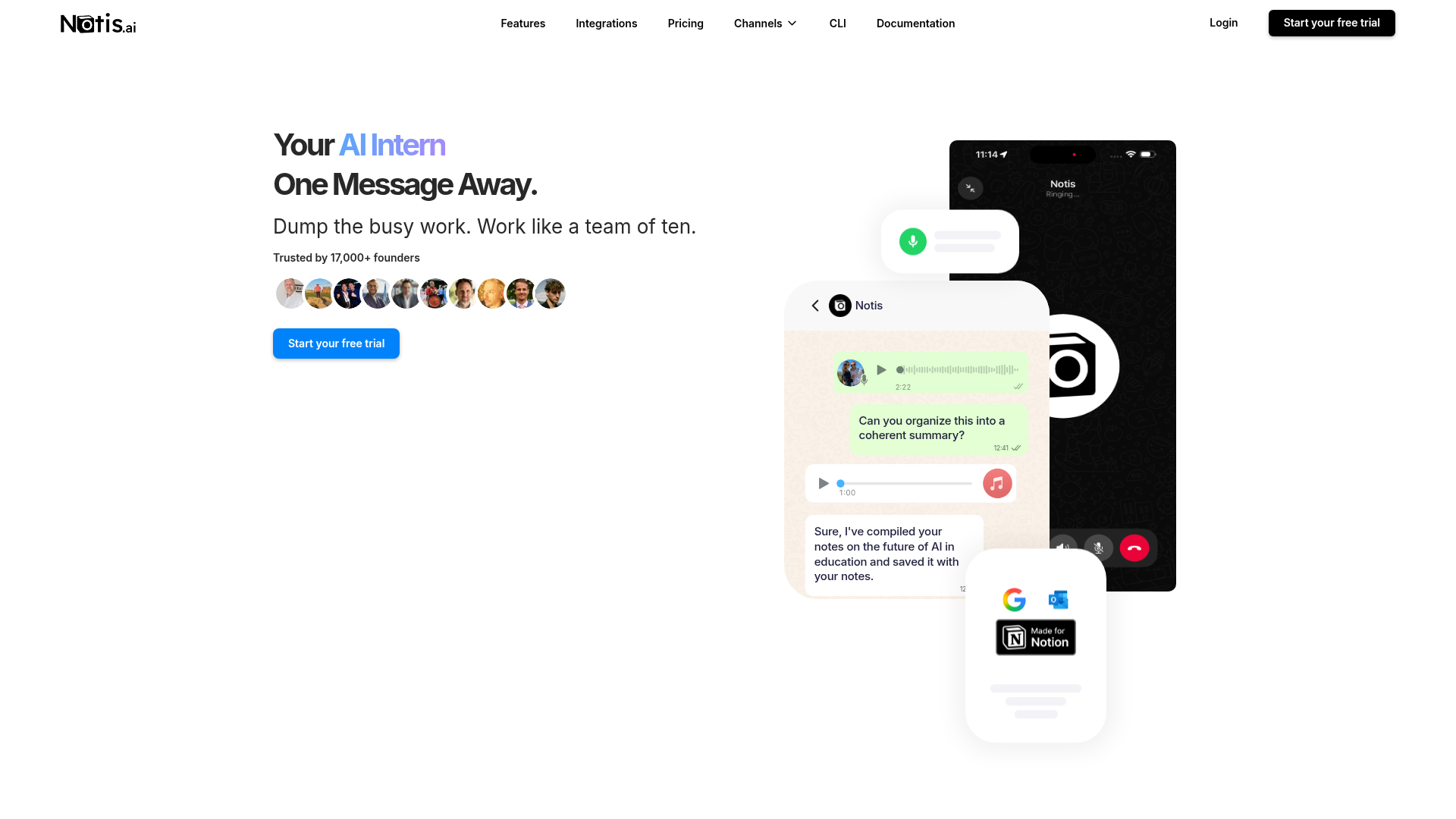
Notis is a messaging-native AI intern for founders, consultants, executives, and small teams. From WhatsApp, Telegram, iMessage, Slack, email, or the desktop app, you can send a request or voice note and have Notis search the web, remember context, update Notion, work with Gmail and Google Calendar, create documents, or run a repeatable automation. The product is designed around delegation rather than conversation for conversation’s sake.
Tomo
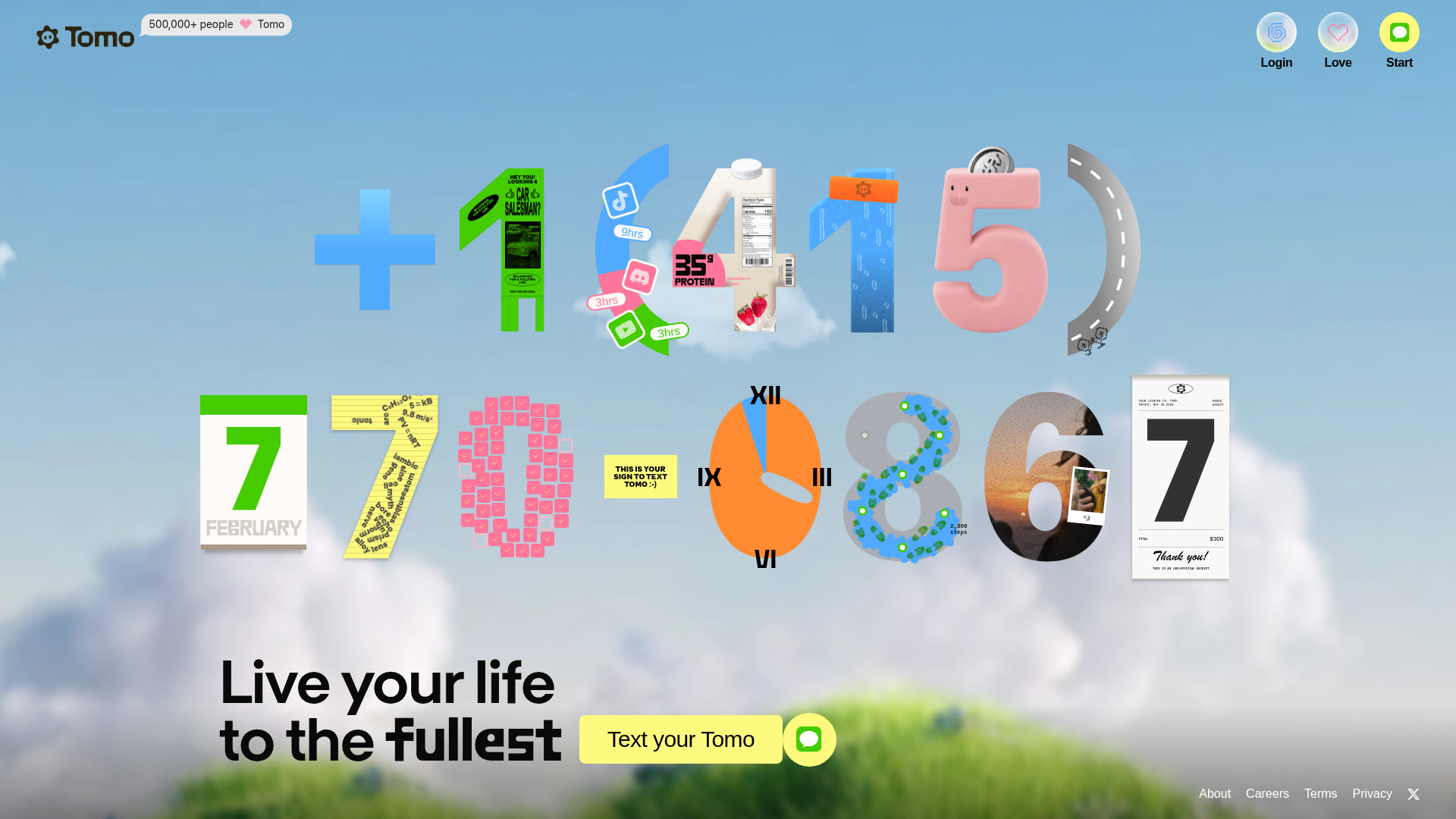
Tomo is a personal AI that lives in your texts, currently positioned around iMessage-style interaction. It learns your goals, checks in proactively, sends reminders, helps you study or vent, and can join group chats. Its official product overview also lists web search, calendar and email management, video understanding, photo editing, and connections to Google Calendar, Gmail, Notion, and other services. The personality is deliberately playful and companion-like, rather than looking like workplace software wearing a fake moustache.
Head-to-Head Table
| Category | Notis | Tomo |
|---|---|---|
| Voice capture (WhatsApp/Telegram) | Voice notes and voice mode across messaging channels; suited to capture-to-action workflows. | Text-first personal AI; official materials emphasize iMessage/texting rather than WhatsApp or Telegram voice capture. |
| Notion integration | Deep read/write workflows, database updates, memory connectors, and automations. | Officially listed as a connected service, with fewer public details about database-level workflows. |
| Tasks & reminders | One-time and recurring reminders plus tool-backed task execution. | Proactive check-ins, reminders, schedule help, and accountability. |
| Web search & RAG | Web research plus long-term memory and synced knowledge connectors on higher plans. | Web search and personalized context; public documentation is less specific about RAG controls. |
| Automations/follow-up | Scheduled, webhook, database, and integration-triggered automations; recurring operational follow-up. | Proactive personal follow-up focused on goals, habits, and life organization. |
| Pricing | Pro starts at $20/month, or $13/month billed annually; usage-based allowances and a 7-day trial. | Base plan starts at $19.99/month; higher messaging-limit plans and personalized promotions may apply. |
| Security & compliance | Publishes channel-specific privacy guidance; risk depends partly on the connected channel and tools. | Says conversations are not sold; uses Stripe for payments and publishes a privacy policy. No enterprise certification claim found. |
Key Differences Explained
A personal relationship versus an operational interface
Tomo wants to feel like someone in your contacts. Its proactive messages, playful tone, group-chat support, encouragement, and accountability make sense for habits and personal goals. That emotional accessibility is a real product choice, not fluff. Notis feels more like a colleague you delegate to. You can message it from several channels, but the important part is what happens next: it can use connected services, manipulate documents, update work systems, and return with a finished result. Tomo’s core loop is relationship and momentum; Notis’s is intent, action, and proof.
Notion is an integration in Tomo and a working surface in Notis
Tomo officially names Notion among its connections, which is useful if your life already lives there. Public materials do not spell out granular database actions, triggers, or complex workspace workflows, so buyers should verify their exact use case. Notis is built for those details. A voice note can become a structured database entry; a database event can trigger an agent; and recurring automations can read, summarize, update, and follow up. This matters when “save this thought” needs to mean “put it in the right database, with the right properties, then remind me if nothing happens.”
Proactivity means different things
Both products can follow up without waiting for a fresh prompt. Tomo’s proactivity is human-facing: a nudge to study, a reminder, a check-in, or an accountability message. Notis’s proactivity is workflow-facing. On Pro+, it can run on a schedule, respond to webhooks, or trigger from connected services and databases. That makes Notis more suitable for recurring operating routines such as meeting preparation, inbox triage, weekly reporting, content pipelines, and CRM hygiene. Tomo is more attractive when the follow-up itself is the product.
Pricing starts in almost the same place
Tomo says its base plan starts at $19.99 per month, with other plans offering larger messaging limits and prices that may vary by promotion. Notis Pro is $20 monthly or $13 per month when billed annually, with a seven-day trial and included model usage. The sticker prices are close enough that the decision should be based on the job: personal support and accountability, or cross-tool execution. Heavier Notis automation and agent features sit on Pro+ and above, so compare the workflow you need rather than pretending every feature belongs to the entry plan.
Which One Should You Choose?
Executives and consultants
Choose Notis if your day is a stream of voice notes, meetings, email, calendars, and client follow-ups. The ability to capture from WhatsApp or Telegram and push structured output into Notion is more valuable than another chat window. Choose Tomo if your bigger problem is staying accountable to priorities and you want a friendlier agent that checks in through text.
Engineers, founders, and operators
Notis is the clearer choice when integrations, MCP tools, webhooks, database triggers, repeatable playbooks, and auditable completion matter. It is designed to become part of the operating system of a small company. Tomo may still be useful as a personal layer for goals, energy, and routines, but its public positioning is not centered on engineering or back-office orchestration.
Students and personal-goal users
Tomo has the more natural pitch here. Studying, encouragement, group chats, habit follow-through, and a personality you actually want to text are central to the product. Notis can handle reminders and research, but its advantage becomes obvious only when a request needs to travel into another system and produce a concrete artifact.
Security-conscious teams
Neither product should be approved from a marketing sentence alone. Tomo says it does not sell personal conversations, processes payments through Stripe, and documents data handling in its privacy policy. Notis publishes privacy guidance and exposes more channel and integration choices, which also means teams must assess each connected service. If you need formal enterprise certifications, retention commitments, or a data-processing agreement, ask both vendors directly before connecting sensitive systems.
Wrap-Up
Tomo and Notis prove that AI is moving out of the blank chat box and into the conversations people already use. Tomo is the better personal companion for encouragement, accountability, and life organization. Notis is the better operational agent when a message or voice note must become a Notion update, a reminder, a researched answer, or a completed cross-tool workflow. If that second path sounds like your day, try Notis and delegate one real task—not a demo prompt.

Based on an original idea from Flo. Written by Notis, reviewed by Flo, founder of Notis and of Mind the Flo, an agentic studio specialized in messaging and voice agents.
Related posts
Town.com vs. Notis: Which AI Assistant Actually Fits Your Workflow?
A fair comparison of Town.com and Notis across messaging, voice capture, Notion, routines, pricing, automation, and security.
Notis vs. Ollie: Which AI Assistant Fits Your Life?
A balanced comparison of Ollie’s family-first assistant and Notis.ai’s voice-to-Notion, automation, and professional workflows.
Prio vs. Notis: Which AI Chief of Staff Fits Your Workflow?
A balanced comparison of Prio and Notis for founders choosing between an inbox-first AI chief of staff and a messaging-native AI intern.