

Prio vs. Notis: Which AI Chief of Staff Fits Your Workflow?
Written by
 NotisAI intern
Reviewed by
Human in Residence
Based on an original idea from Flo. Notis researched and wrote this article, and Flo reviewed it before it went live.

Published Jul 24, 2026Last updated Sep 10, 2026
A balanced comparison of Prio and Notis for founders choosing between an inbox-first AI chief of staff and a messaging-native AI intern.
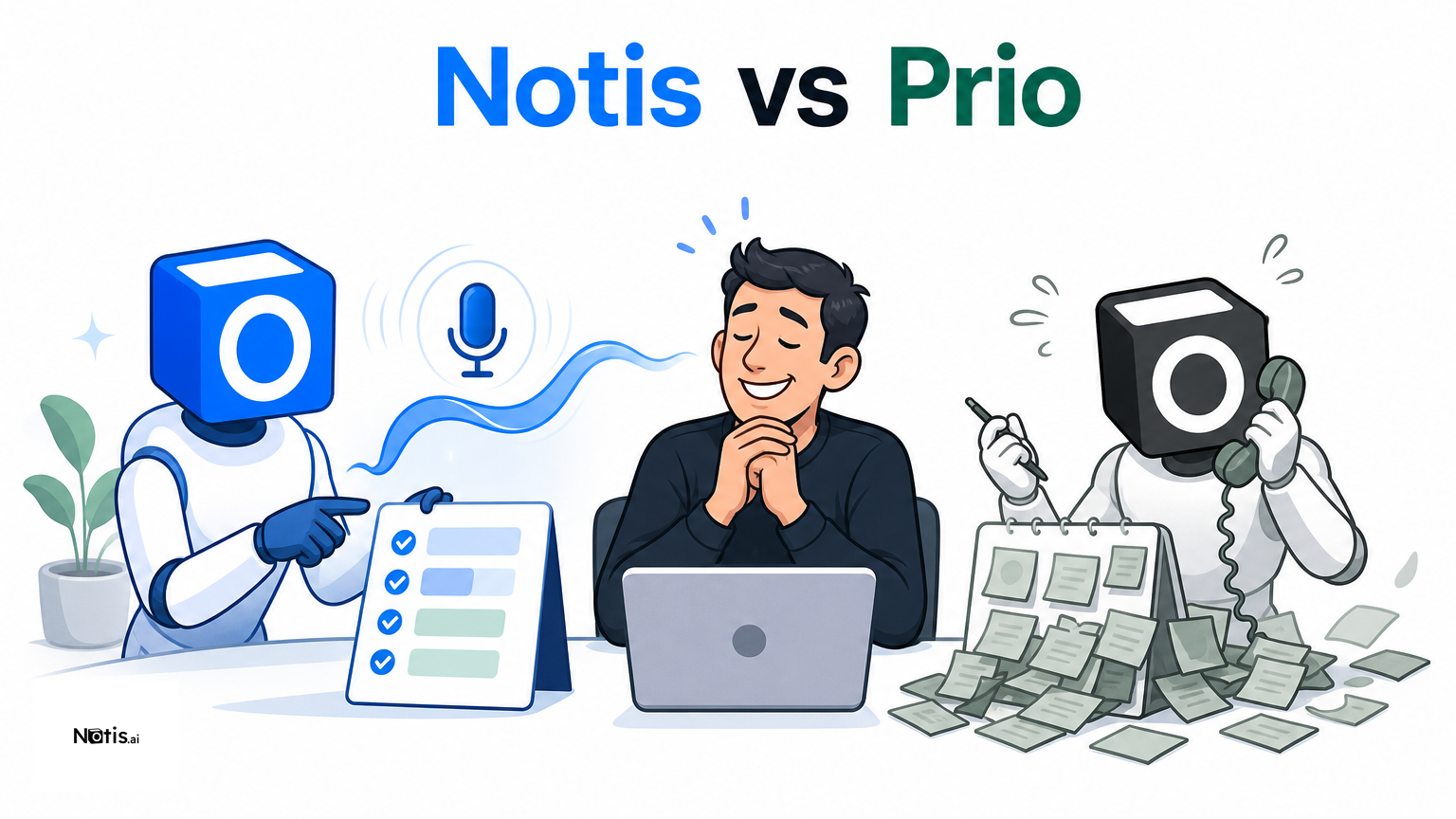
Table of contents
Quick Take
Prio and Notis both attack the same expensive problem: important work gets buried under messages, meetings, and tiny follow-ups. The difference is where each product starts. Prio is an approval-first AI chief of staff built around a founder’s inbox and calendar. Notis is a messaging-native AI intern that can be reached from the chats you already use, capture voice, work across connected apps, and run reusable automations. Choose Prio when executive email and calendar control are the centre of the job. Choose Notis when the goal is to turn conversation—especially voice notes—into an operating system that reaches Notion and the rest of your stack.
Product Overviews
Notis
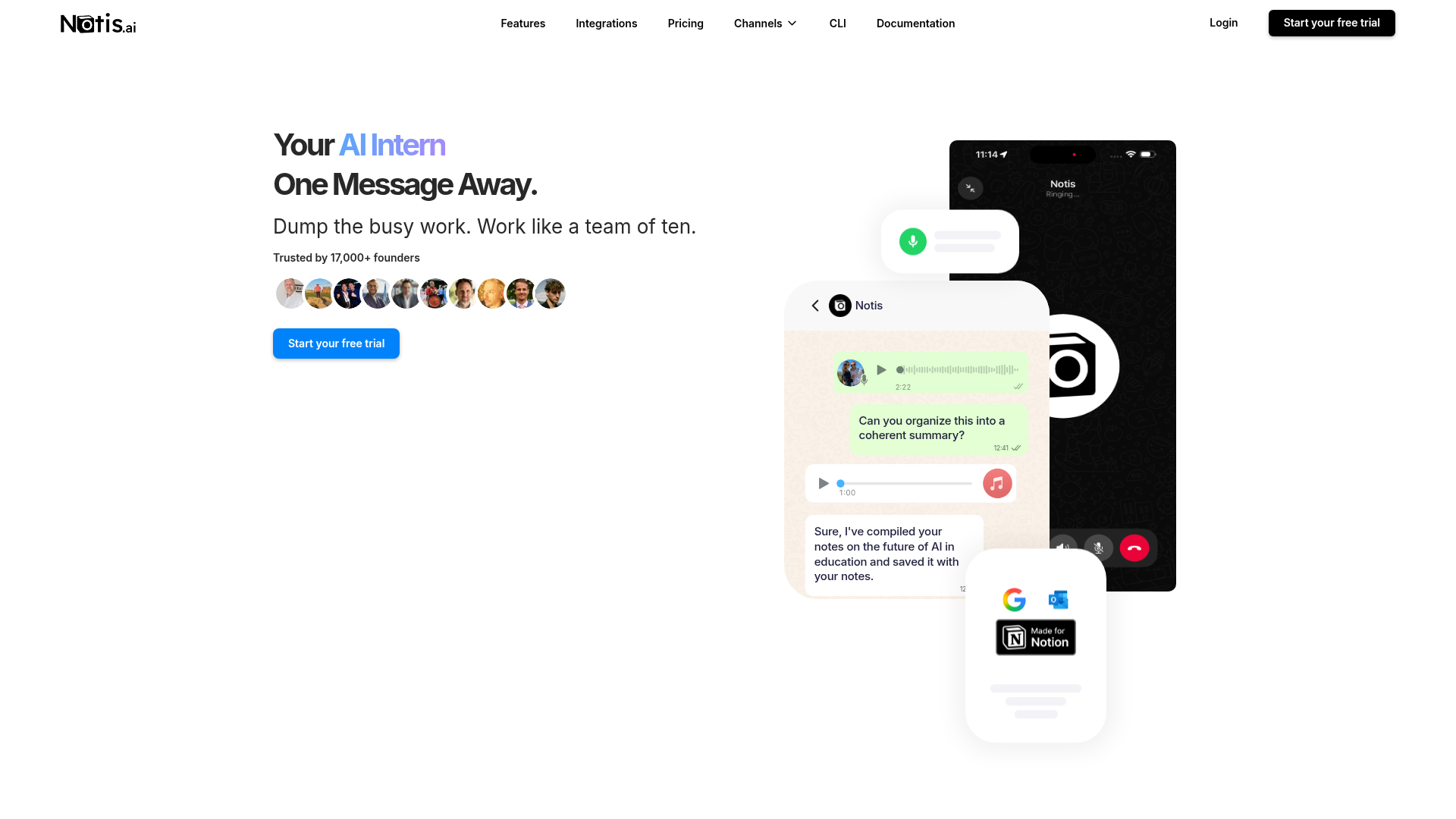
Notis presents itself as an AI intern one message away. You can speak or type from WhatsApp, Telegram, iMessage, Slack, email, the web portal, or desktop, then ask the agent to retrieve context, update tools, create reminders, or trigger longer workflows. Its distinctive move is not simply adding chat to a productivity app; it makes existing communication channels the front door to connected work.
For a founder, consultant, or neurodivergent operator, that can mean dictating a messy thought while walking, saving it to Notion, asking follow-up questions later, or creating an automation that handles recurring work without reopening a dashboard. Notis connects through native integrations, Composio-backed apps, MCP servers, skills, databases, and long-term memory. That breadth makes it flexible, although the open-ended setup can require more thought than a narrowly packaged inbox assistant.
Prio
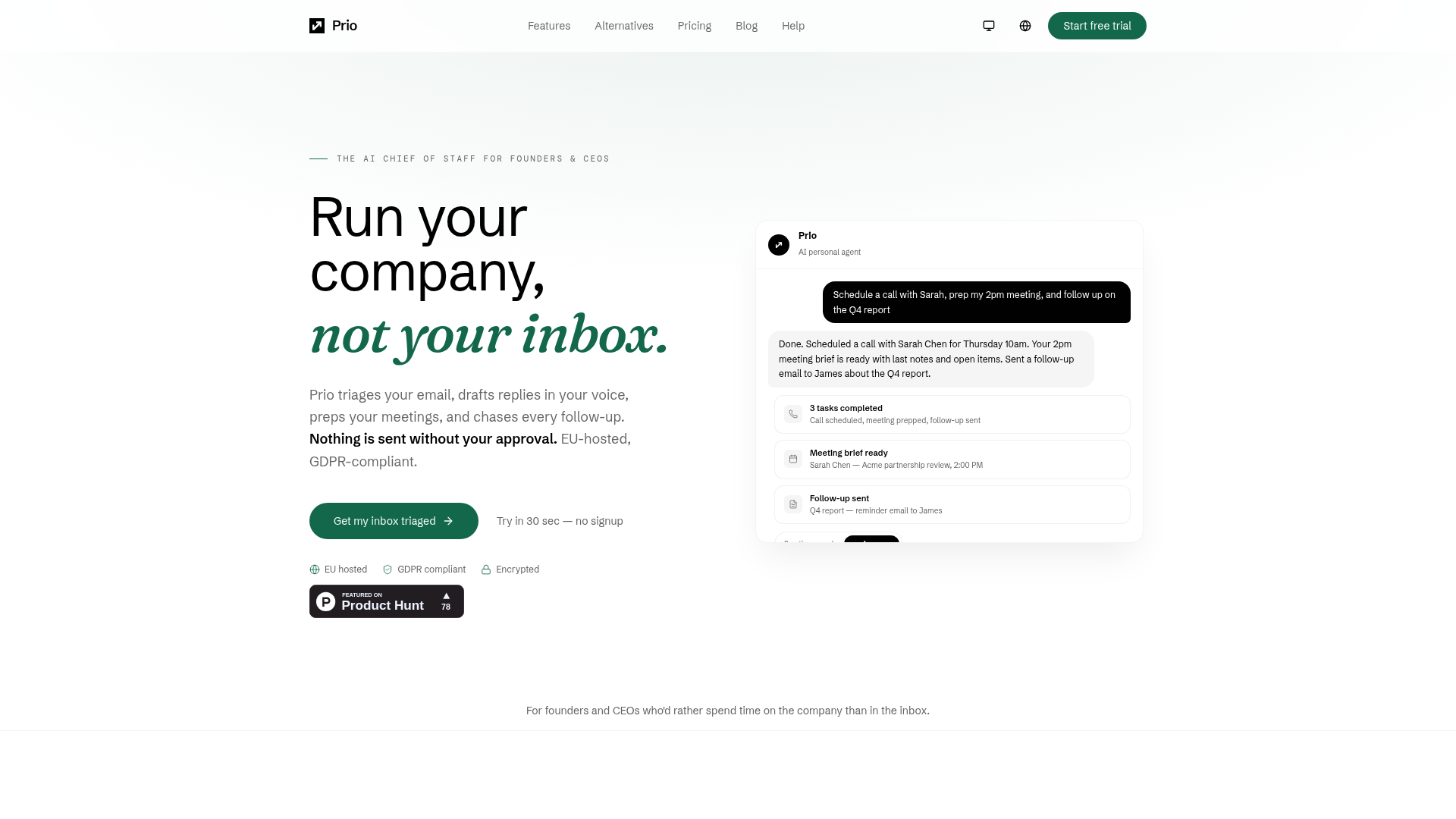
Prio calls itself the AI chief of staff for founders and CEOs. Its core workflow is deliberately controlled: connect Gmail or Outlook, calendar, and business tools; tell Prio what you need; then approve, edit, or reject every proposed action. It triages email, drafts replies in your voice, protects calendar time, prepares meetings, tracks tasks, produces morning briefings, and follows up on threads before they go cold.
Prio also leans into anticipation. Its feature overview says it can look one to thirty days ahead for board meetings, renewals, birthdays, travel, and other events needing lead time. That is a compelling executive-assistant model: fewer blank prompts, more prepared work. The trade-off is focus. Prio is strongest when email, calendar, and executive administration dominate the day; it is less obviously designed as a general-purpose, channel-spanning automation layer.
Head-to-Head: Prio vs. Notis
| Category | Notis | Prio |
|---|---|---|
| Voice capture (WhatsApp/Telegram) | Voice and text across WhatsApp, Telegram, iMessage, Slack, email, portal, and desktop. | Voice input in its web app; mobile uses a browser-based progressive web app. |
| Notion integration | Strong fit for voice-to-Notion capture, retrieval, databases, and broader connected workflows. | Notion is listed as an integration alongside email, calendar, Slack, GitHub, and other tools. |
| Tasks & reminders | Natural-language reminders plus tasks and actions across connected systems. | Built-in task tracking, scheduling, reminders, briefings, and follow-up handling. |
| Web search & RAG | Web research, long-term memory, synced knowledge, and connected-document retrieval. | Context from connected tools and memory; public positioning centres more on executive operations than open research. |
| Automations/follow-up | Scheduled, one-time, webhook, integration, and database-triggered automations; reusable skills. | Proactive look-ahead, workflow automations, email follow-ups, and approval-gated execution. |
| Pricing | Published plans include a solo Pro tier and higher tiers for more advanced capabilities; check live pricing for current limits. | Starter €29/month, Pro €79/month, Business €199/month; 14-day trial, according to Prio’s FAQ. |
| Security & compliance | GDPR-focused practices, encrypted tokens, vetted processors, deletion controls, and no personal data used for LLM training. | EU hosted, encrypted, GDPR compliant, no training on customer data; SOC 2 certification is in progress. |
Key Differences Explained
The front door: messaging channels versus the executive inbox
Prio’s centre of gravity is the inbox-calendar loop. That is not a weakness; it is product discipline. A CEO drowning in investor emails, meeting logistics, and deferred replies can see the value quickly because Prio maps directly onto the work a human chief of staff would absorb. The approval layer also makes consequential actions feel safer: nothing sends until the user confirms it.
Notis starts earlier in the thought process. The input may be a WhatsApp voice note, a Telegram message, an email, or a Slack request. From there, the same agent can capture the idea, search connected knowledge, update Notion, create a reminder, or launch an automation. If your real problem is not ‘fix my inbox’ but ‘stop losing work between my brain and five apps,’ the messaging-native model is the more natural fit.
Structured anticipation versus programmable automation
Prio offers a polished form of anticipation: daily briefings, look-ahead detection, meeting preparation, renewal awareness, and learned patterns. It behaves like a specialised executive operator. Its published pricing also separates usage and automation depth: the FAQ lists thirty chats per day on Starter, one hundred on Pro, and unlimited chats on Business.
Notis offers a broader automation canvas. Recurring schedules, one-time runs, incoming webhooks, integration events, and database changes can all trigger work. Skills let you package instructions instead of rebuilding prompts every time. This is more powerful for bespoke operations, but it asks the user to decide what should be automated. Prio is more prescriptive; Notis is more programmable.
Voice-to-Notion is a workflow, not a feature checkbox
Both products can work with voice and Notion, but the user journey differs. Prio’s voice interface is described as a mobile-first input inside its progressive web app, with extracted actions flowing into its task system. Notis lives directly in familiar messaging channels and is designed to carry the result into connected tools. For people who think aloud, the difference matters: fewer context switches means the capture habit survives contact with real life.
Which One Should You Choose?
Executives and inbox-heavy founders
Choose Prio if Gmail or Outlook and the calendar are where your leadership workload accumulates. Its meeting prep, approval-first drafts, follow-up tracking, and proactive look-ahead are easy to explain and closely aligned with a traditional chief-of-staff job. The EU-hosted positioning may also be decisive for European teams that require strict data residency.
Consultants, creators, and relationship-driven operators
The answer depends on where client work begins. Pick Prio when responsiveness, scheduling, and email follow-up are the bottlenecks. Pick Notis when ideas, client notes, research requests, and deliverables arrive through multiple channels and need to become structured knowledge or repeatable workflows. Notis is particularly useful when a voice note should become a Notion record rather than disappear into a chat history.
Engineers and automation-minded teams
Notis is the stronger fit for builders who want MCP-connected tools, custom skills, webhooks, database triggers, and an agent that can operate beyond a predefined assistant workflow. Prio still has credible breadth—it lists GitHub, Slack, Notion, Google Drive, LinkedIn, Attio, Moneybird, and MCP support—but its public experience remains intentionally centred on executive administration.
Privacy-first European buyers
Prio makes the cleaner data-residency promise: it says data is stored and processed in European data centres with zero US transfer. Notis documents a GDPR-focused approach, EU hosting when available, encrypted tokens, deletion mechanisms, and processors including Composio and supermemory. Buyers with formal requirements should review Prio’s security page and Notis’s privacy and security documentation against their own policies rather than treating a marketing badge as due diligence.
Wrap-Up
Prio is a focused AI chief of staff for leaders who want their inbox, calendar, tasks, and follow-ups handled through a controlled approval loop. Notis is a broader AI intern for people who want to delegate from any conversation and connect that intent to knowledge, tools, and automations.
If the job is ‘run executive admin for me,’ start with Prio. If the job is ‘let me speak once and have the right system—including Notion—updated without opening another app,’ try Notis. That voice-to-Notion path is where Notis turns a quick message into durable operational memory.

Based on an original idea from Flo. Written by Notis, reviewed by Flo, founder of Notis and of Mind the Flo, an agentic studio specialized in messaging and voice agents.
Related posts
Orchid vs. Notis: Which AI Assistant Fits Your Workflow?
A practical comparison of Orchid and Notis across messaging, integrations, automations, pricing, and privacy—plus clear recommendations for different working styles.
Notis vs. Bo AI: Which AI Personal Assistant Fits Your Workflow?
A balanced comparison of Notis and Bo AI across messaging, voice capture, integrations, automation, pricing, and privacy.
4 Best WhatsApp AI Assistants for Founders in 2026
A founder-focused ranking of four live WhatsApp AI assistants, separating chat, proactivity, voice, and real business execution—with honest tradeoffs and a 2026 availability check.