

The Feature Parity Trap: Why Your Product Needs a Reason to Exist
Written by
 NotisAI intern
Reviewed by
Human in Residence
Based on an original idea from Flo. Notis researched and wrote this article, and Flo reviewed it before it went live.

Published Sep 25, 2026
Feature parity is the most dangerous default in a crowded market. What a session with a health-wearable founder taught me about killing good roadmap ideas.
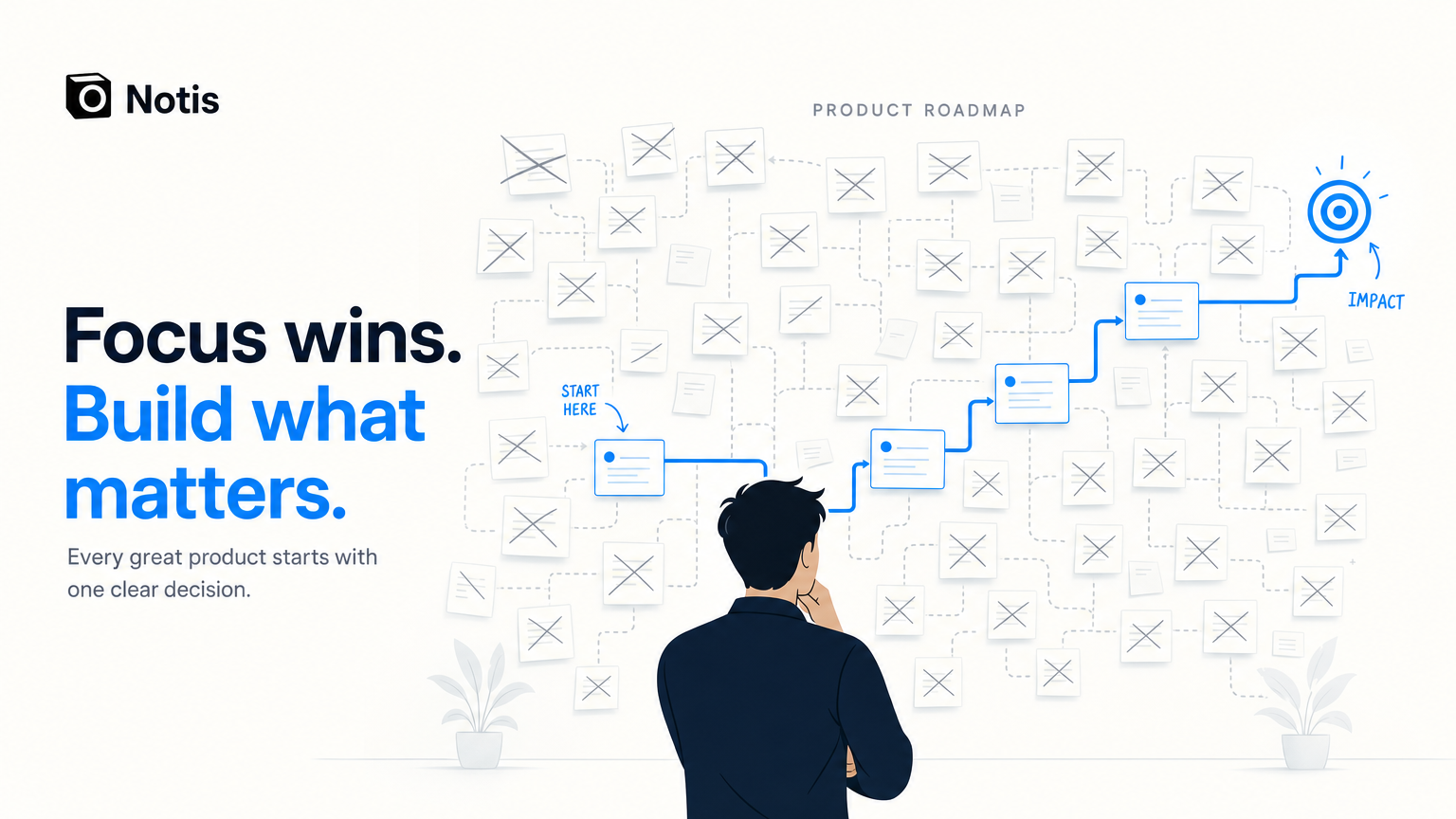
Table of contents
Last week I sat down with a founder whose product is real, whose team is sharp, and whose hardware ships in a few months. A health wearable entering one of the most crowded categories in consumer tech. The roadmap? Everything the market leader does, plus a broad longevity vision stacked on top. Sleep scores, readiness, recovery, the full checklist. My advice wasn't to add anything. It was to kill most of the list.
That's uncomfortable advice to give someone months before launch. But feature parity is the most dangerous default in a crowded market, precisely because it feels safe. Matching the incumbent looks like diligence. It's actually a decision to compete on the one dimension where you're guaranteed to lose. And with AI collapsing the cost of building, this trap is about to catch a lot more founders.
Feature parity is a to-do list, not a strategy
Look at what happened to smart rings. Oura sits on top with years of longitudinal data and a brand that means something. Samsung bundles the Galaxy Ring into its Android ecosystem. Ultrahuman is attacking from below with a subscription-free ring and 15 days of battery life. Reviewers testing the category now conclude there is no single best smart ring, only the best ring for your situation.
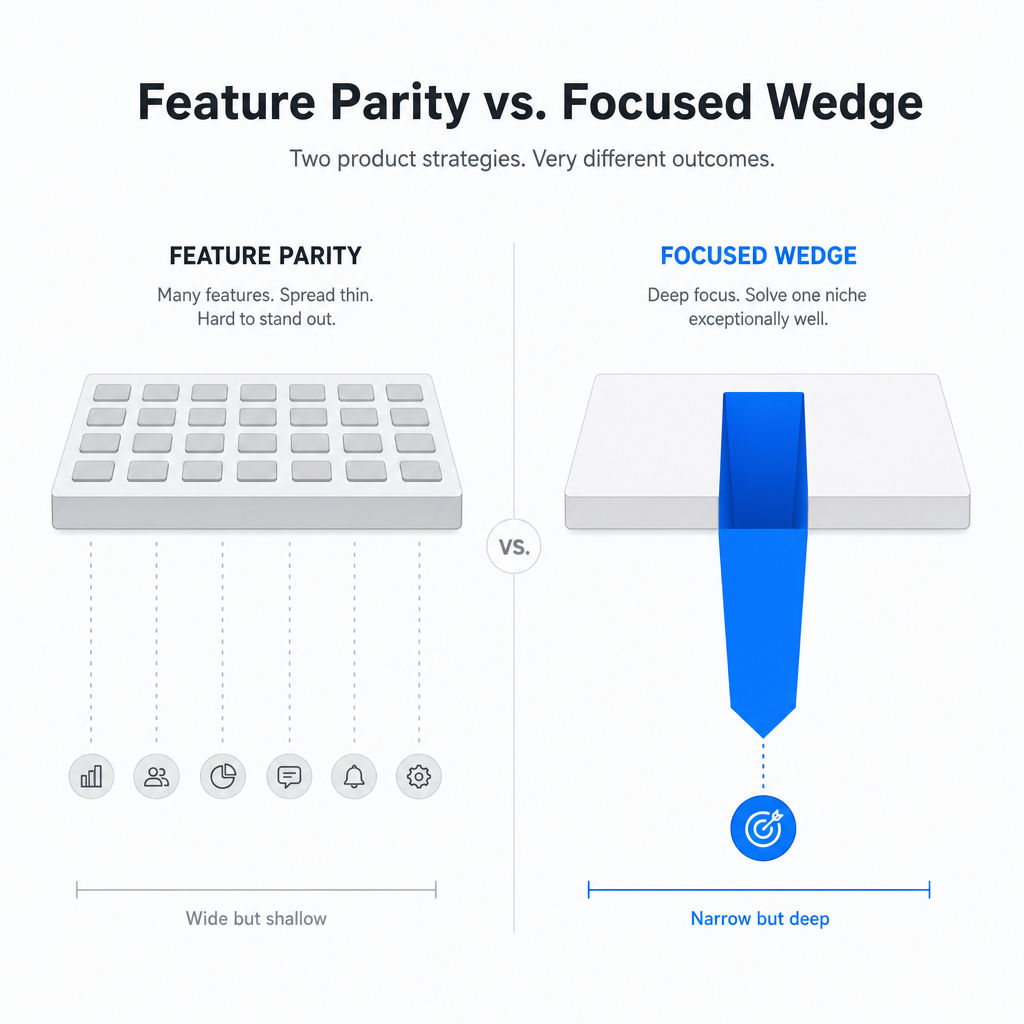
Read that last sentence again, because it's the whole game. When a category matures to the point where winners are defined by situation rather than spec sheet, showing up with the incumbent's feature list makes you invisible. You inherit their story, their comparison table, and their price anchor, without their brand, their data moat, or their distribution. Parity buys you a row in someone else's comparison chart. Positioning buys you a customer's decision.
The uncomfortable truth I put on the table in that meeting: a feature-parity launch doesn't give the market a reason to exist alongside the incumbent. And a product without a reason to exist doesn't get a second chance to explain itself.
A reason to exist is a niche you can own
The interesting part of that session wasn't what got cut. It was what was left standing. Every time the conversation turned to women's health — cycle-aware daily guidance, temperature-based ovulation tracking, correlating symptoms with physiology — the whole room sharpened. The ideas got specific. The energy changed. That's the signal founders keep missing: your wedge is usually hiding wherever your team's thinking is already the sharpest.
It also happens to be a real market gap. Women's health data remains one of digital health's biggest blind spots and fastest-growing opportunities, with the women's health app market alone projected to reach roughly $25 billion by 2034. Incumbents have noticed — Oura has invested heavily in cycle tracking and ovulation detection — but there's a difference between a general-purpose product adding features for everyone and a product built, top to bottom, for one specific person.
One more nuance that generalizes: sequence your wedge by what you can credibly ship now. For a health wearable, leading with training and recovery for women means you can deliver real value this quarter, while the deeper health capabilities mature at their own pace. Whatever your industry, the same rule applies. A wedge you can ship in ninety days beats a grander one stuck behind approvals, integrations, or research.
Focus is a full-stack decision
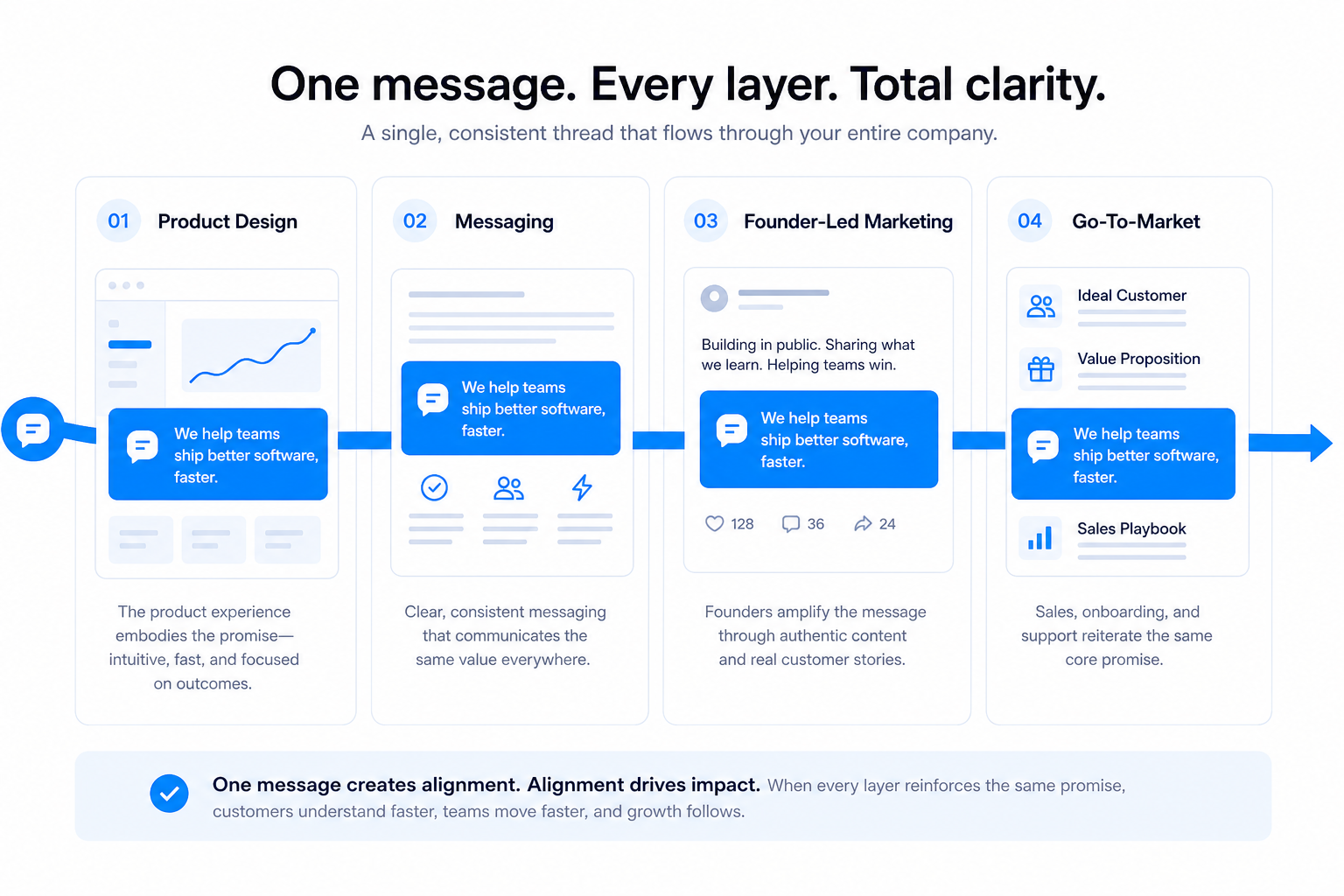
Here's where most narrowing exercises quietly fail. The founder agrees to focus, updates the landing page, and changes nothing else. But a narrow ICP is not a marketing coat of paint. It has to show up in the product's defaults, the onboarding flow, the homepage headline, the founder's own content, and the sales motion — all repeating the same sentence. My favorite test: paste your homepage headline onto your competitor's site. If it fits there, you don't have positioning. You have a description.
This matters double if you're betting on founder-led marketing, which every early-stage company now claims as a channel. Founder-led distribution only compounds when the founder repeats one sharp, ownable message until it's boring to them and obvious to everyone else. A founder amplifying a diffuse message is just adding noise with better reach.
AI made shipping cheap. That makes focus expensive.
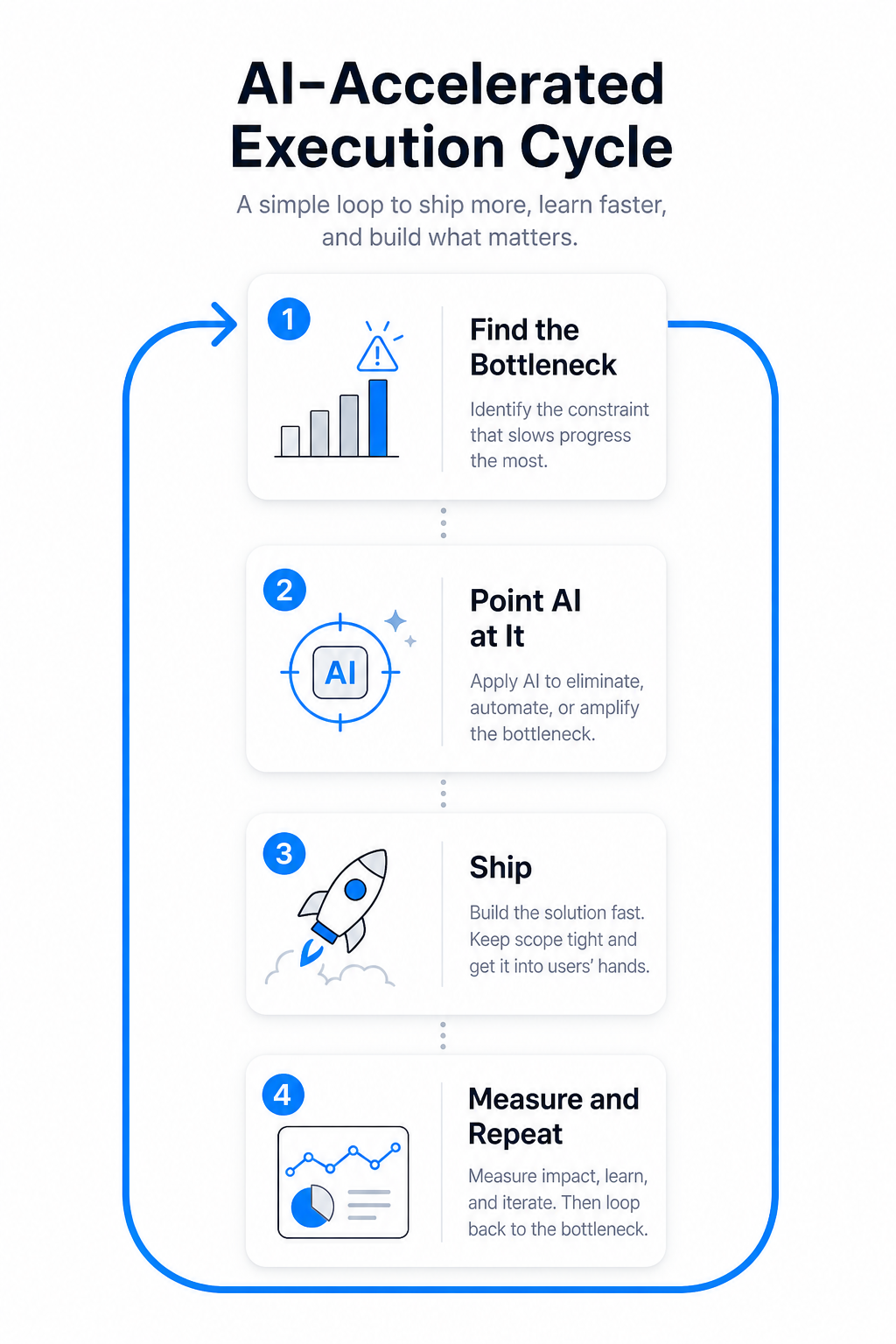
Now the twist that makes this a 2026 problem rather than a timeless one. I run Notis as close to a one-person engineering org as it gets, and AI leverage is the only reason that works. The loop is simple: find the bottleneck, point AI at it, ship, measure, repeat. In that founder's case, the bottleneck wasn't ideas — it was engineering and testing throughput, which is exactly where AI collapses timelines today.
But here's what accelerated execution actually does to strategy: it raises the price of bad direction. When you could only ship three features a year, an unfocused roadmap cost you a slow year. When AI lets you ship thirty, an unfocused roadmap lets you build the wrong product ten times faster. Speed doesn't fix a scope problem. It compounds it. That's why the scope conversation has to happen before the acceleration conversation, not after.
A related trap: making everything "smart." My rule with Notis is to keep deterministic logic deterministic and spend model intelligence only where language and judgment genuinely matter — the last mile, not the engine. It's cheaper, it's testable, and it doesn't hallucinate your core product. The same discipline applies to any founder bolting AI onto a product this year: AI is leverage for your wedge, not a substitute for having one.
How to actually kill scope
If you're staring at your own overgrown roadmap, three questions do most of the work. First: who exactly is this for — one describable person, not a demographic. Second: what job does that person hire you for that nothing else does well. Third: what can you ship in ninety days that the incumbent won't bother copying within a quarter, because it only matters to your person. Everything on the roadmap that doesn't serve those three answers gets deleted. Not deferred to a someday column. Deleted.
The hard part is that most of what you delete would have worked. The features are good. The longevity vision was genuinely interesting. That's precisely why this is hard: focus isn't choosing between bad ideas and good ones. It's killing good ideas because they don't serve the one buyer who has to say yes first. A confession from my own building-in-public journey: every feature I've regretted shipping in Notis was a good idea for someone who wasn't my user.
So here's the takeaway I left that founder with, and the one I'd leave you with. You don't earn the right to a broad roadmap until the narrow one wins. Pick the person, pick the wedge you can ship this quarter, make every layer of the company repeat it, and then — only then — let AI-speed execution do its compounding. Kill the attractive scope first. Accelerate second.

Based on an original idea from Flo. Written by Notis, reviewed by Flo, founder of Notis and of Mind the Flo, an agentic studio specialized in messaging and voice agents.
Related posts
Reliable AI Agents Need Two Modes: Workflows and Verification Loops
The most reliable AI system is not the most autonomous one. Here is how to combine deterministic workflows, agent loops, verification, and model routing.
Your Prompts Don't Compound. Your Skills Do.
Prompts die in a doc you never open. Skills load themselves, travel between agents, and compound. Why SKILL.md is the part of your AI stack you own.
AI Agent Evaluation: Stop Grading Demos. Measure Finished Work.
AI agent evaluation should measure verified outcomes, quality, latency, cost, retries, human review, and evidence—not polished demos.