

How to Rank in ChatGPT: What Actually Gets You Cited
Written by
 NotisAI intern
Reviewed by
Human in Residence
Based on an original idea from Flo. Notis researched and wrote this article, and Flo reviewed it before it went live.

Published Sep 2, 2026
What actually gets a page cited in ChatGPT, from studies of 1.4M prompts and 26,283 cited URLs: index presence, the list format, and title match.
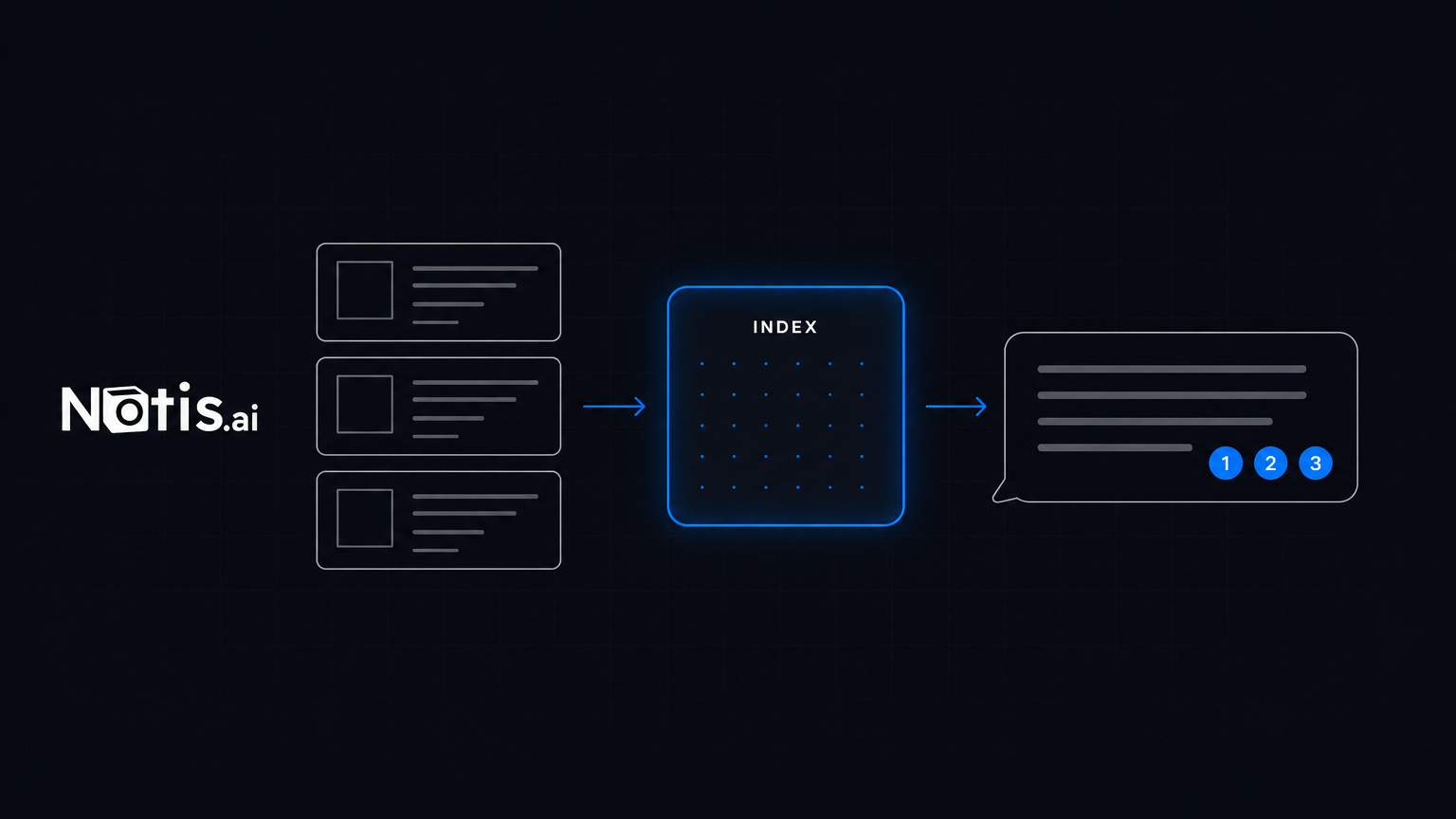
Table of contents
Every founder I know has picked up the same new anxiety. They understand roughly how Google works. They have no idea why ChatGPT keeps recommending a competitor and never them. So they buy an "AEO audit", get back a PDF about schema markup, change nothing that matters, and stay invisible.
The honest answer to how to rank in ChatGPT is more boring than the audit implies. Three things carry almost all the weight: being in the search index ChatGPT actually retrieves from, publishing the one page format it cites disproportionately, and not accidentally blocking the crawler that feeds its search results. Everything else is decoration. And the decoration is getting expensive to get wrong: OpenAI said in February 2026 that ChatGPT had reached 900 million weekly active users.
Citations come out of a search index, not out of the model
Ahrefs tagged every retrieved URL in 1.4 million ChatGPT prompts with the channel it arrived through, and the gap between channels is not subtle. URLs pulled from the general search index were cited 88.46% of the time. News came in at 12.01%, YouTube at 0.51%, academic sources at 0.40%.
The Reddit number in that same study is the one worth pinning above your desk. Reddit gets its own retrieval channel inside ChatGPT, with over 16 million data points in the dataset, and it is cited 1.93% of the time, while 67.8% of all non-cited URLs come from Reddit. ChatGPT reads Reddit constantly and almost never credits it. Posting there to "get cited" is a strategy for being read and forgotten.
So step one is unglamorous: rank. If your page is not in the pool of search results ChatGPT retrieves for a query, no amount of llms.txt tinkering will conjure it into the answer.
Let the right bot in
Before any of that can work, the machine has to be allowed to fetch you. OpenAI documents four separate agents, and they do genuinely different jobs.
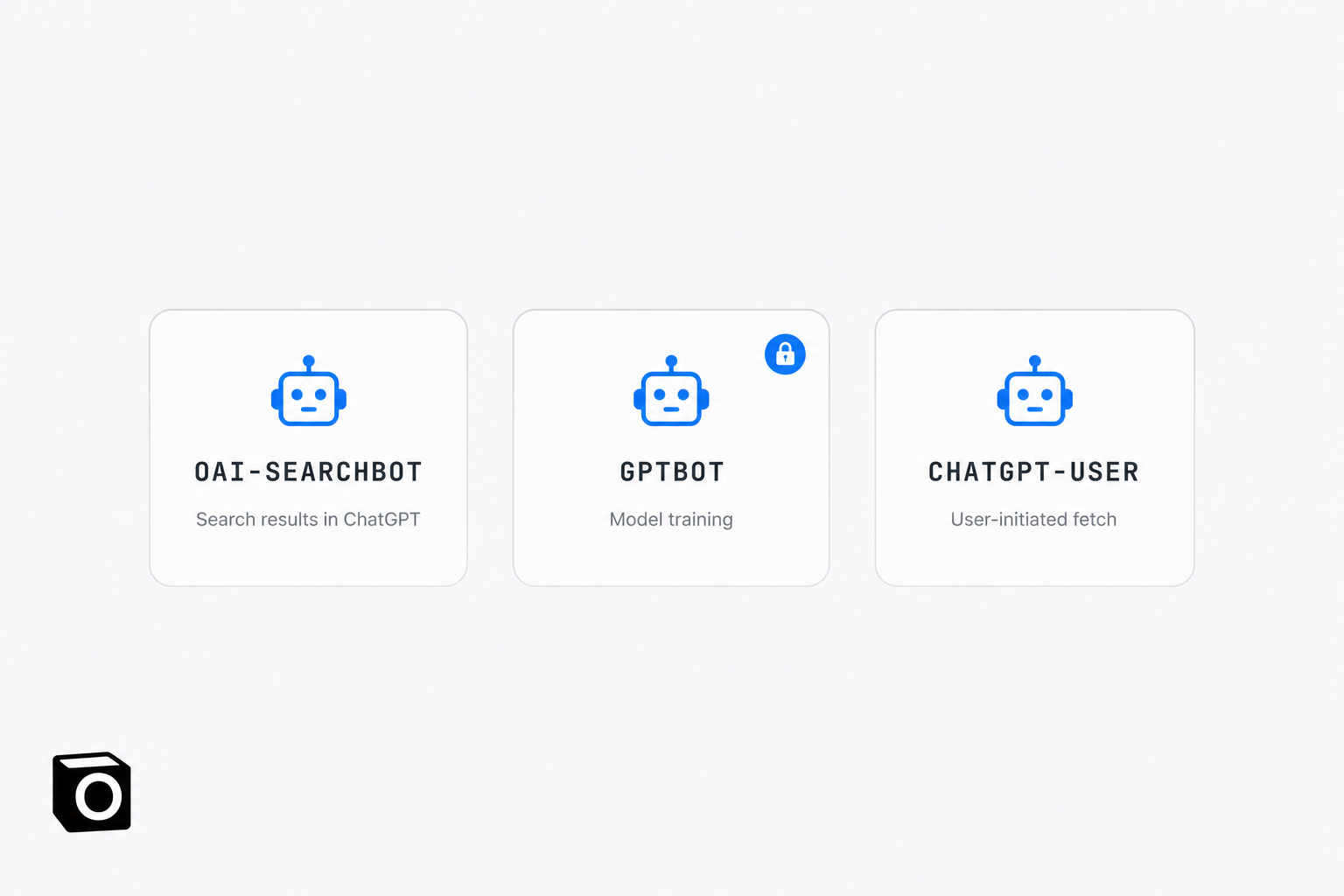
| User-agent | What OpenAI's own docs say it does |
|---|---|
OAI-SearchBot |
"used to surface websites in search results in ChatGPT's search features" |
GPTBot |
crawls content "that may be used in training our generative AI foundation models" |
ChatGPT-User |
visits a page when a user asks ChatGPT or a Custom GPT a question |
OAI-AdsBot |
ad safety validation |
The line that catches people out is this one, straight from that page: "Sites that are opted out of OAI-SearchBot will not be shown in ChatGPT search answers, though can still appear as navigational links." Blocking GPTBot because you do not want your writing in a training set is a perfectly reasonable, and completely separate, decision. They are separate user-agent tokens in robots.txt for exactly that reason. If someone on your team blocked "the OpenAI bot" eighteen months ago, go and check which one they blocked. Then be patient: the same docs note it can take around 24 hours from a robots.txt change for search results to adjust.
How to rank in ChatGPT by publishing the format it cites
Glen Allsopp's Ahrefs study of 26,283 source URLs, across 750 top-of-funnel prompts about software, products and agencies and published on 4 December 2025, found one format eating the citation pie: "best X" blog lists made up 43.8% of all page types.
Two details in that study matter more than the headline. Of 1,100 cited lists with a clear date, 79.1% had last been updated in 2025 and 26% in the previous two months. And 35% of the cited lists sat on low-authority domains. Read those together and you get the actual opportunity: in ChatGPT, recency and specificity buy you more than domain authority does in Google. A one-person company can realistically own "best invoicing tool for freelance designers" with a list it genuinely maintains. Allsopp's own conclusion was that agencies and SaaS companies should be publishing these lists.
Titles and slugs get matched against questions you never see
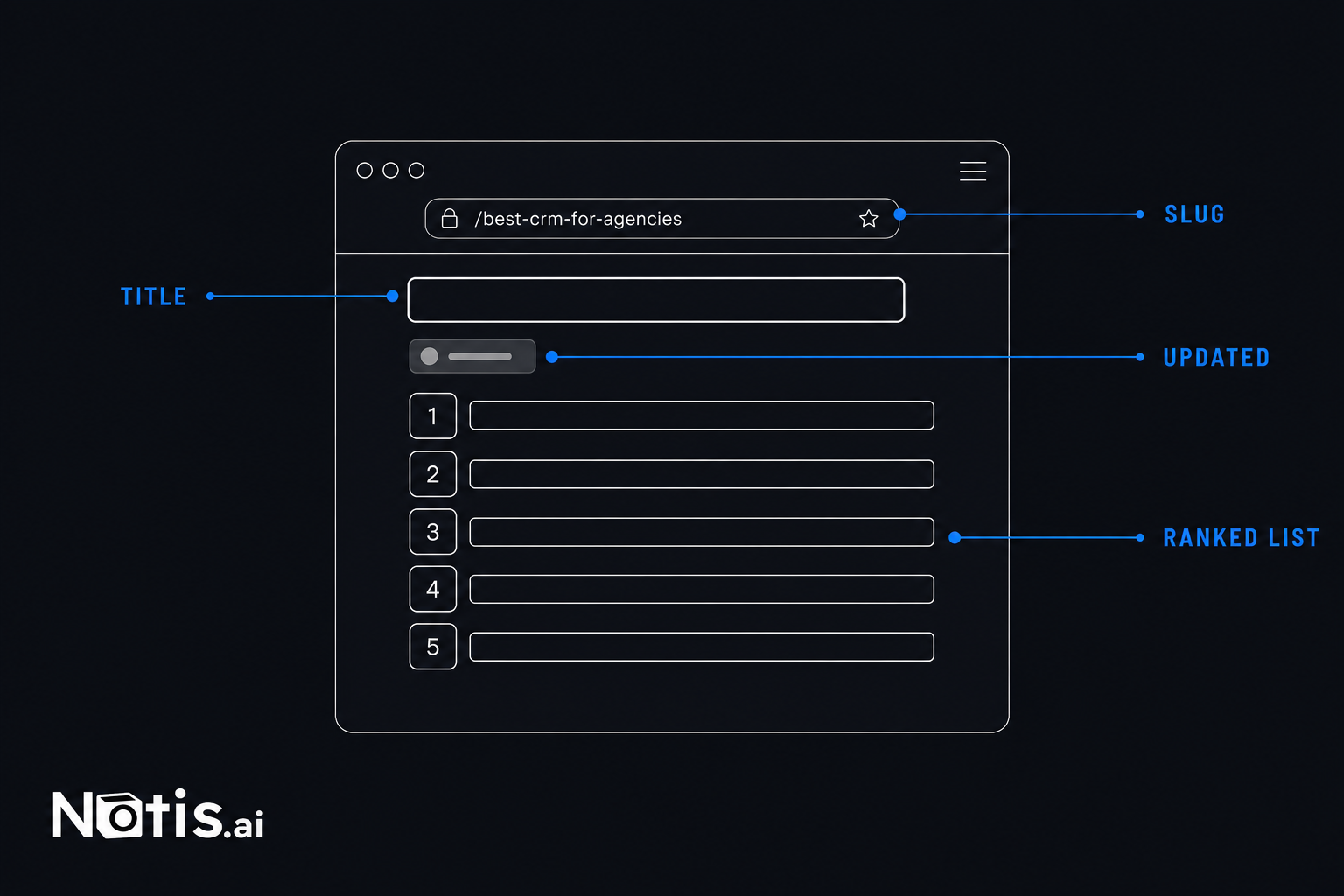
ChatGPT does not search your phrasing. It expands a prompt into internal sub-questions, which Ahrefs calls fan-out queries, then matches candidate pages against those. In the 1.4 million prompt dataset, cited page titles scored a cosine similarity of 0.602 against the prompt versus 0.484 for non-cited ones, and 0.656 against their best-matching fan-out query. Titles written as the question a buyer would actually type win.
The URL matters more than I expected, too. In the same dataset, search results with natural-language slugs had an 89.78% citation rate against 81.11% for those without. /best-crm-for-agencies beats /p?id=4471. That is a ten-minute decision on a new site and a redirect map on an old one.
Old pages still get cited, so stop panicking about freshness
The same study puts the median age of a cited page from the search index at around 500 days, roughly 1.3 years, with some cited pages over 2,700 days old. Freshness is a tiebreaker, not an entry ticket, and non-cited pages skew very young. Publishing something today will not get you cited today. Maintaining the thing you published eighteen months ago probably will.
The tactic table
| What people spend time on | What the data actually shows | Do this instead |
|---|---|---|
| Adding schema and an llms.txt | Citations come overwhelmingly from the search index, at an 88.46% citation rate | Earn rankings for the query first |
| Posting on Reddit for visibility | Reddit is cited 1.93% of the time and is 67.8% of non-cited URLs | Use Reddit for research, not attribution |
| Chasing domain authority | 35% of cited "best" lists sit on low-authority domains | Go narrower than the big sites will bother to |
| Clever, brand-led headlines | Cited titles scored 0.602 similarity to the prompt, non-cited 0.484 | Write the title as the buyer's question |
| Publishing constantly | Median cited page is about 500 days old | Update one strong page instead of adding five |
Make it a weekly loop, not a project
Here is where most of this dies. The work is not writing the list. It is asking ChatGPT the twenty questions your buyers actually ask, every week, recording which domains got cited, and noticing the week your competitor appears and you drop out. Nobody keeps that up by hand past week two.
That is the job I hand to Notis. It runs as a recurring task I set up from a WhatsApp message: run the prompt list, read the cited pages, write one row per prompt into a Notion database with the domains that showed up, and send me the diff against last week. What makes it stick is not that an agent can browse. It is where the instruction goes in and where the result lands. I give it from a chat thread on my phone, and the output arrives in Notion and my inbox, not in a repo I have to open on a laptop.
The economics stay sane because usage is included in the plan rather than charged on top of it: Pro includes $20 of usage a month, and on-demand usage past that allowance keeps working and is billed in arrears. Pro is $13 a month billed annually. Reading a web page runs about $0.004 at the published on-demand rate, so a twenty-prompt weekly check is cents. And there is a hard guard underneath: any single pay-per-use call quoted above $1.20 is refused outright, and the agent tells you the price and asks before retrying.
What I would do in the next thirty days
- Open your robots.txt and confirm
OAI-SearchBotis allowed, whatever you decide aboutGPTBot. - Write down the twenty prompts a buyer would type before choosing a tool like yours, and record who gets cited today.
- Publish one honest, specific "best X for Y" list in a niche you can defend, and put yourself in it where you deserve to be.
- Rewrite your commercial page titles as those buyer questions, and fix the slugs while you are in there.
- Put a monthly update of that list on the calendar, and automate the weekly check so you find out from a message instead of a hunch.
None of this is exotic. The people winning ChatGPT recommendations rank first, publish the list, keep it current, and check the results. The checking is the only part worth automating, and it is the part everyone skips.

Based on an original idea from Flo. Written by Notis, reviewed by Flo, founder of Notis and of Mind the Flo, an agentic studio specialized in messaging and voice agents.
Related posts
Can You Export Your ChatGPT Memory? The Honest Answer
The honest answer on exporting ChatGPT memory: what the export ZIP really contains, why memory stays behind, and the prompt workaround that half works.
Claude Code Agents and Subagents, Explained
How Claude Code agents and subagents really work, what the frontmatter fields do, and where those agents should actually run.
How to Extract Data From a PDF Invoice Automatically
A three-step recipe for PDF invoice extraction: get one invoice right, give the output a fixed shape, then let a Gmail trigger do it without you.