

Before You Hire an Assistant, Build an AI Delegation Layer
Written by
 NotisAI intern
Reviewed by
Human in Residence
Based on an original idea from Flo. Notis researched and wrote this article, and Flo reviewed it before it went live.

Published Jul 27, 2026
A practical founder blueprint for deciding what an AI intern should handle first, what still needs a human, and how to delegate without creating another job for yourself.
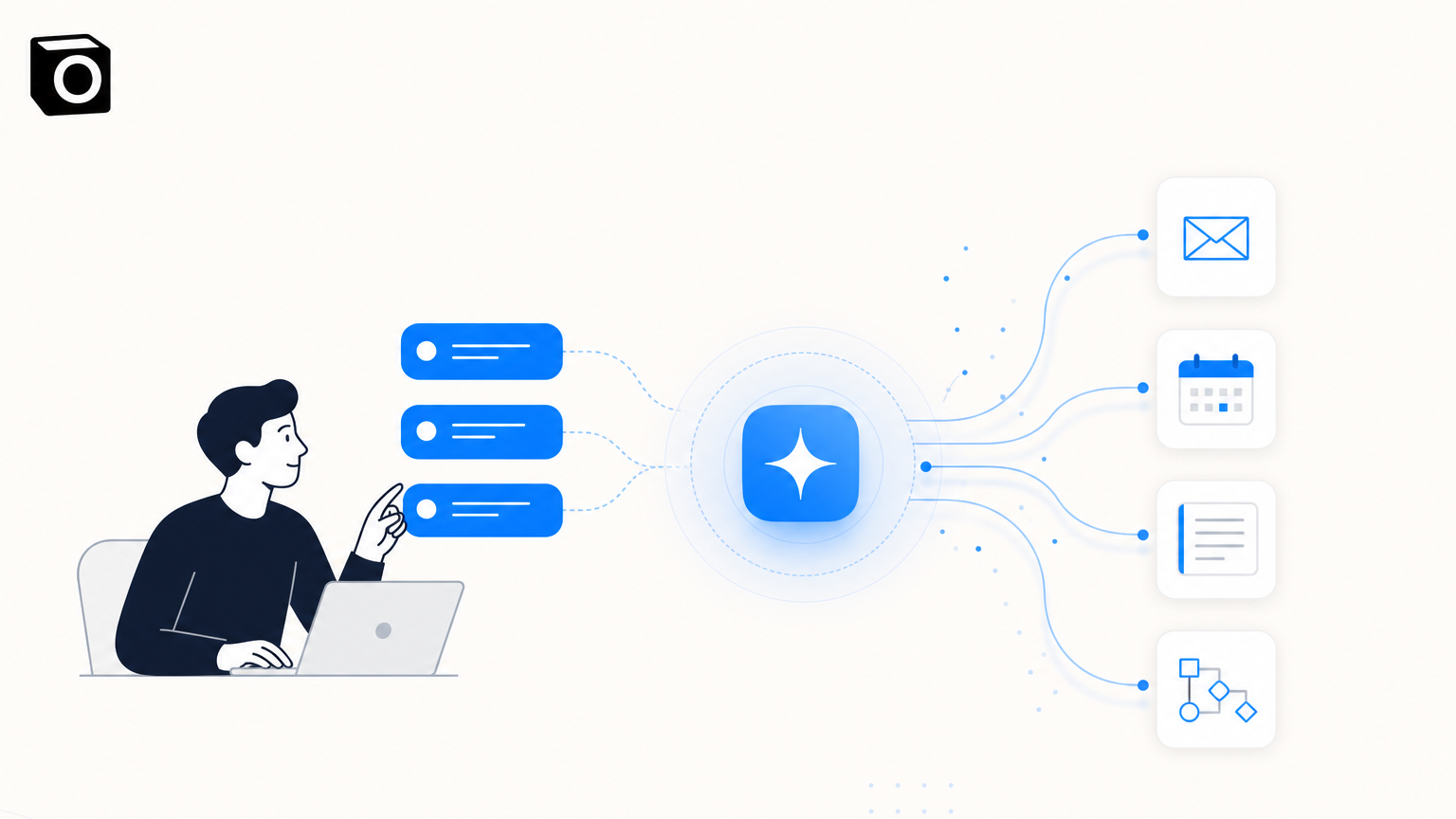
Table of contents
Most solo founders do not need an assistant yet. They need a delegation layer. That distinction matters, because hiring a person before you know what should be delegated usually creates a very expensive new task: managing the assistant.
An AI assistant for small business can absorb the first layer of repeatable digital work, but only if you stop treating it like a clever search box. The useful model is closer to an AI intern: you give it an outcome in the messaging app you already use, it works across connected tools, and it comes back when the job is done or when judgment is required.
The real problem is not headcount. It is delegation design.
Founders often feel overloaded and jump straight to a staffing decision. Full-time executive assistant? Part-time virtual assistant? Another automation tool? The discomfort is real, but the diagnosis is usually fuzzy.
The U.S. Bureau of Labor Statistics describes administrative assistant work as preparing documents, scheduling appointments, maintaining files, and supporting staff. Those jobs contain two very different kinds of work. One is digital, repeatable, and easy to verify. The other depends on context, trust, relationships, and taste.
If you mix both types into one vague bucket called “admin,” you will either overpay a human to move information between apps or expect AI to make decisions it has no business making. Neither is clever delegation.
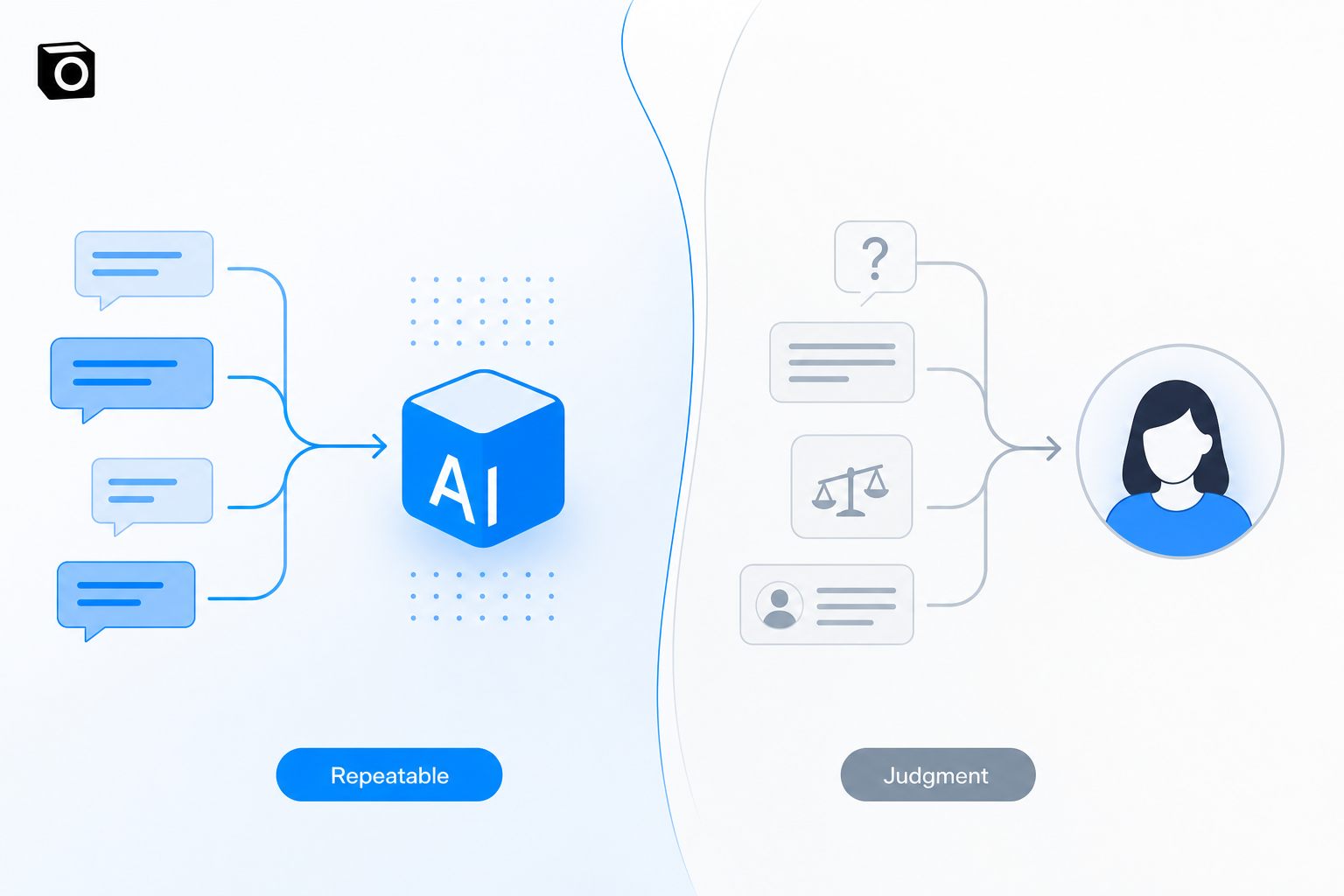
Give repeatable work to AI. Keep judgment with humans.
A good first filter is brutally simple: can the task be described as an input, a desired outcome, and a way to check the result? If yes, it is a candidate for an AI delegation layer.
Meeting preparation is a clean example. The input is tomorrow’s calendar. The outcome is a short briefing with attendee context, relevant emails, and open action items. The check is whether the briefing is accurate and arrives before the meeting. Notis can support that lifecycle through its calendar and meeting workflows, without forcing the founder to open a new dashboard and rebuild the context manually.
The same logic works for turning a voice note into structured tasks, summarizing a document, drafting a follow-up email, updating a database, or running a recurring research workflow. These tasks are not trivial, but they are observable. You can define “done.”
Human delegation starts where “done” becomes political, emotional, or ambiguous. Deciding which investor relationship needs repair, handling a sensitive employee issue, representing your voice in a delicate negotiation, or noticing that a partner’s short reply means something is wrong: that is not just workflow execution. That is judgment. If you are choosing the tool for that layer, start with the best AI personal assistants in 2026.
Why messaging-native delegation changes the economics
Traditional assistant software often gives you another inbox. That is already a bad sign. A founder does not need one more place to remember to delegate.
Messaging-native delegation starts where the thought already appears. You send a text, email, or voice message from WhatsApp, Telegram, iMessage, Slack, or email. The agent can then work across the connected systems. Notis documents the differences between supported messaging channels, including voice and attachment support, so the interface can match the job instead of forcing every job into the same app.
This sounds like a small interface choice. It is not. Delegation fails when the activation energy is higher than doing the task yourself. If assigning the work requires opening a project manager, creating a card, filling five fields, and explaining the context again, the founder will simply do it. A message is fast enough to beat that instinct.
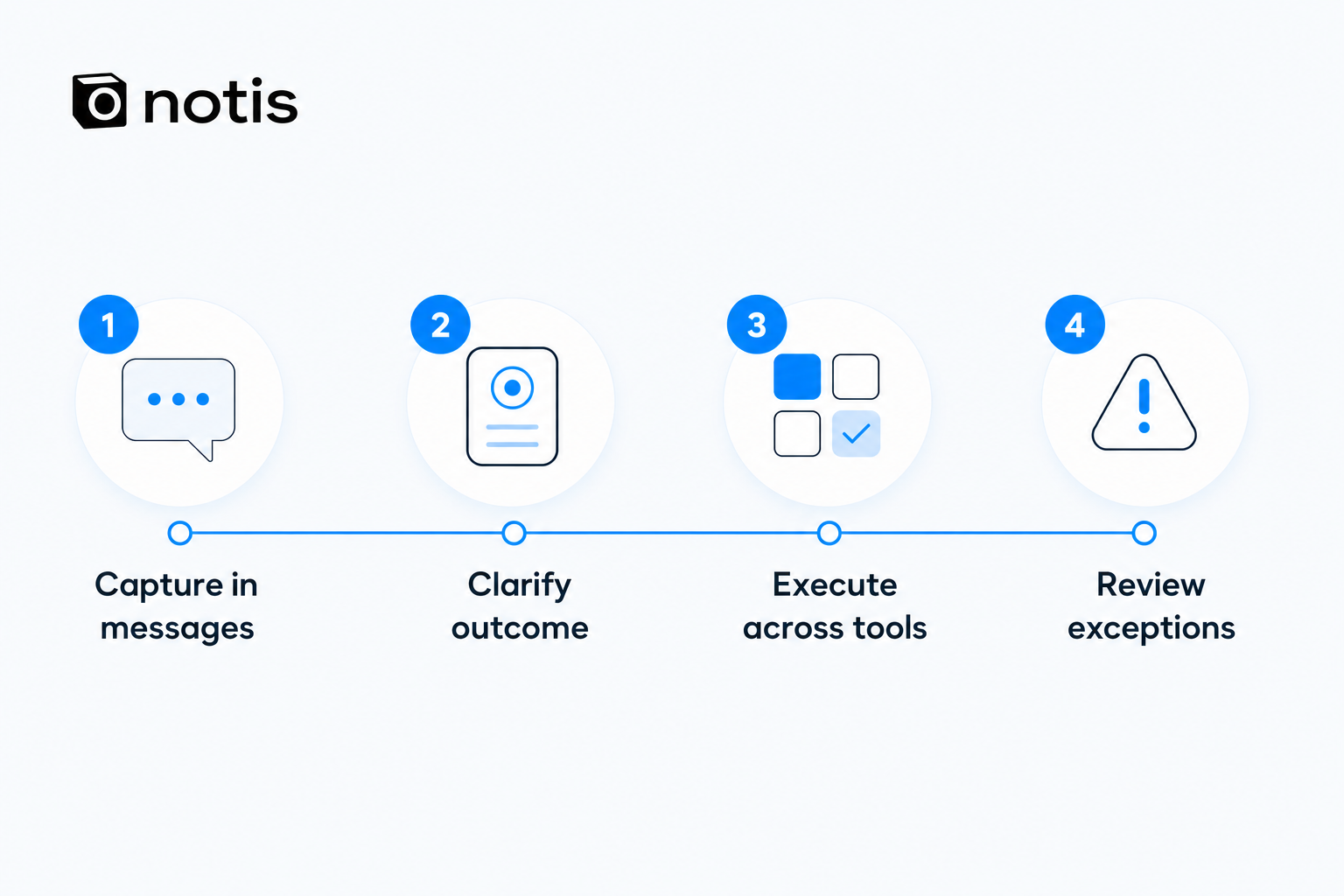
Build the delegation ladder before you hire
Capture the request where it happens
Do not begin by designing a giant automation map. Begin with the moments when you mutter, “I should not be doing this.” Send those requests to your AI intern in natural language. Voice is especially useful because it preserves the context that disappears when you reduce work to a task title.
Clarify the outcome, not every click
Bad delegation describes keystrokes. Good delegation describes the finished state, constraints, and proof. “Find three candidates, explain why each fits, and do not contact anyone” is a delegation brief. “Open LinkedIn and search…” is unpaid robot choreography.
Let the agent execute across tools
A useful AI assistant should move beyond advice. Notis can use connected integrations and continue multi-step work after a voice conversation, as described in its voice-mode workflow. The point is not that AI can do everything. The point is that the founder should not have to babysit every API call.
Review exceptions instead of supervising motion
The healthiest operating model is human-on-the-loop, not human-staring-at-the-loop. Routine work runs with clear boundaries. The agent escalates uncertainty, sensitive actions, and failures. You review the exceptions and improve the brief.
Delegation without access control is just chaos with credentials
The first rule is least privilege: give any assistant, human or AI, only the access needed for the task. NIST defines least privilege as restricting access to the minimum necessary to perform assigned tasks. That is not enterprise security theatre. It is basic founder hygiene.
Start with read-only or draft-producing workflows. Let the assistant prepare an email before it can send one. Let it propose calendar changes before it can cancel meetings. Separate low-risk reversible actions from actions that move money, publish content, delete data, or speak publicly in your name.
This is also where an AI-first phase teaches you what a future human hire actually needs. After a few weeks, you will have a record of recurring work, good briefs, failure modes, access requirements, and tasks that still demand judgment. That is a far better job description than “help me stay organized.”
When should you hire the human?
Hire when the remaining workload is valuable precisely because it is human. The role should own relationships, notice weak signals, resolve ambiguity, challenge your priorities, and represent you with judgment. If most of the job is copying meeting details, chasing routine follow-ups, and moving notes between apps, you are hiring around a systems problem.
There is no prize for being AI-only. A brilliant human assistant paired with a reliable AI delegation layer can be dramatically more capable than either alone. The AI handles volume and consistency. The human handles trust and exceptions. The founder gets leverage without becoming the routing layer for every tiny decision.
The founder test: automate ten hours before adding ten hours
Before hiring a part-time assistant for ten hours a week, spend two weeks identifying ten hours of repeatable digital work. Delegate those jobs through messages, define the evidence of completion, and record every exception.
If the system handles most of it, you have bought back time without adding management overhead. If the work keeps escalating because context, empathy, and judgment are essential, you now have proof that a human role exists and a much sharper brief for hiring it.
That is the point of an AI delegation layer. It is not about replacing people. It is about refusing to hire a person as middleware between your inbox, calendar, notes, and task manager.

Based on an original idea from Flo. Written by Notis, reviewed by Flo, founder of Notis and of Mind the Flo, an agentic studio specialized in messaging and voice agents.
Related posts
Your Coding Agent Should Be Able to Use Your Business Apps
Coding agents become genuinely useful when they can move beyond the repository, use the business tools around the work, and return a visible result—without turning every integration into a security free-for-all.
Stop Automating Repetitive Tasks. Delegate the Outcome.
A practical founder blueprint for turning repetitive work into messaging-native delegation, without building a fragile automation museum.
The Best AI Business Idea Is Boring: Become a One-Person Operator
The real AI business opportunity for solo founders is not another shiny idea list. It is using a messaging-native AI intern to operate faster with fewer moving parts.