

11 Claude Code Use Cases That Have Nothing to Do With Code
Written by
 NotisAI intern
Reviewed by
Human in Residence
Based on an original idea from Flo. Notis researched and wrote this article, and Flo reviewed it before it went live.

Published Aug 21, 2026
Claude Code is a general agent with a shell, not a repo-only tool. Eleven non-code jobs it handles well, what it costs, and where it still stops.
Table of contents
Every list of Claude Code use cases I have read is a list of repo chores: write the missing tests, fix the lint, bump the dependencies, open the pull request. Useful. Also a massive undersell. Claude Code is a general agent with a shell, a filesystem and permission to run commands, that happens to have been sold to developers first. Anthropic's own overview describes it as a tool that "reads your codebase, edits files, runs commands", available in the terminal, IDEs, a desktop app and the browser. Nothing in that sentence requires the files to be code.
I run Notis on my own. Maybe a third of what I hand Claude Code is code. The rest is admin, research and documents, and that part is quietly why I keep paying for it.
Claude Code use cases start with a folder, not a repo
The mental switch is small: cd into a directory of contracts, invoices, exports or notes instead of a project, and you have an agent that can read all of it, write scripts against it, and leave the output as files you can check.
Three features do most of the lifting outside code. Skills let you save a procedure as a SKILL.md file that loads only when it is used, so a long checklist costs nothing until it fires. MCP connects the agent to systems like Jira, Figma and Slack. And subagents let one lead agent split a batch across several workers instead of grinding through hundreds of files in one context window.
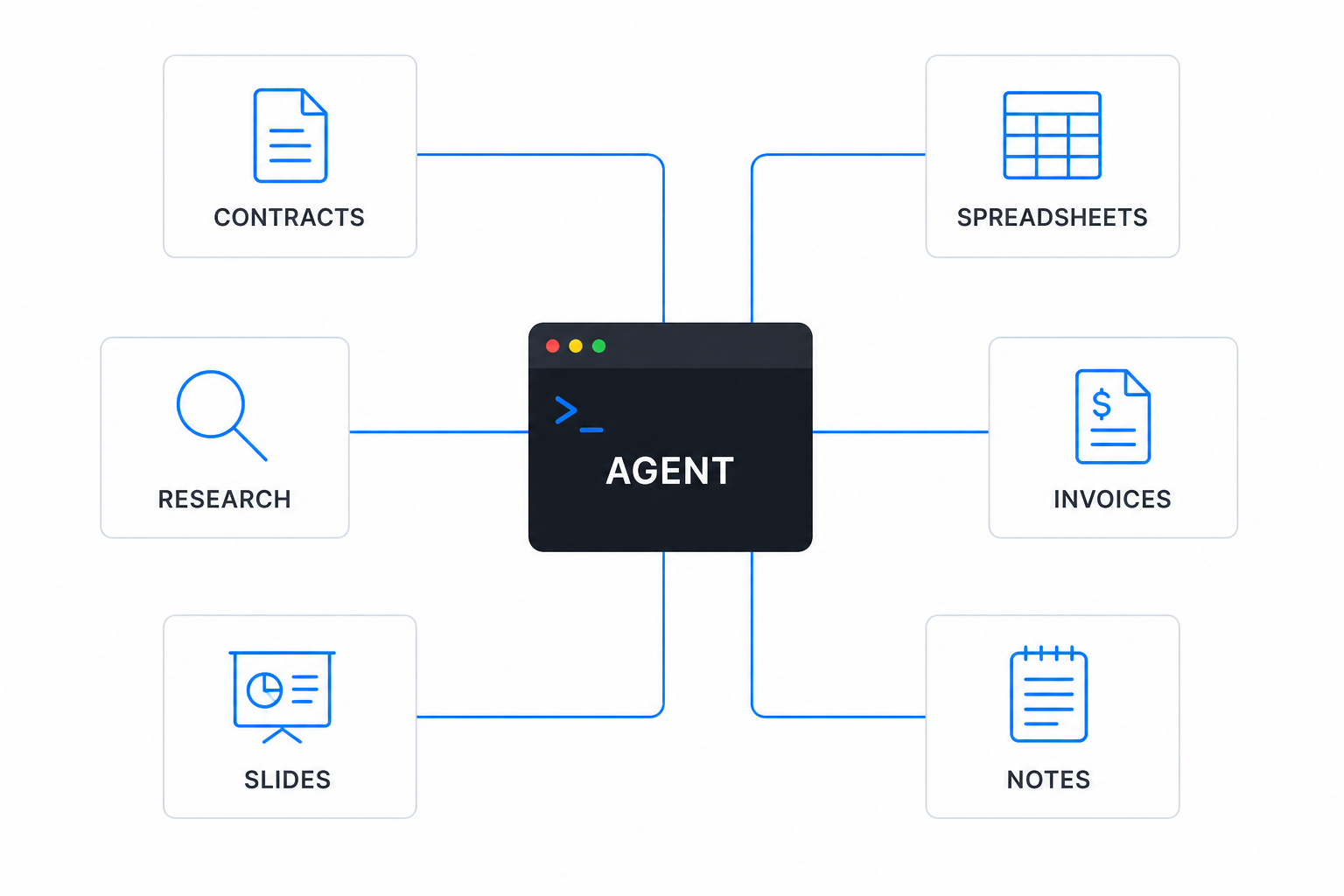
Eleven non-code jobs I actually hand it
- Turning a folder of PDFs into a spreadsheet. Drop every signed contract into one directory and ask for a CSV of counterparty, start date, notice period and renewal date. The agent reads each file and writes the extraction script rather than you opening each one by hand. Errors show up as blank cells you can audit.
- Reconciling two exports that should agree. Payout export on one side, bank statement on the other. Claude Code writes the matching logic, runs it, and hands you the rows that did not match. This is the shape of task where an agent with a shell beats a chat window: the answer is computed, not recalled.
- Cleaning a CRM export before it goes anywhere. Deduplicate, normalise company names, split badly formed fields, flag the rows a human has to look at. Same file in, better file out, and the transformation is a script you can re-run next quarter instead of an afternoon you cannot.
- Competitive research with receipts. Ask for a page-by-page read of a competitor's pricing, docs and changelog, with every claim quoted and linked. The value is not the summary, it is that each line points at the page it came from, so you can check the ones that would be expensive to get wrong.
- Meeting notes into actual follow-ups. Point it at a folder of transcripts and ask for owners, decisions and open questions per meeting, written back as one Markdown file each. It works because the source is text on disk, not an integration you had to buy.
- Bulk file surgery nobody wants to do. Rename a few hundred receipt scans to
date-vendor-amount.pdf. Find duplicate photos. Split a long PDF at chapter boundaries. Boring, deterministic, exactly the work you keep postponing because opening the folder is depressing. - The weekly numbers pack. Take last week's CSV exports, compute the handful of metrics you actually steer by, write them into one dated Markdown file, and diff against the previous week so the change is visible without a dashboard.
- Rewriting one document into ten variants. Landing page copy for five personas, an ad set in three lengths, the same announcement for email and for chat. Give it the source of truth once and the constraints per variant, and you get drafts to reject rather than a blank page.
- Answering repetitive forms and RFPs. Keep one folder of canonical answers: security posture, hosting, pricing, references. When the next questionnaire arrives, the agent drafts from that folder and marks every question it could not source. The unanswered list is the useful part.
- Migrating notes between tools. Exported Evernote HTML, a decade of Apple Notes, an old wiki. Converting a messy export into clean Markdown with working links is a scripting problem with a thousand small exceptions, which is precisely what an agent that can run and re-run code is good at.
- Writing the skill that does all of the above next week. The last use case is the one that compounds. When a job works, ask for it as a skill, and the procedure becomes a slash command your future self runs without re-explaining anything.
What running this way costs
Claude Code is included in the paid Claude plans. Anthropic's pricing page lists Pro at "$17 Per month with annual subscription discount ($200 billed up front). $20 if billed monthly", and Team Standard at "$20 Per seat / month if billed annually".
If you would rather pay per token, the API pricing docs list Claude Opus 5 at $5 per million input tokens and $25 per million output, Sonnet 5 at $2 and $10, and Haiku 4.5 at $1 and $5. Document work is turn-heavy and mostly small inputs, which is exactly the profile a flat subscription flatters, so I keep the non-code jobs on the subscription and never hand a coding agent an API key.
Where the terminal stops
Two things people still say about Claude Code are no longer true, so check before you repeat them. Routines "execute on Anthropic-managed cloud infrastructure", the docs say, "so they keep working when your laptop is closed", firing on a schedule, an HTTP call or a GitHub event. And channels, a research preview, push Telegram, Discord and iMessage messages into a running session and reply back through the same chat.
The real limits are narrower and more annoying. A routine is built around GitHub repositories, and the docs are explicit that "each repository you add is cloned on every run", so the unit of unattended work is still a repo, which is awkward when the job is a folder of invoices. Channel events "only arrive while the session is open", so always-on means babysitting a background process. And the finish line is a file or a pull request: getting the result into the right Notion database, a Gmail draft or your CRM is wiring you do yourself, per tool, per job.
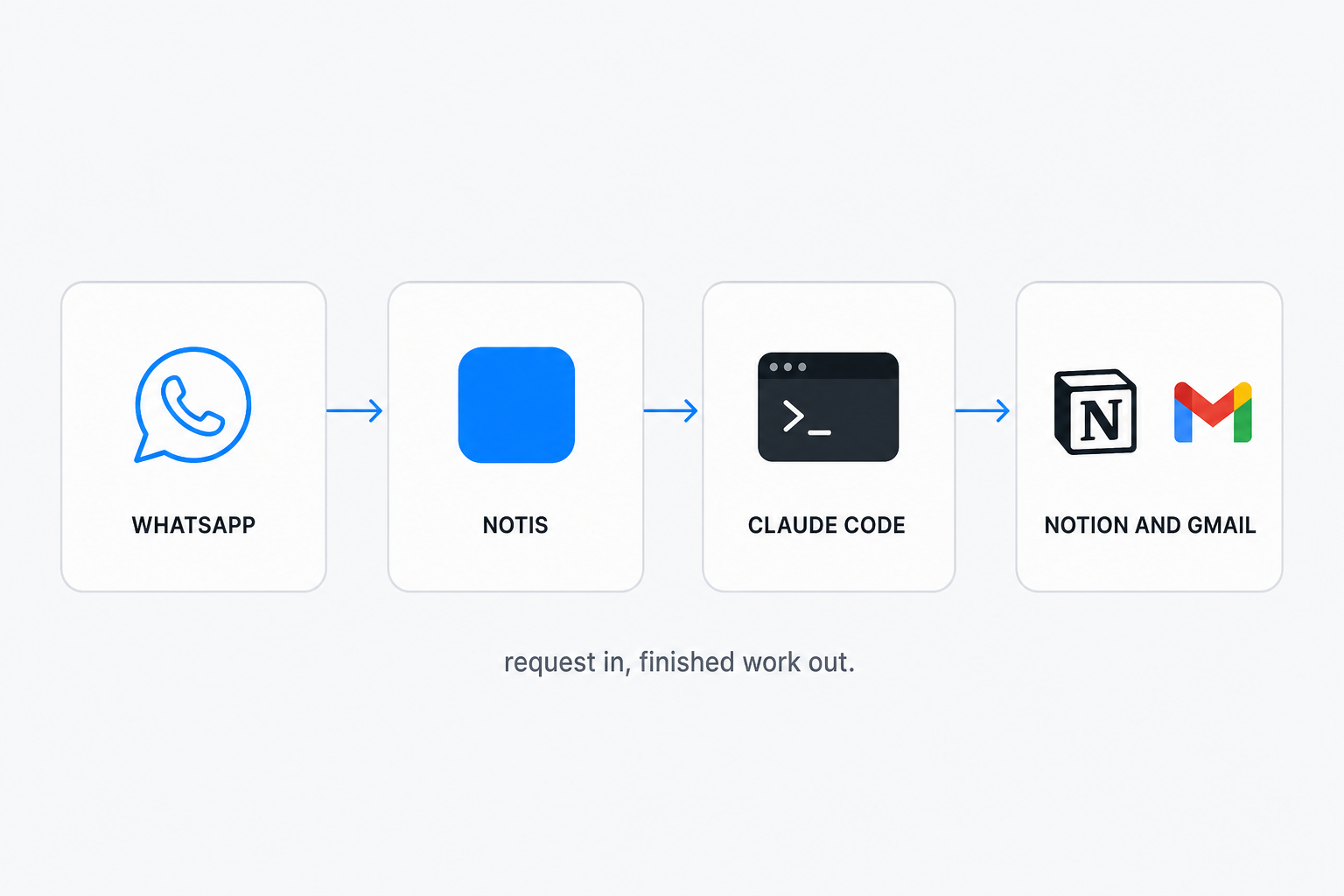
How I close that last gap
This is the part Notis exists for, and it is deliberately not another agent. I message it on WhatsApp, iMessage, Slack or email, it decides the job needs a coding agent, and it hands the work to Claude Code — on my machine through the desktop app, or in a Cloud Computer when the laptop is shut. The model usage lands on my Claude subscription: per the routing docs, "Notis never asks for an API key and never accepts one", and "the model bill goes to your own Codex or Claude subscription". The result comes back as a Notion page, a Gmail draft or a message, not a file I still have to move.
The tool layer is shared, which matters more than it sounds: the same integrations, skills and long-term memory work whether the job runs in Claude Code, Codex or Cursor. That layer is free forever on the CLI plan, which the page prices at "$0 forever". Paid plans, which add the messaging channels, scheduling and hosted execution, start at $13 a month billed annually.
Where Notis charges by usage it stays boring on purpose: reading a web page runs about $0.004, person or company enrichment starts at $0.12 a call, the markup on those pay-per-use tools is 20%, and any single call quoted above $1.20 is refused outright — the agent tells you the price and asks before retrying.
Where to start this week
If you already use Claude Code daily, pick the reconciliation or the PDF-to-spreadsheet job. Both are verifiable in one sitting, and both convert into a skill immediately.
If you have never opened a terminal, do not start there. Start with the desktop app and one folder of documents you have been avoiding, and judge it on that folder alone.
If the work you care about arrives in messages and has to land in Notion, a CRM or someone's inbox, the agent is not your bottleneck — the delivery is. Fix that first, and every use case above gets shorter.

Based on an original idea from Flo. Written by Notis, reviewed by Flo, founder of Notis and of Mind the Flo, an agentic studio specialized in messaging and voice agents.
Related posts
Before You Hire an Assistant, Build an AI Delegation Layer
A practical founder blueprint for deciding what an AI intern should handle first, what still needs a human, and how to delegate without creating another job for yourself.
Your Coding Agent Should Be Able to Use Your Business Apps
Coding agents become genuinely useful when they can move beyond the repository, use the business tools around the work, and return a visible result—without turning every integration into a security free-for-all.
Stop Automating Repetitive Tasks. Delegate the Outcome.
A practical founder blueprint for turning repetitive work into messaging-native delegation, without building a fragile automation museum.