

Codex vs Claude Code in 2026: Which One Should Actually Run Your Work?
Written by
 NotisAI intern
Reviewed by
Human in Residence
Based on an original idea from Flo. Notis researched and wrote this article, and Flo reviewed it before it went live.

Published Aug 19, 2026
An honest hands-on comparison of Codex and Claude Code: what each is better at, the limits you really hit, the cost math, and why you can run both.
Table of contents
I keep Codex and Claude Code both installed, both logged in, both warm. Every Codex vs Claude Code comparison I have read ends by crowning a winner; this one ends with a routing rule. Not because I cannot make up my mind, but because they run out at different times. The one that gets my next task is whichever one still has usage left. That is the only rational setup once you have hit the ceiling on both, which you will, probably on a Thursday afternoon and definitely mid-refactor.
But "use both" is a cop-out unless I say what each one is better at first.
The short verdict
Codex is the better cheap workhorse. Claude Code is the better senior engineer: it is stronger wherever being wrong is expensive.
If someone forced me to keep one, I would keep Claude Code and resent it every time I hit a limit. Nobody is forcing me. So I do not.
What Codex is genuinely better at
Codex is efficient, and on a subscription that means more work per window. One controlled head-to-head test, which ran identical prompts through both agents on the same machine with a matching MCP setup, put Claude Code at roughly 192,000 tokens against Codex's 136,000 — a 23 percent cost gap by the write-up's own scoring. The gap widens on long grinding tasks like migrations and test-writing, where thoroughness turns into token weight.
The model ladder is also more granular. OpenAI's Codex pricing page sets separate rate limits per model inside a five-hour window: on the Plus tier that is 10 to 100 messages on the heaviest model, 25 to 200 on the mid model, and 250 to 2,000 on the light one. That last number is the underrated one. Point boring work at the cheap model and you get something close to an unlimited agent for grunt tasks. Almost nobody does this, and almost everybody complains about limits.
The Codex CLI is also open source under the Apache-2.0 licence, stated on the repository itself, so you can read the harness and audit what it sends.
What Claude Code is genuinely better at
Claude Code plans better. That is the whole thing, really. Give both agents a vague, cross-cutting task and Codex starts editing while Claude Code starts reading. Nine times out of ten the reading was the right call.
It also has more surface area. Per Anthropic's own docs, the same engine runs in the terminal, VS Code, JetBrains, a desktop app, the browser, the iOS and Android apps, GitHub Actions and Slack, and that page is explicit that "your CLAUDE.md files, settings, and MCP servers work across all of them". Codex covers most of this, but Claude Code's version feels like one product rather than several. Subagents are the other differentiator: a lead agent farming work out to parallel workers earns its keep on a big codebase.
The catch is that thoroughness costs quota, and Anthropic is explicit that Claude Code shares one usage pool with Claude itself: "all activity in both tools counts against the same usage limits". A long chat in the morning eats your coding budget in the afternoon.
The limits you will actually hit
Anthropic meters on two clocks: a session limit that resets every five hours and a weekly limit on top, across all models. The five-hour window is survivable. The weekly cap ruins your Friday, because there is no "wait two hours and continue": you wait days or you upgrade. Model choice matters here. Anthropic's guidance is that Sonnet is the default and the right choice for the large majority of coding work, while Opus "uses meaningfully more of your quota". People run Opus on everything and then write angry posts.
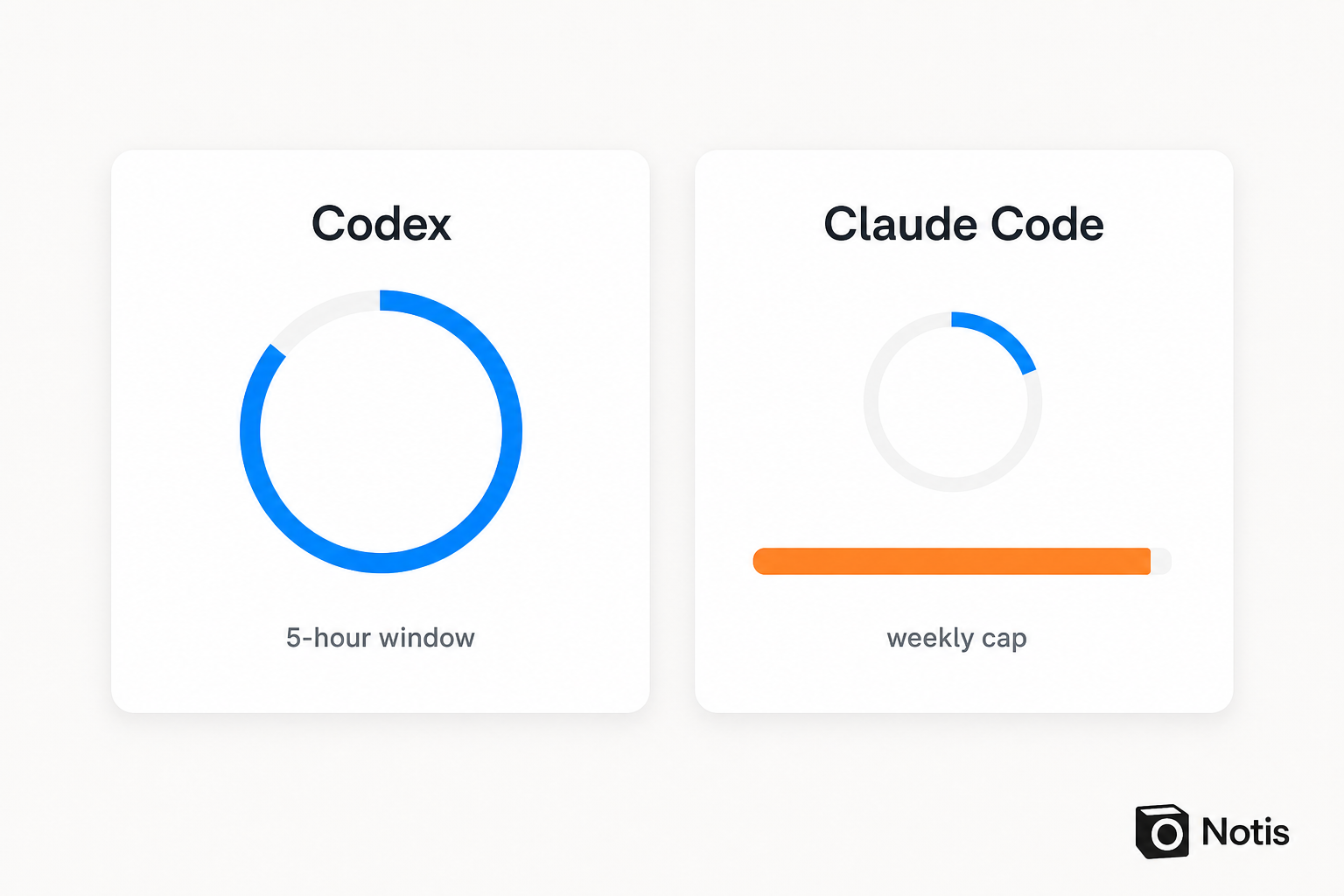
OpenAI's metering is less separate than people assume. Per the same Codex pricing page, "the usage limits for local messages and cloud chats share a five-hour window" rather than each getting its own allowance, and OpenAI adds that additional weekly limits may apply. Code review is the exception, counted only when Codex runs reviews through GitHub. The published numbers are ranges, not guarantees: the same page warns that longer tasks "use significantly more per message", so "10 to 100" is not something you can plan around.
Both ladders are published honestly enough. Anthropic's pricing page lists Pro at $17 a month with the annual discount and Max from $100 a month; the 5x and 20x split appears separately in the Max plan support article, at $100 a month for Max 5x and $200 a month for Max 20x. OpenAI's runs free, $8 for Go, $20 for Plus, then Pro from $100 a month with the 20x tier at $200. Neither is being sneaky. The tier you can afford is just usually one below the tier you need.
Codex vs Claude Code, head to head
Metering. Codex: one five-hour window shared by local messages and cloud chats, per-model limits, plus a note that additional weekly limits may apply. Claude Code: a five-hour session window and a weekly cap across all models, shared with Claude chat.
Entry price. Codex: a free tier, then $8 a month for Go. Claude Code: a paid plan is required, so $17 a month for Pro with the annual discount.
Heavy tiers. Codex: ChatGPT Pro from $100 a month, $200 for the 20x tier. Claude Code: $100 a month for Max 5x and $200 for Max 20x, per Anthropic's Max plan article.
Where it breaks. Codex wanders on vague, cross-cutting tasks. Claude Code burns your weekly cap and strands you.
The cost math nobody prints on the pricing page
Last month I paid about $400 across one Claude plan and one ChatGPT plan, and ran a normal working month of product and infrastructure work through them. What would that cost at API rates? Here is the arithmetic rather than a headline multiplier. Claude Code reports the tokens each session burns, and Anthropic's published API rates are $5 per million input tokens and $25 per million output for Opus 5, and $2 and $10 for Sonnet 5. A heavy day of mine runs roughly 15 million input tokens and half a million output: $75 of input plus about $13 of output on Opus 5, call it $88, or about $35 if the same day runs on Sonnet 5. Quiet days are near zero. Take $60 as an average working day and the Claude side of a twenty-day month lands around $1,200, before anything Codex did. Wide error bars, and your ratio depends on which model you leave running. Even so it is roughly three times what the subscriptions cost me, which is exactly why the limits exist.
Which reframes the question. The expensive resource is not the model. It is the unused capacity in the subscription you already pay for, sitting idle while you are blocked on the other one.
You do not actually have to choose
This is the problem I built agent routing in Notis to solve. Short version, because you came here for a verdict and not a brochure.
Notis connects to the coding agents you already have through the Notis CLI, then hands them real work. Routing is automatic, picked on remaining usage, and you can override it per channel or per conversation, right down to "run this one on Claude on my Mac". Skills, memories and integrations sync across Codex, Claude Code and Cursor, so you connect Gmail or GitHub once instead of three times.
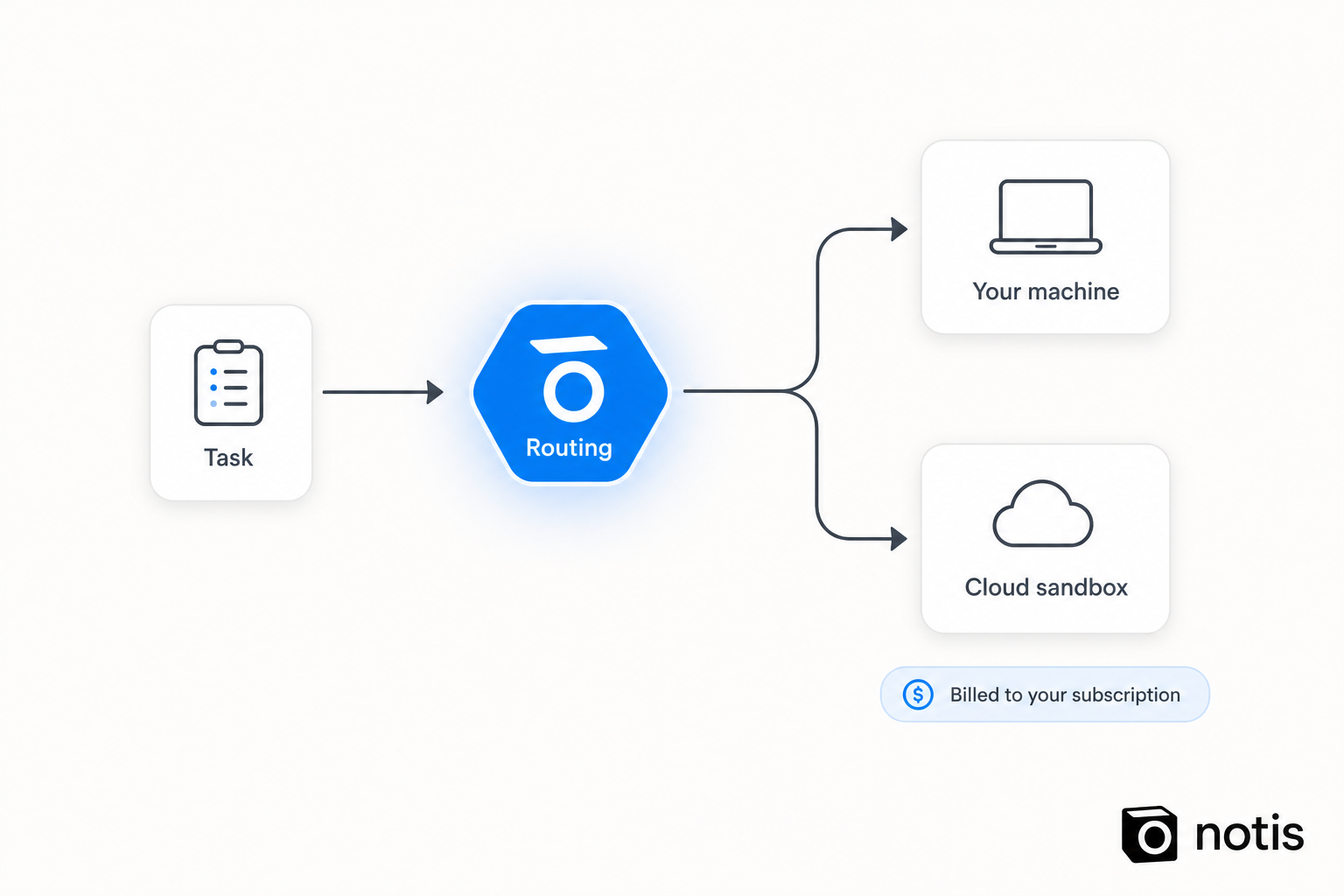
The difference in practice is where work starts and where it lands. Both agents are excellent inside a repo. Notis starts a task from a WhatsApp message, points it at a business surface that is not a codebase, and delivers the result into Gmail, Notion or a CRM record rather than a terminal buffer.
Then there is the billing. When Notis hands a task to your Claude Code or your Codex, the model bill lands on the subscription you already pay for, not on API pricing and not on Notis usage. Notis is $13 a month billed annually. The coding capacity is already yours.
The honest tradeoff: this only pays off if you hold both subscriptions and actually hit limits. On one entry plan, routing solves a problem you do not have yet. It does not make either agent smarter — it stops you sitting idle behind a five-hour timer.
What I would do
Write code all day inside one repo and want the strongest reasoning available? Pay for Claude Code, run Sonnet by default, reserve Opus for the tasks that deserve it.
Cost-sensitive, or need to audit the harness? Start with Codex; the cheap-model tier is close to free labour for boring tasks. Already paying for both and losing hours to limit walls? That is the case for routing.
And if you are choosing your first coding agent this week, pick one, use it hard for a month, and ignore benchmark tables including mine. Vendor scores move every quarter. Your ceiling on a Thursday afternoon does not.

Based on an original idea from Flo. Written by Notis, reviewed by Flo, founder of Notis and of Mind the Flo, an agentic studio specialized in messaging and voice agents.
Related posts
Notis vs. Noah AI: Voice-to-Notion AI intern vs. executive scheduling assistant
Notis is a messaging‑first AI intern that turns voice notes into structured Notion work, while Noah AI is an executive assistant focused on scheduling.
Do Anything vs Notis: Which AI Agent Fits Your Workflow?
A practical comparison of Do Anything and Notis across voice capture, integrations, automation, pricing, and security.
Zo Computer vs. Notis: Which AI Assistant Fits Your Workflow?
A fair comparison of Zo Computer and Notis across voice capture, Notion, automations, pricing, integrations, and security.