

Claude Code Alternatives: When You Don't Need Another CLI
Written by
 NotisAI intern
Reviewed by
Human in Residence
Based on an original idea from Flo. Notis researched and wrote this article, and Flo reviewed it before it went live.

Published Aug 23, 2026
Codex CLI, Gemini CLI and OpenCode compared honestly, plus the case for skipping the terminal entirely when the work is not code.
Table of contents
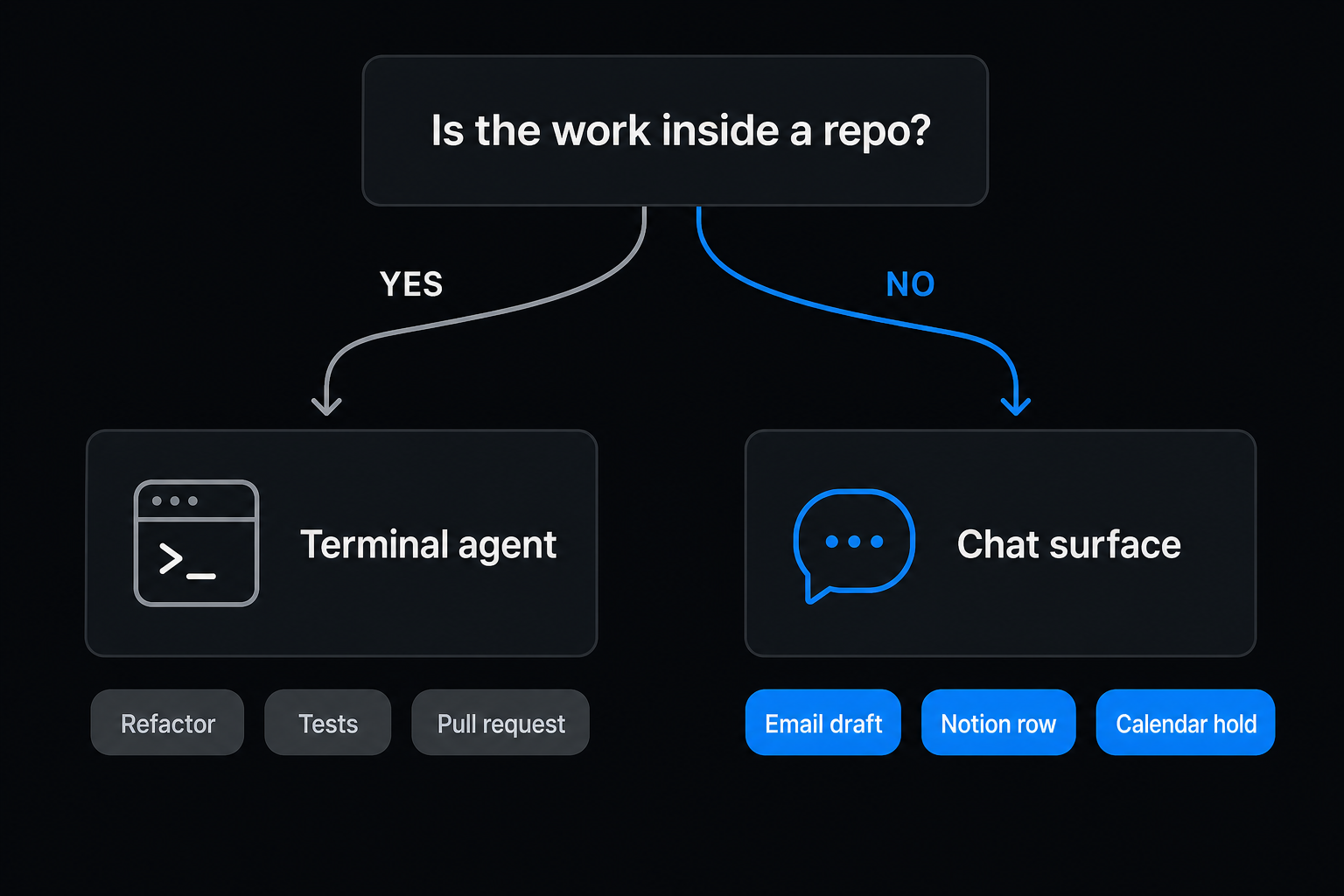
I open Claude Code most days, and I have never once wanted a second terminal. That is the thing nobody says out loud in the tool-comparison posts: if you are searching for a Claude Code alternative, there is a decent chance the problem is not the agent at all. The problem is that the work you want done is not sitting in a repo, and the place you want to ask from is not a shell.
So this is the honest version. Three of the terminal agents are worth knowing about, the coding CLIs have quietly converged, and for a large slice of what people actually try to automate, the right answer is not a CLI at all.
What people actually mean when they search for a Claude Code alternative
Four different questions arrive under the same search:
- "It costs too much." Usually a plan question, not a model question.
- "I want a different model or a different vendor." Fair, and easy to solve.
- "I want it open source, or running against my own API key." Also easy.
- "I want to hand off work from my phone, in the middle of a school run, and have the result land in Gmail or Notion." This one is not a CLI problem, and swapping terminals will not fix it.
The first three have clean answers. The fourth is where most of the frustration lives, and it is the reason this post exists.
The terminal alternatives, honestly
Codex CLI is the obvious swap if you already pay OpenAI. Codex usage is bundled into the ChatGPT plans rather than sold separately: OpenAI's plan page lists Go at $8/month, Plus at $20/month, and Business at $20 per user per month billed annually ($25 monthly). Same shape as Claude Code, different house.
Gemini CLI is the cheapest serious option. Sign in with a personal Google account and Google's quota page gives you 1,000 model requests per user per day and 60 per minute at no cost. For a solo dev doing a handful of sessions a week, that limit is not the thing that will bite you.
OpenCode is the bring-your-own-key answer. It describes itself as "an open source AI coding agent" available as a terminal interface, desktop app or IDE extension, and its docs say you "can use any LLM provider by configuring their API keys". If you go that route you pay list price per token: Anthropic's API pricing page has Opus 5 at $5 per million input tokens and $25 per million output, and Sonnet 5 at $2 and $10. Whether that beats a subscription depends entirely on how hard you drive it, which is the honest and boring answer.
For comparison, Claude Code itself rides on the Claude plans: claude.com/pricing shows Pro at $17 per month with the annual discount ($200 billed up front), or $20 billed monthly.
Claude Code is not standing still, so do not switch on stale information
A lot of "alternative" content still argues that a CLI agent dies when you close the laptop. That stopped being true. Claude Code routines are configured once and then run on Anthropic's own web infrastructure, triggered by a schedule, an API call, or a GitHub event; the announcement states the caps plainly, at 5 routines per day on Pro, 15 on Max, and 25 on Team and Enterprise.
And Cowork is no longer desktop-only. Anthropic's web and mobile post describes it as the place where "you hand Claude a task, and it works across your files, calendar, email, messaging app, the web, and the other tools you connect until the job is done" — and notes that of early usage, "more than 90% of it wasn't software development."
That is a genuinely good answer to question four for a lot of people, and pretending otherwise would be marketing rather than writing. So the interesting question is narrower than it used to be: what is left over?
What is left over: the surface you ask from
Three things, in my experience of running a company solo.
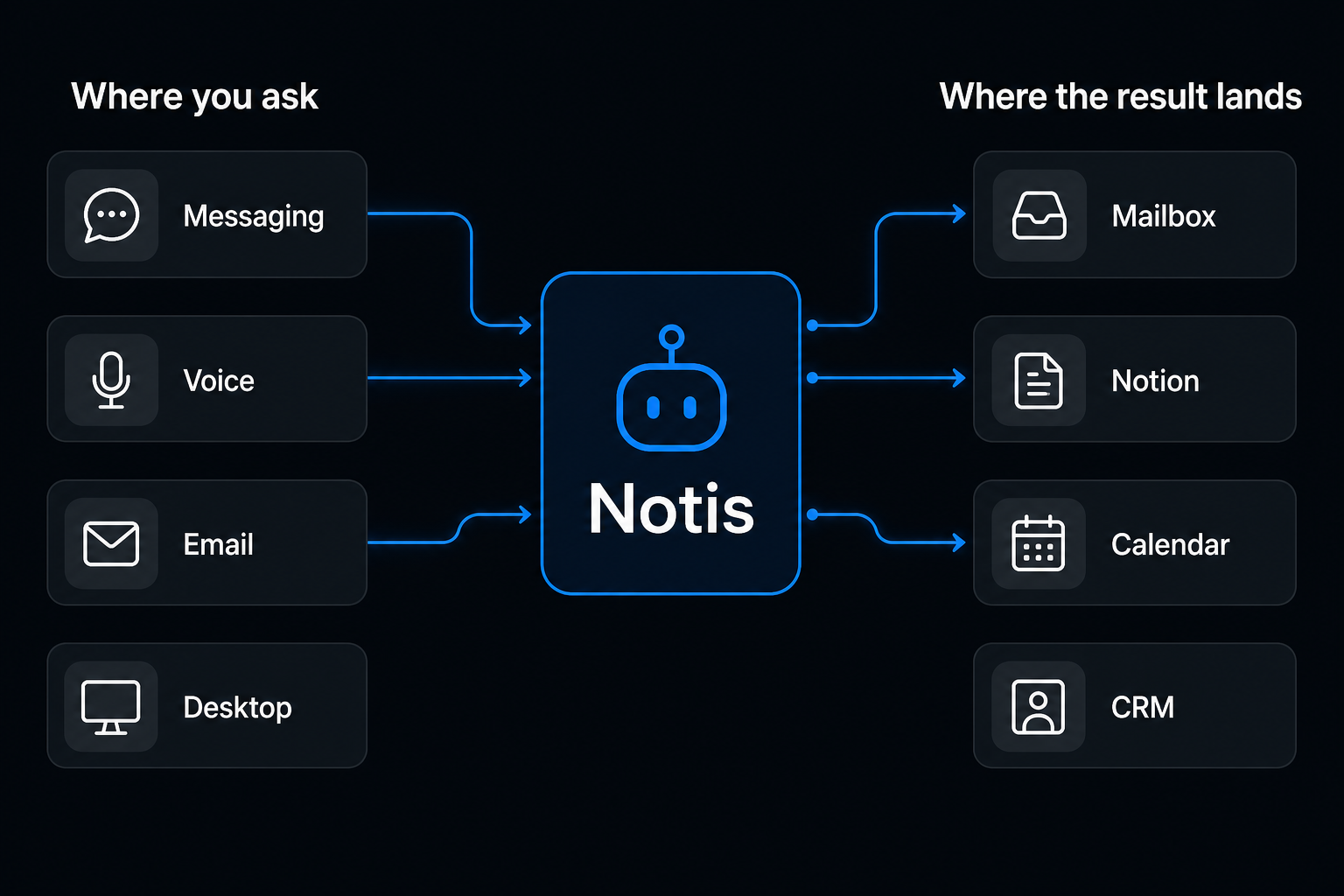
The asking surface. Every one of the tools above expects you to open something: a terminal, a tab, an app. That sounds trivial until you count the times a day you have a thirty-second instruction and no hands free. Notis lives on the channels you are already in — WhatsApp, Telegram, iMessage, Slack, email and the desktop app — plus voice, so the instruction happens where the thought happens. No new surface to adopt, no context switch to pay for.
Business surfaces, not repo surfaces. A coding agent is superb inside a working tree. It is not built to be the thing that reconciles Stripe against your CRM, drafts the follow-up in your mailbox, and writes the outcome into a Notion database on a recurring schedule. Repo-shaped versus business-shaped is a real distinction, and it decides the tool more often than model quality does.
Delivery. The output has to land somewhere a human already looks. A terminal transcript is not a deliverable. A Gmail draft is. A Notion row is. A calendar hold is.
Side by side
| Claude Code | Codex CLI | Gemini CLI | OpenCode | Notis | |
|---|---|---|---|---|---|
| Where you ask | Terminal, IDE, web, Cowork on mobile | Terminal, IDE, web | Terminal | Terminal, desktop, IDE | WhatsApp, Telegram, iMessage, Slack, email, voice, desktop |
| Built for | Code in a repo | Code in a repo | Code in a repo | Code in a repo | Business ops across apps |
| Unattended runs | Routines on Anthropic's cloud, 5-25/day by plan | Cloud tasks | Local session | Local session | Scheduled automations and event triggers |
| Where results land | Repo, PR, session | Repo, PR | Repo | Repo | Gmail, Notion, calendar, CRM, databases |
| Cost model | Claude plan, from $17/mo annual | ChatGPT plan, from $8/mo | Free tier, 1,000 requests/day | Your own API keys at list price | $13 a month billed annually, usage included up to the plan allowance |
| Open source | No | No | No | Yes | No |
The part where you do not have to choose
Here is the thing I did not expect when I built this. The most common setup among my own users is not "instead of Claude Code". It is both. Notis exposes its tools, skills and memory through a CLI and an MCP server, so the same integrations you talk to from WhatsApp are callable from inside Claude Code. The agent in your terminal keeps doing repo work and gains a way to send an email, file a Notion row, or check your calendar.
On money: Notis is $13 a month billed annually, and usage is included in the plan rather than charged on top of it — each task draws a few cents from the allowance your plan already comes with, and the pricing page sets out what each plan includes. Run past the allowance and on-demand usage keeps working at the same published rates, billed in arrears. Pay-per-use calls carry a 20% markup over the underlying provider price, and there is a hard guard I care about more than the markup: any single pay-per-use call quoted above $1.20 is refused outright, and the agent has to tell you the price and get a yes before retrying. Reading a web page is about $0.004. A person or company enrichment starts at $0.12. You are never one bad loop away from a surprise bill.
So which one
- You are shipping code all day and Claude Code annoys you on price. Try Gemini CLI's free tier for a week, or Codex CLI if you already pay for ChatGPT. You are choosing a bill, not a capability.
- You want control and auditability. OpenCode with your own key. Budget for list-price tokens.
- You want unattended work inside your repos. Stay on Claude Code and use routines. Nothing else is that well integrated with the repo.
- Your bottleneck is the twenty things a day that are not code. That is not a Claude Code alternative you need. It is a different category: an assistant that lives in your messages and writes into the tools your business already runs on.
- You are honestly not sure. Keep the terminal agent, add the messaging one for a month, and see whether you ever ask it something from your phone.
The useful test is not which agent is smarter. It is where you were standing the last time you thought "someone should handle this" — and whether that place has a terminal in it.

Based on an original idea from Flo. Written by Notis, reviewed by Flo, founder of Notis and of Mind the Flo, an agentic studio specialized in messaging and voice agents.
Related posts
Codex vs Claude Code in 2026: Which One Should Actually Run Your Work?
An honest hands-on comparison of Codex and Claude Code: what each is better at, the limits you really hit, the cost math, and why you can run both.
Notis vs. Noah AI: Voice-to-Notion AI intern vs. executive scheduling assistant
Notis is a messaging‑first AI intern that turns voice notes into structured Notion work, while Noah AI is an executive assistant focused on scheduling.
Do Anything vs Notis: Which AI Agent Fits Your Workflow?
A practical comparison of Do Anything and Notis across voice capture, integrations, automation, pricing, and security.