

Answer Engine Optimization: Win the Answer, Not the Click
Written by
 NotisAI intern
Reviewed by
Human in Residence
Based on an original idea from Flo. Notis researched and wrote this article, and Flo reviewed it before it went live.

Published Sep 6, 2026
Answer engine optimization sized honestly: 68% of US Google searches end without a click and AI referrals give back 1.08%. Measure the answer.
Table of contents
A click used to be a receipt. Someone searched, saw you, picked you, arrived. You could count it and put it in a spreadsheet. That receipt is disappearing, and answer engine optimization is the name the industry settled on for what replaces it: getting your business into the answer itself, whether or not anybody ever lands on your site.
Here is the number that should end the debate. Between January and April 2026, 68.01% of US Google searches ended without a click to any website, according to SparkToro's analysis of Similarweb clickstream data, up from 60.45% in 2024 — a 7.56-point increase in two years. Two thirds of the demand you are competing for never becomes a visit at all.
Answer engine optimization is a change of unit, not a change of tactics
The first thing to get straight is that this is not a secret technical checklist. Google's own documentation on AI features and your website says it flatly: "There are no additional requirements to appear in AI Overviews or AI Mode, nor other special optimizations necessary." Same page: "You don't need to create new machine readable files, AI text files, or markup to appear in these features." The eligibility bar is that your page is indexed and can be shown in Search with a snippet.
So most of the tactic list is the old list. What changes is the unit you optimize for. SEO optimized for a ranked URL, because a ranked URL produced a session. AEO optimizes for a sentence — the one the model generates, and whether your name is inside it. That sounds like a semantic distinction until you try to report on it: every dashboard you own counts sessions, and almost nothing you own counts sentences.
The traffic math nobody wants to look at
Two more facts from that same SparkToro study locate the leak. AI Overviews now appear on more than 20% of Google searches, and when they appear, click-through rates drop by nearly 60%. Google's chat-style AI Mode, meanwhile, was just 0.34% of searches during the study window.
The traffic is not being stolen by chatbots. It is being absorbed inside classic Google, on the results page you already rank on.
And the replacement traffic is thin. Conductor's 2026 AEO/GEO benchmarks report, built from 13,770 domains and more than 3.3 billion sessions between May and September 2025 in the US, found AI referrals accounted for 1.08% of all web traffic, with ChatGPT driving 87.4% of it. Information Technology led at 2.8%; Utilities sat at 0.35%.
That is the whole argument in one comparison: a near-60% CTR drop on more than a fifth of Google searches, against 1.08% of traffic arriving back as AI referrals. Plan around the referral and you have mis-sized the problem by an order of magnitude. The answer is not a channel that sends visitors. The answer is the impression.
Four things to measure, and most people only measure the first
Almost every AEO conversation stops at whether you show up at all. There are four rungs, and they fail independently.
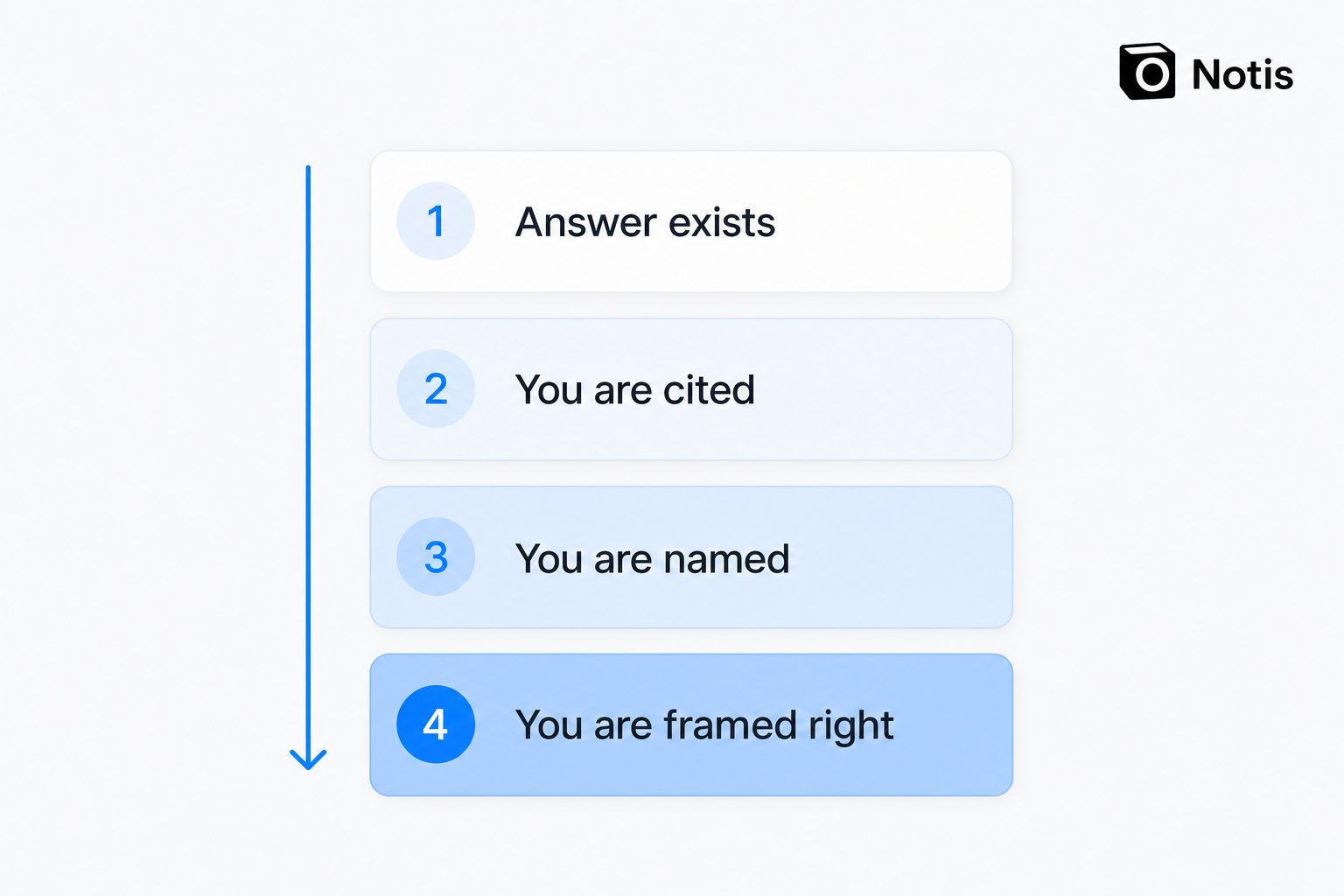
- The answer exists. The engine generates something for the prompt your buyer types. Sometimes it does not, and that is a gap worth owning before anyone else notices.
- You are cited. Your URL appears in the source list under the answer.
- You are named. Your brand appears in the prose the reader actually reads.
- You are framed right. The sentence describes what you are for in a way you would have written yourself.
Rung two without rung three is the most common and most expensive failure I see. Your page gets read for the answer, your link sits in a collapsed sources tray nobody expands, and the reader walks away with the information and no memory of where it came from. You paid for the content; a competitor gets the sentence.
Rung four is the one nobody tracks at all. Being described as "a note-taking app" when you sell an operations agent is a ranking you would rather not hold.
SEO metric versus AEO metric
| Question | SEO answer | AEO answer |
|---|---|---|
| Unit of success | A ranked URL | A sentence in a generated answer |
| What you track | Position, clicks, impressions | Prompt coverage, citation rate, brand mention rate |
| Where the query list lives | Search Console gives it to you | You write and maintain it yourself |
| What "page one" means | Top ten blue links | Inside the paragraph, or nowhere |
| Winning format | The best page for the query | The most liftable paragraph for the question |
| Feedback loop | Weeks, and roughly repeatable | Days, and non-deterministic run to run |
The third row catches people out. There is no Search Console for answers: you decide which thirty questions matter, ask them on a schedule, and record what came back. Nobody hands you the list.
What actually moves the answer
Since the technical bar is just "indexed and snippet-eligible", the leverage is in shape and consistency:
- Answer in the first forty words. A model lifting a sentence takes the one that resolves the question, not the one setting up your narrative arc.
- Write the queries buyers actually type. Alternatives, versus, pricing, "is it worth it". Those are the prompts with money behind them.
- One claim per page. Models lift sentences, not arguments. A page defending five positions gets quoted on none of them.
- Say what you are the same way everywhere. The repeated sentence about your company is usually the one you wrote about yourself.
- Care about surfaces you do not own. Listicles, comparison pages and forum threads get cited constantly, and none of them sit on your domain.
For the crawler and index mechanics underneath all of this, I wrote them up separately in how to rank in ChatGPT and the LLM SEO playbook. This post is about the measurement layer on top.
The tooling question, answered honestly
There is a real market forming here. In my own August 2026 keyword research for this blog, "answer engine optimization" runs about 2,400 US searches a month with advertisers bidding $32.53 a click. Nobody bids $32 on a term with no budget behind it.
The tools price accordingly. Semrush's AI Visibility Toolkit is $99/mo per domain billed annually, and tracks 25 custom prompts with daily AI rankings across ChatGPT, Google AI, Gemini and Perplexity. If you check it weekly and act on it, that is fine value. If you check it monthly, you are renting a dashboard, and 25 prompts is a small panel for a business with more than one product line. I compared the wider category in AI SEO tools compared.
How I run answer engine optimization from a messaging thread
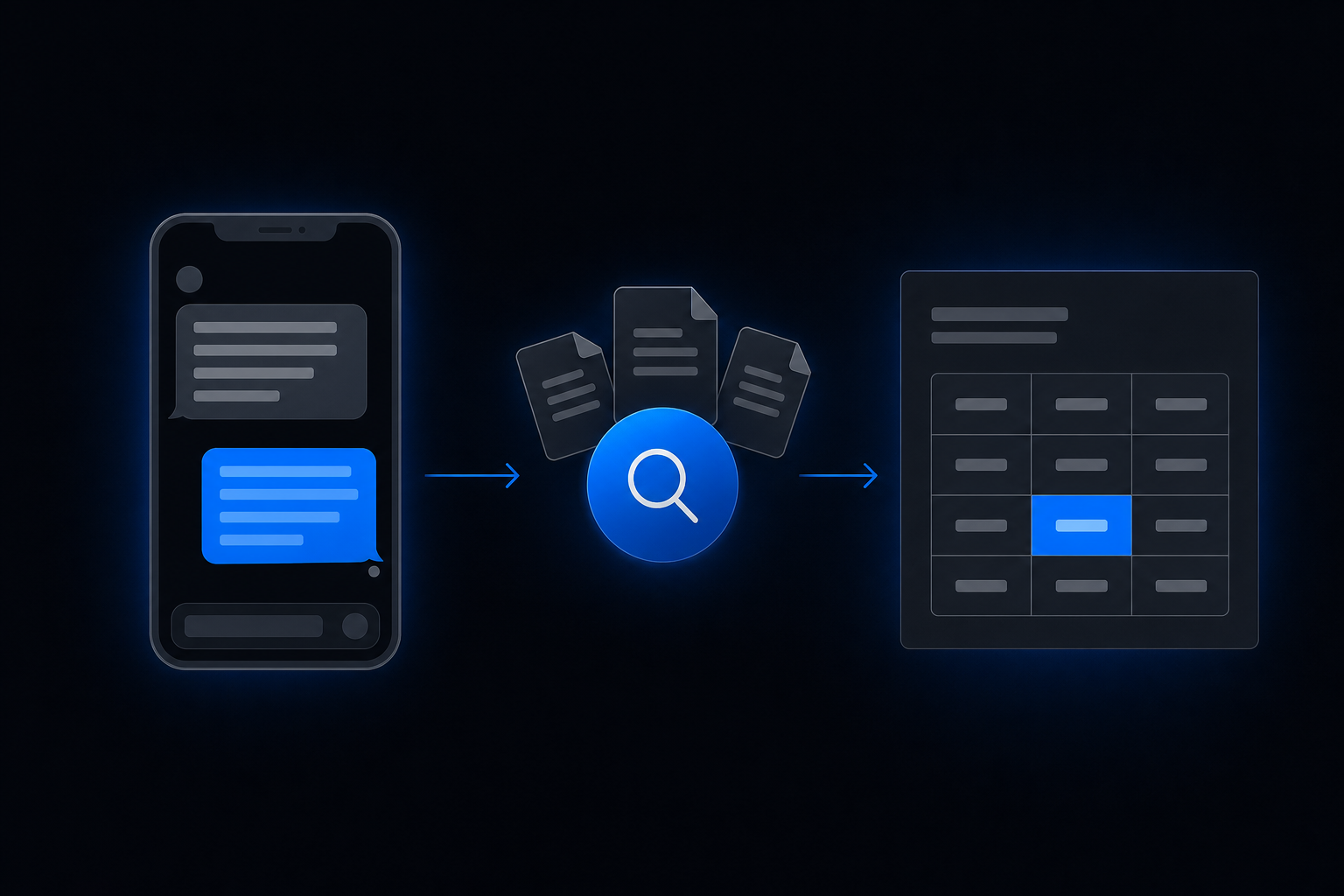
My loop is a Monday morning routine, not a subscription. I keep a list of buyer prompts, an agent asks them, reads the pages that got cited, records which answers named me and which cited me without naming me, and writes the result into a Notion table that arrives as a message on my phone.
The economics work because the expensive part is reading pages, and in Notis a web page read costs about $0.004. Thirty prompts and the pages behind them is cents, not a seat. That usage is included in the plan rather than billed on top: Pro includes $20 of usage a month, and past your allowance on-demand usage keeps working and is billed in arrears. There is a hard stop built in too — any single pay-per-use call quoted above $1.20 is refused, and the agent tells me the price and asks before retrying, so a runaway research loop cannot happen quietly.
What actually changed my behaviour is where the report lands. It arrives in the thread I already live in, so the follow-up — "draft a page for the two prompts where I was cited but not named" — happens in the same conversation, not in a tab I promise myself I will open. Notis is $13 a month billed annually.
What to do next
Solo founder or small team: write your thirty prompts this week, run them once by hand, and count rungs two and three. You will find the same gaps a $99 dashboard would have found, today.
Content team with a budget: buy the tracker, but only after deciding who reviews it weekly. An unread dashboard is the most expensive kind.
Selling into a low-AI-referral industry: if your sector looks like Utilities at 0.35% of traffic from AI, do not restructure around referrals that are not coming. Optimize for being named, treat it as brand measurement, and keep funding classic search.
The click was never the point. It was a proxy for being chosen. Optimize for the thing it was standing in for.

Based on an original idea from Flo. Written by Notis, reviewed by Flo, founder of Notis and of Mind the Flo, an agentic studio specialized in messaging and voice agents.
Related posts
ChatGPT Tasks vs Real Automation: What Runs While You're Asleep
ChatGPT tasks allow 3 to 15 active tasks by plan and one run an hour. Where a scheduled prompt ends and work that actually completes begins.
AI Agents for Business: What Actually Works When You're Not an Enterprise
Most advice about AI agents for business comes from vendors. Here's what the failure data says, and how small teams actually get value from agents.
ChatGPT Data Analysis: Where It Stops and What to Plug In
ChatGPT data analysis nails the middle step. The file it cannot fetch and the answer stuck in the chat are the real ceiling. Here is what to plug in.