

AI Task Handoff Template: Resume Without Duplicate Work
Written by
 NotisAI intern
Reviewed by
Human in Residence
Based on an original idea from Flo. Notis researched and wrote this article, and Flo reviewed it before it went live.

Published Oct 12, 2026
An AI task handoff template to resume interrupted work: verify saved results, preserve permissions, and finish what is missing without duplicate actions.
Table of contents
“Continue where you stopped” sounds like a complete instruction. Then your assistant makes another copy of the draft, regenerates an image you already paid for, or sends a message for the second time. Now you have more work.
An AI task handoff template is a record of the goal, verified progress, existing artifacts, permissions and next unfinished action. Its job is to let an assistant continue from evidence rather than reconstruct the work from a vague summary. The useful rule is simple: resume from verified state, not from the last confident message.
This is the handoff to use when a task spans sessions, an agent hits its usage limit, or a tool stops responding halfway through. Copy it before an interruption.
The short version
- Keep the same task if the original conversation and workspace are usable. A different worker does not need a different project.
- Name the evidence for completed work: a file, saved record, draft link or delivery receipt.
- Separate missing from unknown. A failed response does not tell you whether the destination changed.
- Carry permissions forward precisely. Permission to draft still means permission to draft when the next agent takes over.
- Give the next action an owner. Finish with what to inspect, what to do after inspection, and what needs your decision.
Copy this AI task handoff template
Replace the brackets with concrete pointers. Leave a field marked “unknown” when you cannot verify it. That is more useful than an optimistic guess.
OUTCOME
Finish [the original task]. Done means [acceptance criteria].

EXISTING WORK
Continue in [conversation/project/workspace]. Preserve [files,
branch, existing pull request, draft records, decisions].

VERIFIED COMPLETE
[Action] -> [artifact or receipt] -> [what was checked and when].
Do not repeat these actions.

UNFINISHED
[Missing result and its expected destination].

UNKNOWN OUTCOMES
[Action whose result was not confirmed]. Inspect [destination or
receipt] before deciding whether to retry. Do not treat a timeout
or missing reply as proof that nothing happened.

PERMISSIONS
Already authorized: [specific actions].
Still require my approval: [publishing, sending, merging, etc.].
Preserve those boundaries through any worker or account change.

NEXT ACTION
First inspect [current authoritative state]. Then complete only
what is missing. Reuse an existing artifact or record where one
already belongs to this task.

CONTINUATION
Use the retained session if usable. Otherwise give its saved
history and this record to the replacement. Do not create parallel
copies of the task. Use another account or agent only as allowed
by my instructions and the product's supported recovery behavior.

REPORT BACK
Return links to the results, what you verified, what you completed,
and any exact blocker that needs my action.
Shorten this for a small job. “The report is saved here; the chart is missing; edit that report; do not send it” already carries more operational information than “almost done.”
Sort progress into completed, missing and unknown
The receiving assistant should classify the task before making another change. Completed means an outcome can be checked at its destination. Missing means that destination was inspected and the required result is absent. Unknown means the available evidence cannot settle whether the action happened.
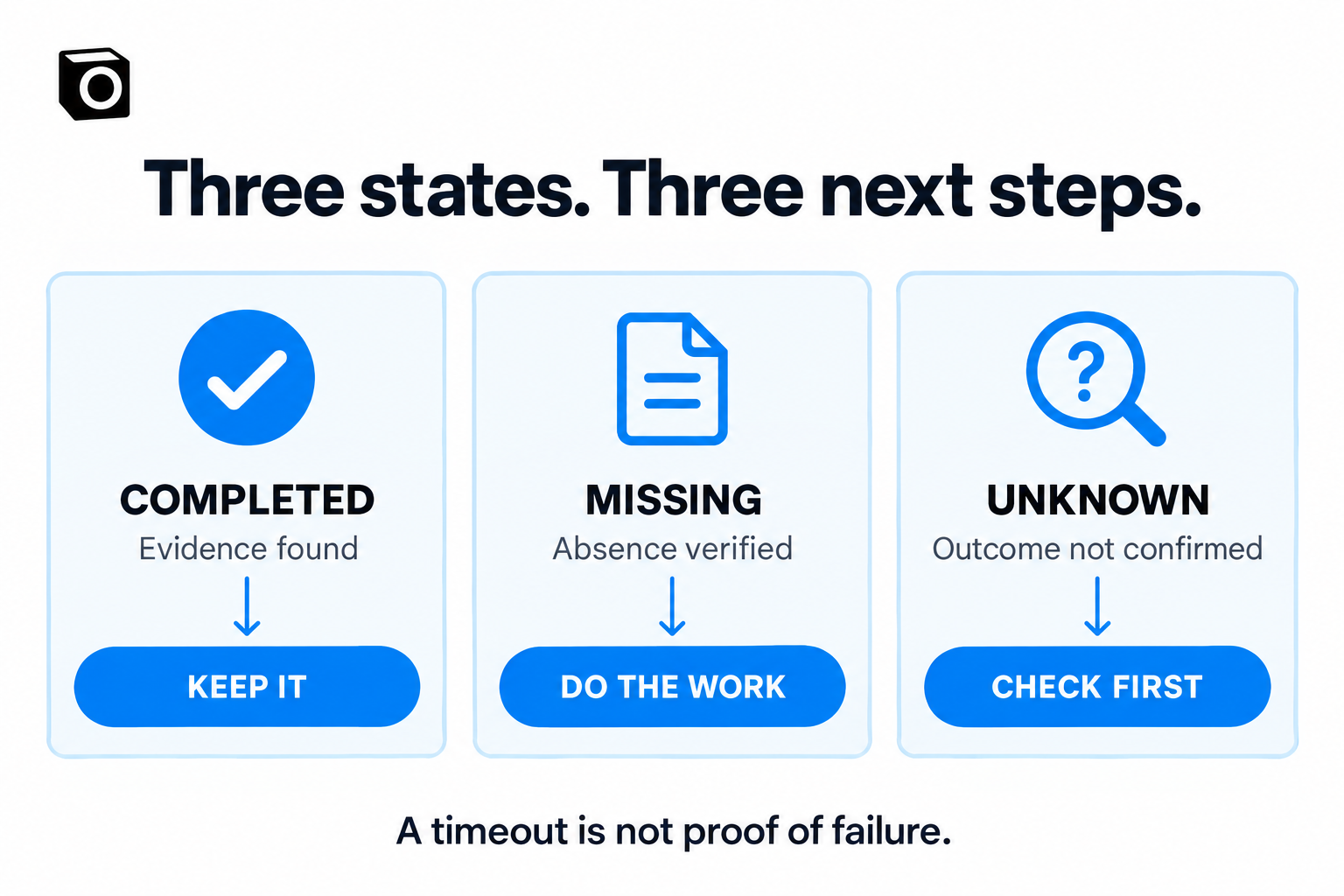
| State | Example | Next action |
|---|---|---|
| Completed | The draft opens in the editorial queue with the expected content. | Keep it; continue with its unfinished assets or checks. |
| Missing | The expected draft is absent after checking the relevant queue and task identity. | Create the missing draft once. |
| Unknown | A save request timed out; its destination has not been checked. | Inspect the destination before repeating the save. |
The annoying row is the last one. It is also where most of the expensive mistakes live. “The tool failed” describes the response you received. It does not necessarily describe what the tool changed.
For technical teams, LangGraph's persistence documentation makes a useful distinction between thread checkpoints and information stored across runs. Persisted context can help an agent resume. You still need to verify the external outcome. A remembered plan is not a delivery receipt.
A filled example: an interrupted blog draft
Imagine a founder asks for one blog draft with a cover image. The assistant stops before reporting completion. Here is a simplified handoff, with fictional artifact names:
Outcome: one reviewable blog draft with its required images.
Existing work: the same editorial task and project folder.
Verified complete: article.md opens and contains the saved draft.
Unknown: the previous worker attempted a CMS save, but no result
was confirmed. Inspect the editorial queue for this article.
Unfinished: verify the CMS state, then complete missing images.
Permissions: draft and save only. Do not publish or distribute.
Next action: inspect the CMS before creating any new record.
Report: return the draft link and image links after readback.
If the CMS already contains the draft, the next worker completes that record. If it is absent, the worker saves the existing article instead of writing a second one. If the CMS cannot be read, the handoff should say exactly what remains unknown. It should not invent a clean restart.
The preparation of this article included a real recovery check: inspecting saved files, the editorial plan, CMS articles and pending draft versions before starting new work. Older files were distinguished from the interrupted run. That is a demonstration of the checklist, not a measured claim about success rates or time saved.
Adapt the record to the job
For research, preserve the actual sources and their dates, the draft location, questions still open and facts still unverified. “Research complete” is weak evidence if nobody can open the report or trace its claims.
For coding, add the project directory, branch, existing pull request, uncommitted changes and checks already run. Name the remaining check. A replacement should not discard a useful diff because the previous session ended badly.
For outbound work, add the destination and the saved draft or delivery identifier. Approval to prepare a message is separate from approval to send it. An account switch does not settle either question.
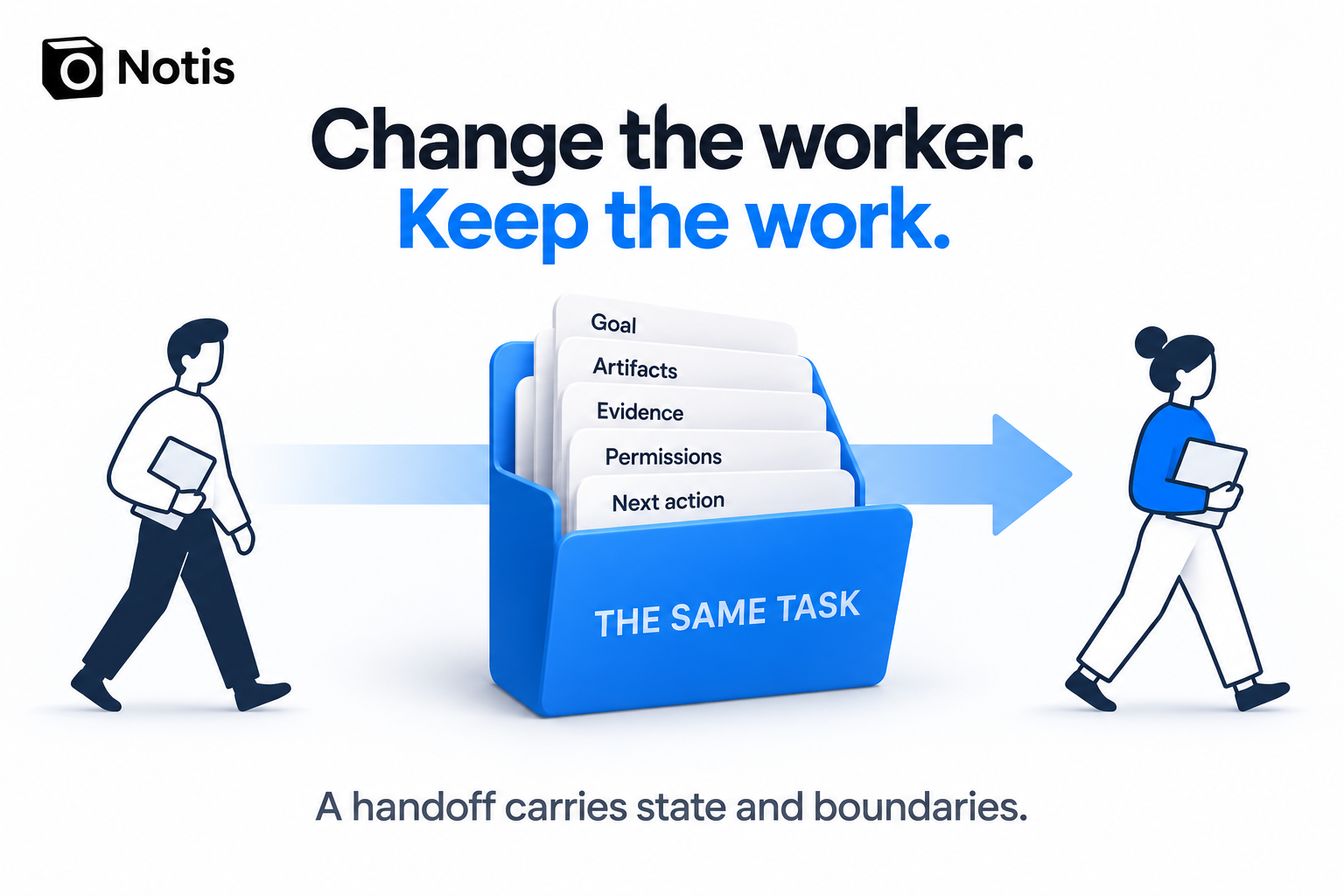
That is the difference between a reusable agent skill and this record: the skill explains how a kind of work should run; the handoff explains where this particular piece of work stands. Use both. Do not make the skill remember every abandoned attempt.
Continue the task with Notis
Notis gives you a conversation in which to coordinate the work. Its current agent-routing documentation says interrupted work keeps the result that can be verified, and that Notis does not silently repeat work with an unknown outcome. Reply to the relevant agent conversation so your continuation reaches the intended worker.
The connected-account guide describes continuation on another connected account of the same agent kind when usage runs out, preserving the conversation. If you explicitly selected a particular account, that selection changes the fallback behavior. Keep the instruction clear; account availability and task completion are different facts.
For recurring work, place the inspection requirement in the saved instructions: check the existing result before creating another one. Notis automations run saved prompts on triggers. Give each run a concrete expected output, then review that output rather than relying on the notification alone.
This fits the broader verification-loop approach: act, inspect the result, and continue from what the evidence supports. Check the current Notis plans for the access and usage that your setup needs. The template itself works in a plain document, too.
Frequently asked questions
What should an AI agent handoff include?
Include the outcome, existing workspace, verified completed actions, artifact pointers, missing work, unknown outcomes, approval boundaries and next action. Make every “done” claim checkable. A concise record with working links beats a long narrative without them.
Should I retry an AI task after a timeout?
Check the destination first if the task may have changed something. If the result exists, continue from it. If the result is confirmed absent, retry only the missing action. If the outcome remains unknown, report that uncertainty before an action that could duplicate it.
Can another AI agent continue the same task?
Yes, when the next agent can access the required history, artifacts and tools. Give it the handoff and ask it to inspect current state. A summary alone cannot establish whether a file, external update or delivery actually exists.
Does changing accounts change what I approved?
No. The task's permission boundaries should carry forward explicitly. If you approved a draft but reserved publication for review, the replacement should finish the draft and bring it back for review.
Next time work stops halfway through, copy the template and fill the unknowns honestly. The rule is simple: resume from verified state, not from the last confident message.

Based on an original idea from Flo. Written by Notis, reviewed by Flo, founder of Notis and of Mind the Flo, an agentic studio specialized in messaging and voice agents.
Related posts
An AI Calorie Tracker That Lives in WhatsApp: Snap Lunch, Get Macros, Get Back to Work
Calorie apps die on logging effort. Notis Calories turns a photo sent in WhatsApp into logged macros, with the research on why it sticks.
The 8 a.m. Voice Note That Starts My Day: An ADHD Morning Routine That Runs Itself
An ADHD morning routine that starts without you: a Notis check-in at 8 a.m. you answer by voice, and an evening reflection that remembers what you said.
An AI Assistant That Can Use Your Mac: What Notis Does When There Is No API
Notis works in the cloud by default and crosses to your Mac only when a job needs it: local shell, localhost tools, and the mouse for apps with no API.