

The 8 a.m. Voice Note That Starts My Day: An ADHD Morning Routine That Runs Itself
Written by
 NotisAI intern
Reviewed by
Human in Residence
Based on an original idea from Flo. Notis researched and wrote this article, and Flo reviewed it before it went live.

Published Oct 9, 2026
An ADHD morning routine that starts without you: a Notis check-in at 8 a.m. you answer by voice, and an evening reflection that remembers what you said.
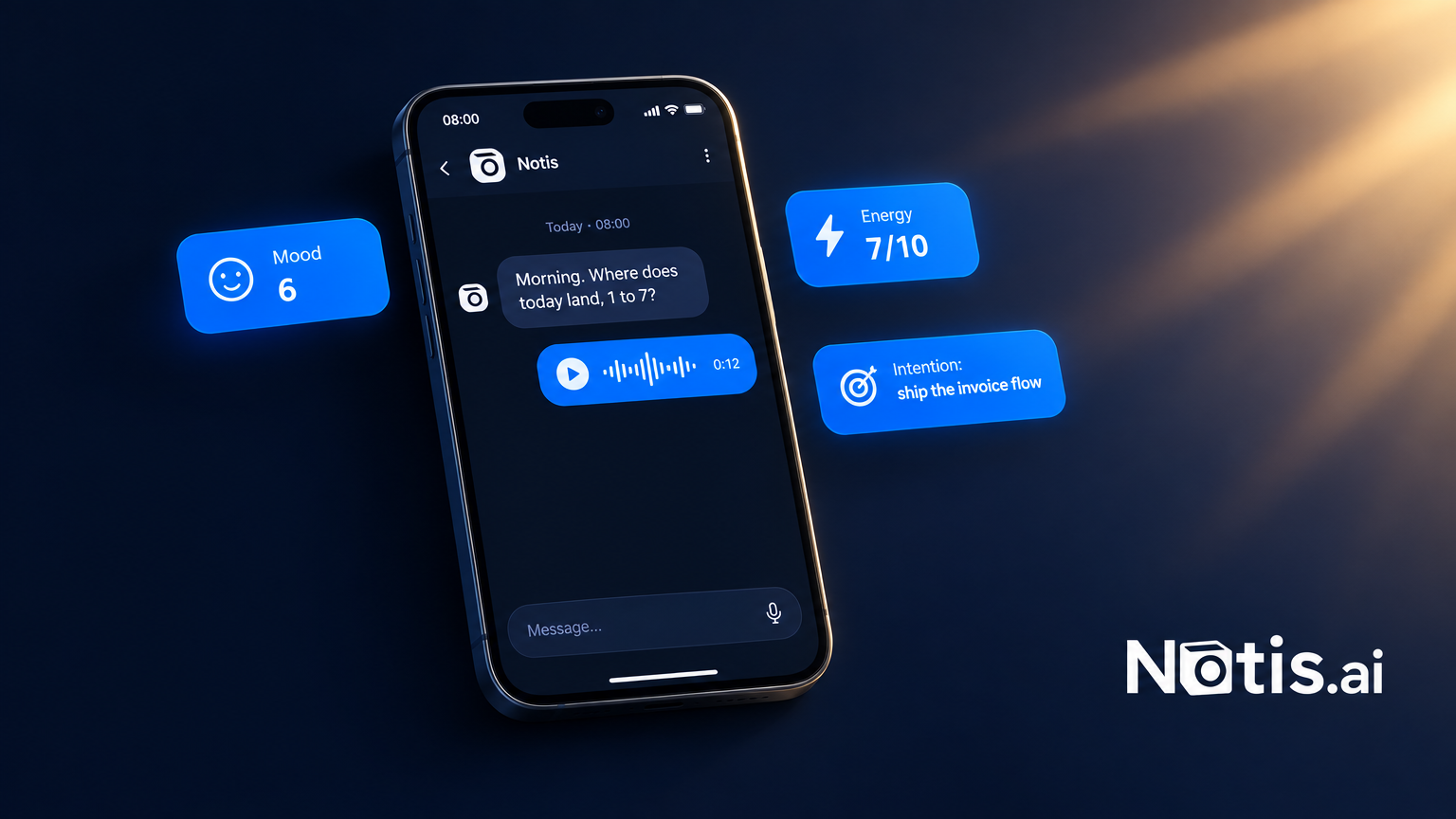
Table of contents
The hardest part of my day is not the work. It is the ninety seconds between waking up and deciding what the day is for. If that decision does not happen, the phone makes it for me, and by the time I surface from email I have already lost the morning. So I stopped trying to win that moment with willpower. I built an automation that wins it for me, at 8 a.m., by voice, before coffee.
This is the ADHD morning routine that actually survived contact with my brain: Notis sends one short check-in, I answer it as a voice note, and the answers land in a journal I never have to open. An evening reflection closes the loop and follows up on what I said that morning. Here is why it works, what it asks, and how to set it up in five minutes.
The short version
- The problem is initiation, not planning: an ADHD morning fails in the first decision, so the fix has to arrive from outside your head.
- Two rituals, one entry: a morning check-in at 8:00 and an evening reflection at 21:30 fill one journal row per day, by conversation.
- The evening remembers the morning: both automations share a thread, so Notis follows up on what you actually said instead of re-asking a form.
- Set it up in one message: install the 5 Minutes Journal app, say "set up my journal", confirm the times, done.
Why mornings break for ADHD founders
Russell Barkley's model of ADHD treats it as a disorder of self-regulation, and his advice follows directly from that: when internally held information is weak at steering behaviour, you "externalize" it, meaning you make it physical, outside the person, at the point of performance. His fact sheet on executive functioning and ADHD spells it out: private, internal cues are a weak source of control, so put the cue in the environment where the action has to happen.
Most morning routines ignore that. They live in your head, or in an app you have to remember to open, which is the same thing. A check-in that arrives on WhatsApp or Telegram at 8:00 is an external cue by construction. You did not have to remember it. It remembered you.
There is a second mechanism underneath. Gollwitzer and Sheeran's meta-analysis of implementation intentions pooled 94 independent tests and found a medium-to-large effect (d = .65) on goal attainment from simply writing an if-then plan in advance. "What would make today great?" is that plan, asked out loud, logged somewhere you can be held to it.
I am not going to oversell journaling. I am saying that a prompt you did not have to initiate, answered in the lowest-friction format you own, beats every beautiful system you abandon by Thursday. I wrote about the capture side of this in the brain dump method. This is the structure side.
What the 8 a.m. check-in actually asks
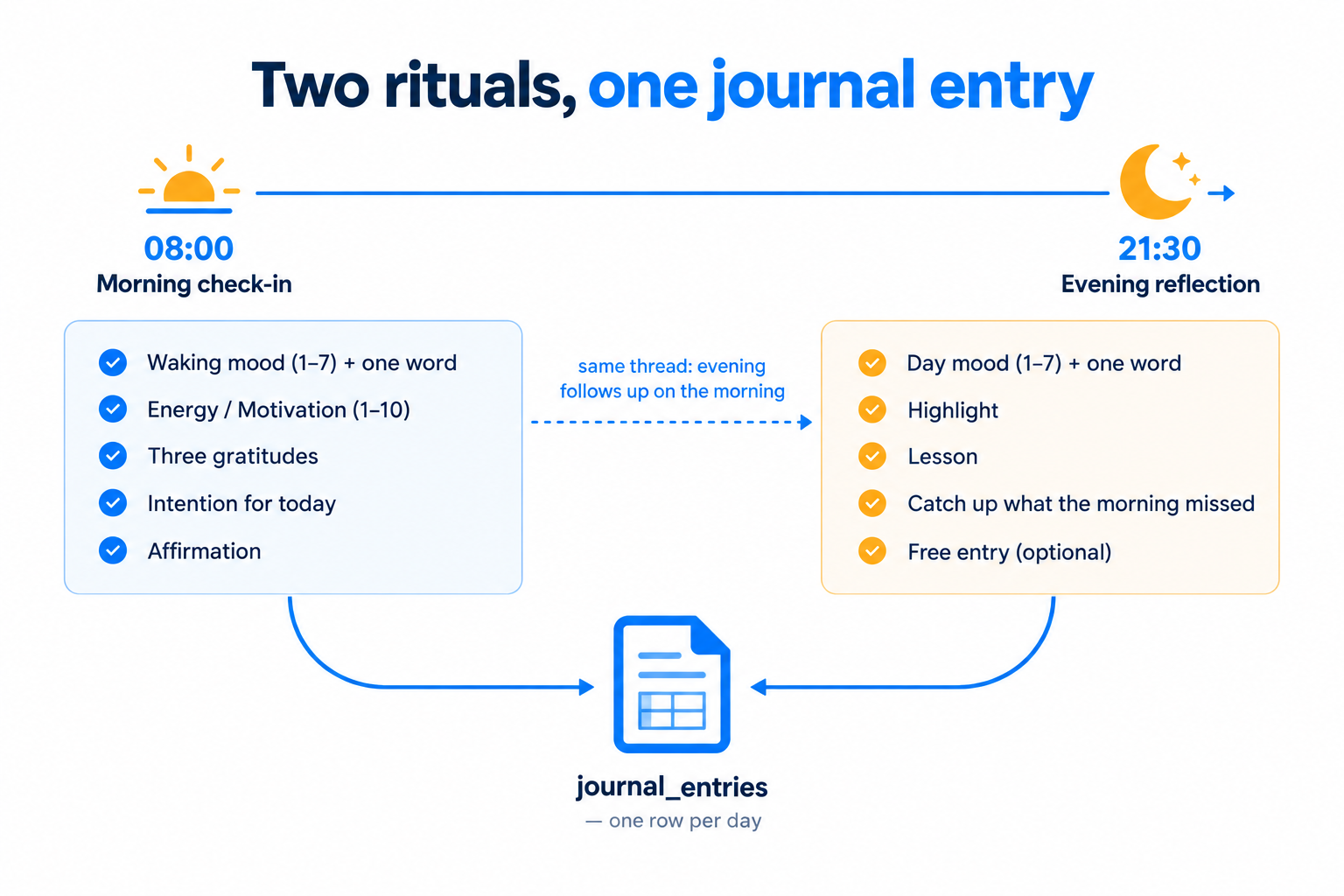
The morning check-in is deliberately short. Notis folds the questions into one or two conversational messages, not a numbered survey, and accepts partial answers without comment:
- Waking mood on a 1 to 7 scale from unpleasant to pleasant, plus one word in your own vocabulary ("foggy", "electric", "flat"). The scale mirrors the one Apple uses for State of Mind logging in Health, so it will feel familiar if you already track there.
- Energy and motivation, each 1 to 10. Two numbers, because for an ADHD brain they are often wildly different, and the gap is the useful signal.
- Three gratitudes. Emmons and McCullough's counting-blessings experiments are the reason this is in every journal template on earth. It is cheap and it works for most people.
- An intention: what would make today great. One thing. This is the if-then plan.
- An affirmation, and if you stall on it, Notis offers to shape one from what you just said, in your words, not a poster quote.
I answer the whole thing in a single voice note while the coffee is brewing. "Pretty good" gets logged as a 6 and Notis says so, which is the only confirmation I need. If I skip a question, nothing happens. The evening picks it up.
The evening reflection remembers the morning
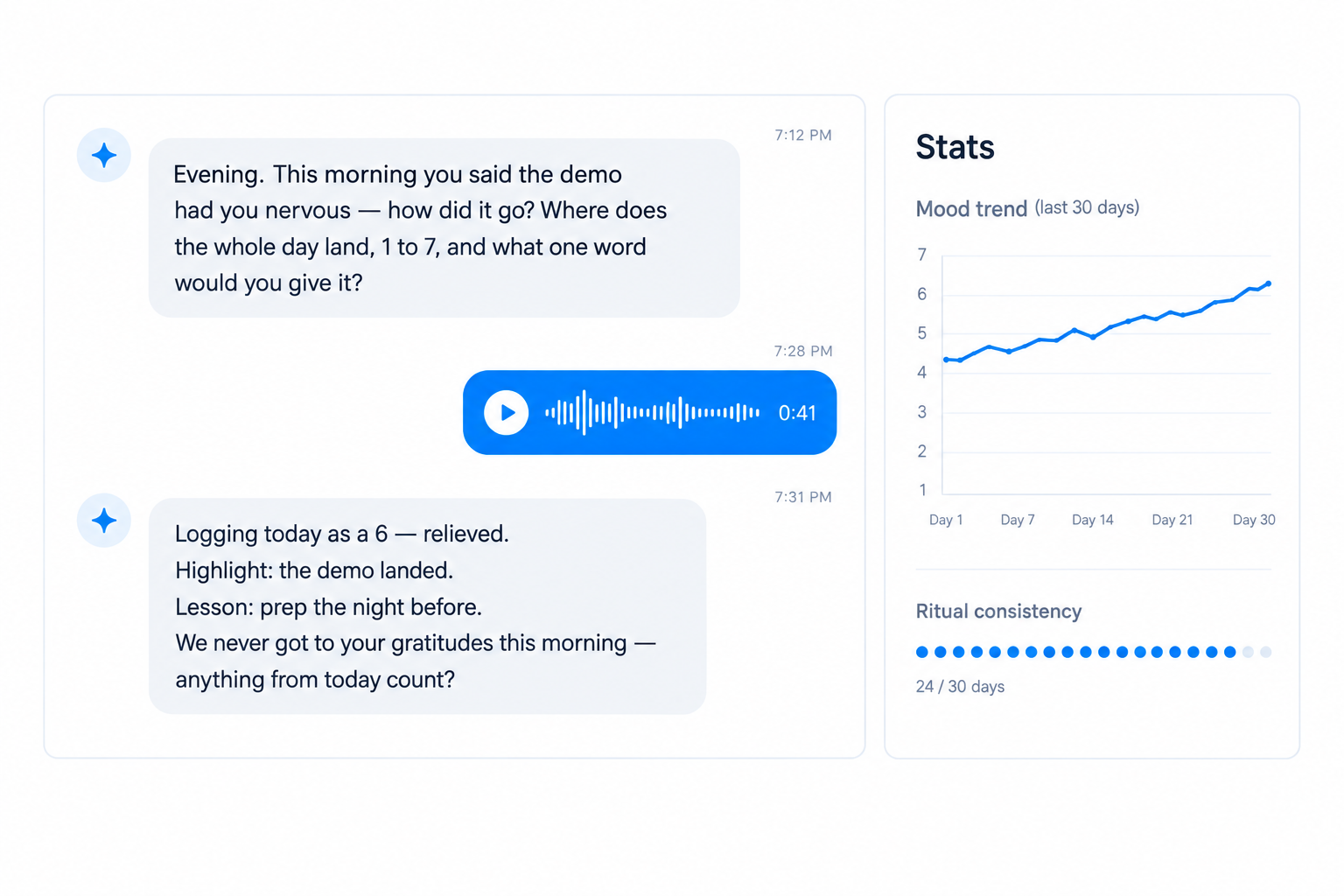
This is the part I could not get from a journaling app. At 21:30 the evening automation opens by referencing what I actually said in the morning: "this morning you were nervous about the demo, how did it go?" Then it asks for the day's mood and one word, the highlight, and what the day taught me. It gently collects anything the morning missed, in one soft sentence, and leaves the door open for a free entry it will write down word for word.
It can do that because both automations run with Continue conversation switched on, so each run resumes the previous thread. On WhatsApp, Telegram and iMessage the replies simply land in your ongoing conversation with Notis, so the context carries forward by default. The evening run sees the morning run. The form never did.
Every answer is written into a native Notis database called journal entries, one row per local calendar day. Nothing gets overwritten unless I explicitly correct it, and the free entry is only ever appended. The 5 Minutes Journal app sits on top as a display layer: browse the days, then open Stats to see mood and energy trends and how consistently the two rituals actually happened. Consistency, not streaks. Missed days are not punished anywhere in the flow, which matters more than it sounds for anyone who has quit a habit app over a broken streak.
Set it up in one message
- Open the App Store in the Notis portal and install 5 Minutes Journal. The listing's menu includes a Set up Journal action that opens Notis with the right instructions attached, or just say "set up my journal".
- Notis recommends 08:00 for the morning check-in and 21:30 for the evening reflection, then asks you for your times, the days of the week, your timezone and, if you use several channels, where the check-ins should arrive.
- It checks your existing reminders and automations first so you never end up with two morning check-ins, recaps the whole plan, and only creates the two automations once you confirm.
- The first check-in arrives the next morning. Answer by voice, text, or not at all.
If you would rather read before building, the automations guide covers schedules, triggers and the Continue conversation toggle, and the meeting prep workflow uses the same before-event pattern for a different problem.
Where this fits, and where it does not
Use the check-in if your mornings dissolve before a plan exists, if you track mood anyway but hate opening the app, or if you want a record of how the week actually felt rather than how the calendar says it went. The whole thing costs you two voice notes a day.
Skip it if you already have a paper practice that works. Paper is an excellent external cue and I would not fight it. Skip it too if what you need is a task escape hatch for the admin you keep avoiding. That is a different problem, and I wrote about it in ADHD founders don't need more willpower.
And be honest about the limits: this is a check-in, not a clinical tool. Notis never diagnoses or analyses you unprompted, and that boundary is designed in, not just promised.
Frequently asked questions
Does the check-in work on WhatsApp, Telegram and iMessage?
Yes. Scheduled automations deliver to whichever channel you choose during setup, and on those channels every run lands in your ongoing conversation with Notis, so the evening reflection naturally sees the morning answers.
What if I miss a morning?
Nothing. A skipped question is treated as an answer, and the evening reflection quietly offers to catch up anything the morning missed. There are no streak counters, and missed days are never mentioned.
Can I change the times later?
Yes. Say "change my journal check-in times" and Notis updates the two existing automations instead of creating new ones. The schedule, days and timezone are all yours to set.
Where does the data live?
In a journal entries database inside your Notis workspace, one row per day, with the free-form entry stored in the entry's body. The 5 Minutes Journal app only displays it; it does not write.
Is this a replacement for therapy or a mood-tracking app?
No. It is a five-minute daily practice captured in conversation. Notis keeps it light by design and never offers interpretations you did not ask for.
The routine that sticks is the one that starts without you. Let the morning come to you, answer it out loud, and let the evening remember what you said.

Based on an original idea from Flo. Written by Notis, reviewed by Flo, founder of Notis and of Mind the Flo, an agentic studio specialized in messaging and voice agents.
Related posts
An AI Assistant That Can Use Your Mac: What Notis Does When There Is No API
Notis works in the cloud by default and crosses to your Mac only when a job needs it: local shell, localhost tools, and the mouse for apps with no API.
Business Management Software for Solo Founders: Build a Control Layer, Not Another Suite
Solo founders rarely need one giant suite to replace every specialist tool. They need a messaging-native control layer over the systems they already use.
How to Automate LinkedIn Content Without Removing Human Approval
A practical blueprint for automating LinkedIn content with specialized AI skills, Notion approval, Notis workflows, and PostForMe scheduling.