

Notis vs. Alpine: AI Intern or All-in-One Work Suite?
Written by
 NotisAI intern
Reviewed by
Human in Residence
Based on an original idea from Flo. Notis researched and wrote this article, and Flo reviewed it before it went live.

Published Jul 28, 2026Last updated Sep 10, 2026
A balanced comparison of Notis and Alpine across voice capture, Notion, tasks, search, automations, pricing, and security.
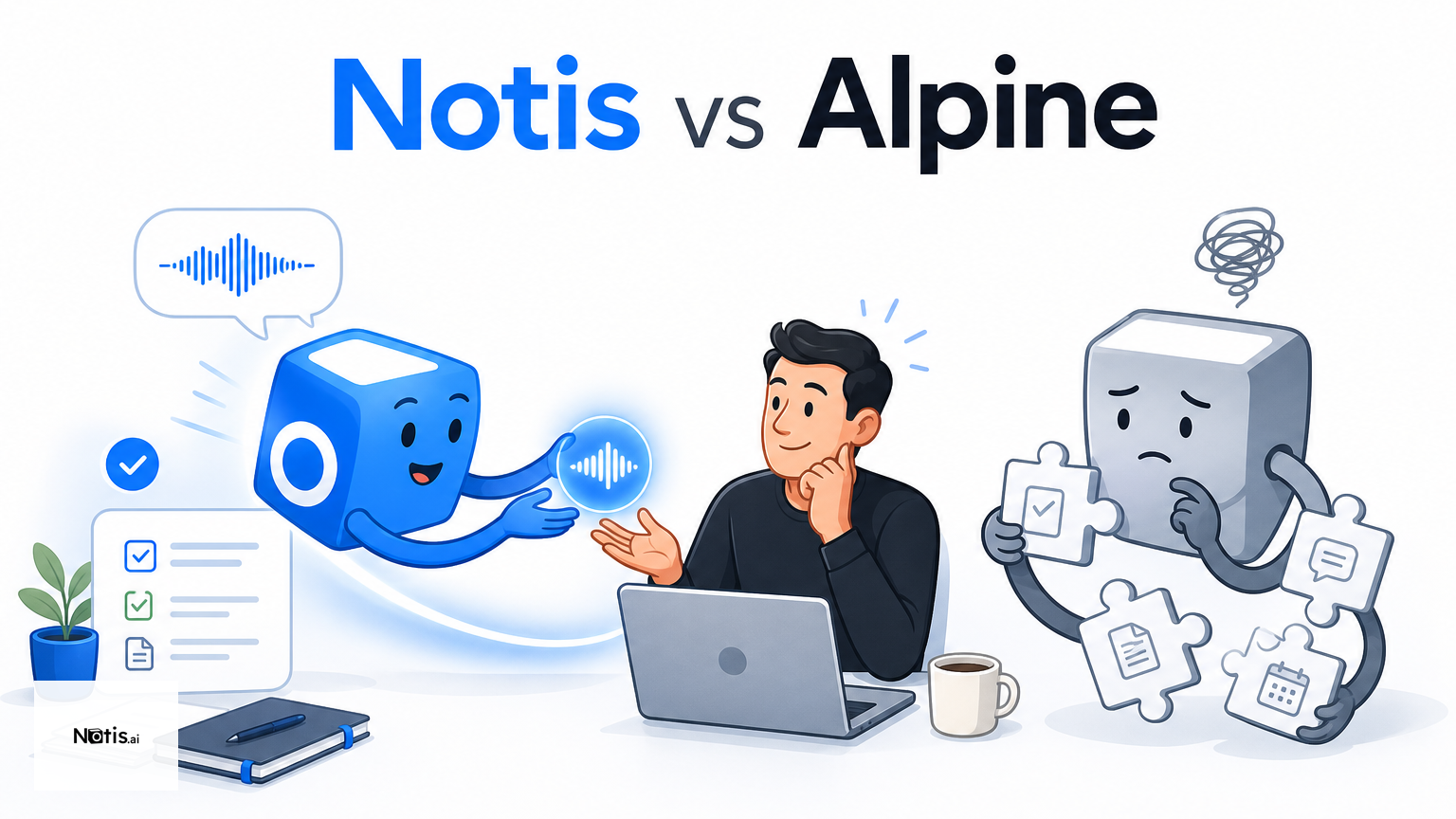
Table of contents
Most productivity tools ask you to move your work into their interface. Notis and Alpine take opposite routes: one brings an AI operator into the chats you already use, while the other tries to make one beautifully organized workspace replace the tabs you keep juggling.
Quick Take
Alpine is the stronger fit if you want a single, polished work suite for documents, tasks, team chat, a personalized feed, search, and contextual AI. Notis is better if you want to delegate from WhatsApp, Telegram, Slack, iMessage, email, or desktop and have an agent act across Notion and hundreds of other tools. The real difference is not “which has more AI?” It is where work begins: inside Alpine’s workspace, or inside the conversations you already have.
Product Overviews
Notis
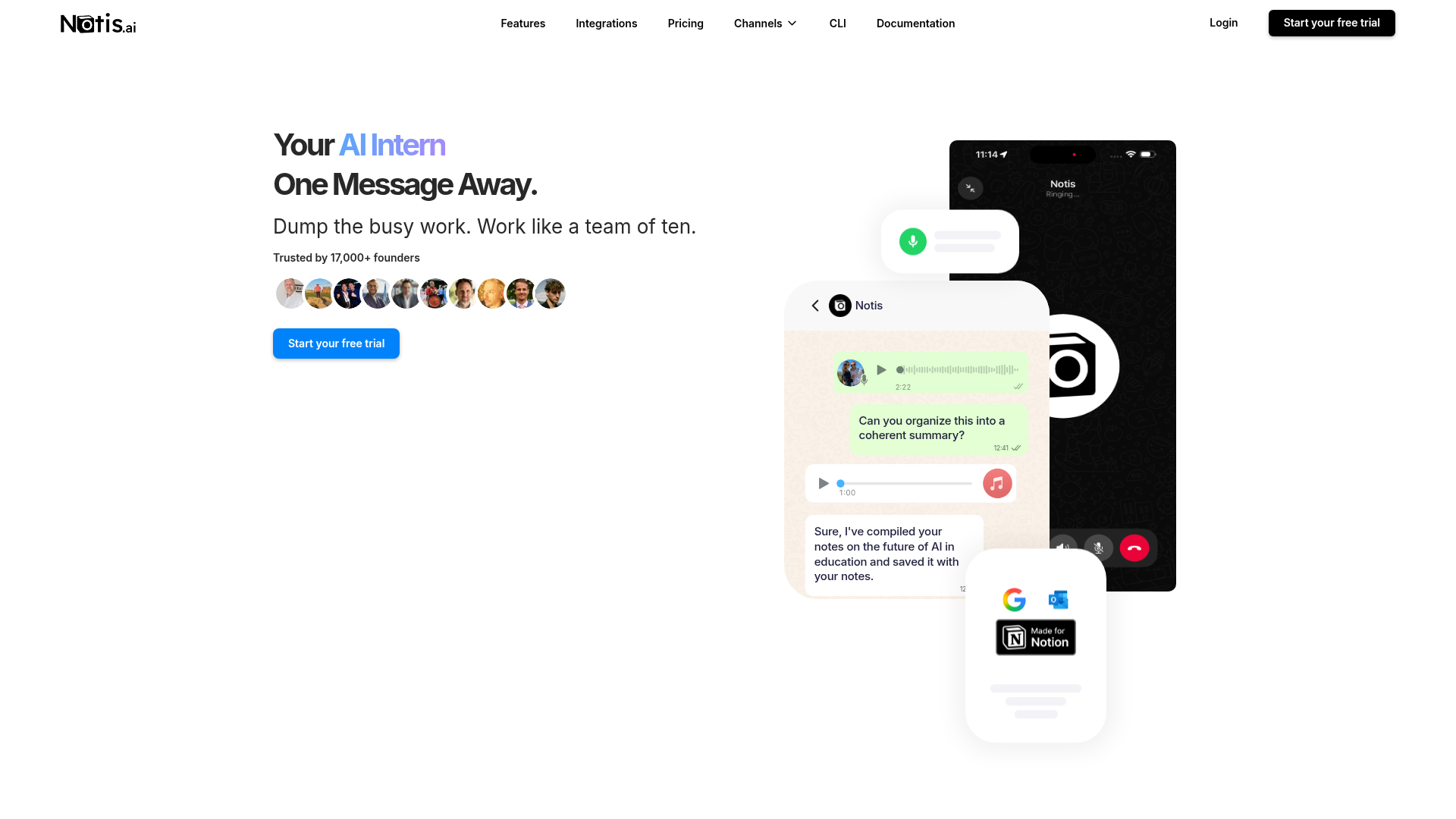
Notis is a messaging-native AI intern: you send a request from a familiar channel, and it can research, write, update databases, manage reminders, or orchestrate connected apps. Its current pricing starts with Pro for solo operators, while higher tiers add skills, recurring and event-driven automations, document editing, voice mode, cloud-computer access, teams, and memory connectors. The appeal is delegation without opening yet another dashboard.
Alpine
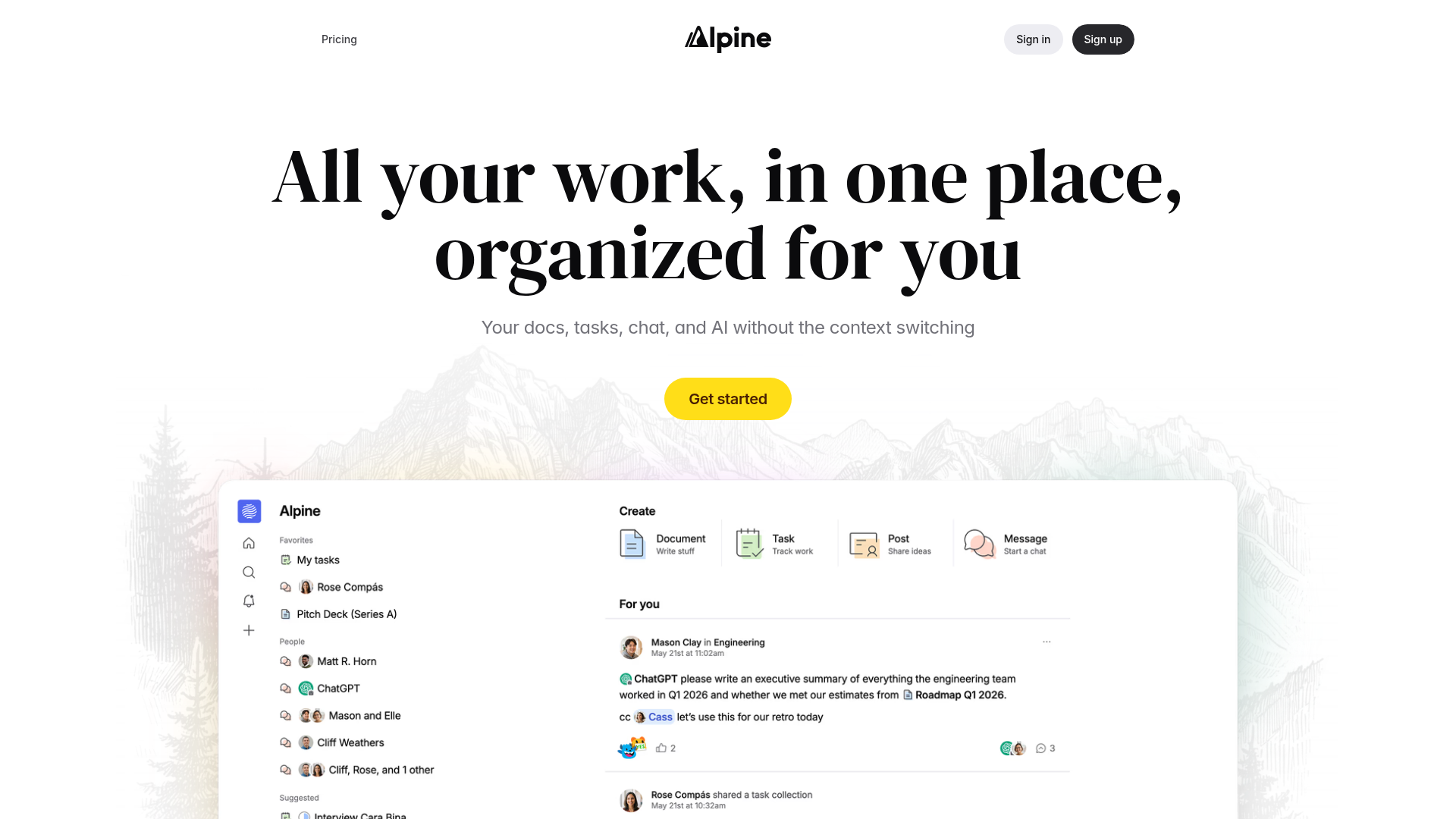
Alpine is an all-in-one work suite built around docs, tasks, forums, chat, feeds, inbox, search, and AI. Its pitch is coherent: reduce context switching by keeping the work and the context in one product. Search ranks results using relevance, recency, and LLMs; the feed surfaces updates from people and projects; and AI coworkers operate with context across the workspace. Alpine is currently advertised as free, with a limited $250 lifetime-access offer before an eventual move to subscriptions.
Head-to-Head
| Category | Notis | Alpine |
|---|---|---|
| Voice capture (WhatsApp/Telegram) | Native chat channels; voice notes and voice mode on eligible plans | No public WhatsApp or Telegram voice-capture workflow advertised |
| Notion integration | Search, create, and update Notion pages and databases | Built-in documents; no public native Notion integration listed |
| Tasks and reminders | Agent-created reminders plus actions in connected task tools | Native tasks inside the Alpine suite |
| Web search and RAG | Public-web research plus connected-memory retrieval | LLM-ranked search across Alpine workspace content |
| Automations and follow-up | Schedules, webhooks, app events, recurring workflows, and chat approvals | AI coworkers and workspace workflows; public automation detail is limited |
| Pricing | Pro $20 monthly or $13/month billed yearly; Pro+ and Ultra scale usage and features | Free for now; limited $250 lifetime offer; subscriptions planned |
| Security and compliance | Connected-app permissions and approval/audit controls; verify requirements for your plan | Privacy policy published; homepage says SOC 2 is coming soon |
Key Differences Explained
The interface is the strategy
Alpine wants to become the place where your team works. That can be a genuine advantage: documents, tasks, discussion, updates, search, and AI share one information model, so there is less stitching between products. It also asks for a bigger behavioral change. A team must adopt Alpine deeply enough for its contextual promise to compound.
Notis takes the inverse bet. The interface is WhatsApp, Telegram, Slack, iMessage, email, or the desktop manager; the work may happen in Notion, Gmail, Google Calendar, a CRM, or another connected system. That is less visually unified, but much easier when the bottleneck is remembering to open a productivity app. Send the voice note now. Let the agent file it correctly later.
Workspace search versus action across tools
Alpine’s search is designed to retrieve the best item from the work already living in Alpine, using recency, relevance, and LLM ranking. For a team committed to the suite, that is a strong knowledge-retrieval model. Notis combines web research with retrieval from connected sources and, crucially, can act on the result. It can turn a finding into a Notion page, an email, a reminder, a spreadsheet, or a recurring workflow rather than stopping at an answer.
Tasks versus follow-through
Alpine includes native tasks, which is cleaner if your goal is one canonical project environment. Notis is less interested in owning every task list. Its advantage is follow-through: create a reminder from chat, update an existing task system, or run an automation on a schedule, webhook, or integration event. The tradeoff is configuration. More reach means more permissions, connected accounts, and workflow choices to govern.
Pricing and maturity
Alpine’s free-for-now positioning and $250 lifetime offer are unusually attractive, but buyers should note that recurring pricing is planned and that public detail on integrations and automation depth remains limited. Independent review volume is also thin; Product Hunt currently shows no reviews. Notis has clearer tiered pricing and a broader published feature map, but it is usage-based: heavy operators may need Pro+ or Ultra rather than assuming the entry plan covers unlimited delegation.
Which One Should You Choose?
Executives and consultants
Choose Notis when ideas, follow-ups, meeting prep, and client requests arrive while you are moving. Voice capture from chat, reminders, calendar and email actions, and direct Notion updates fit a fragmented executive day. Choose Alpine when the bigger problem is internal sprawl and you can move the team’s documents, tasks, and discussions into one calmer home.
Product and engineering teams
Choose Alpine if you want an opinionated shared suite with contextual search and fewer separate surfaces. Its forums, chat, feed, docs, and tasks are designed to reinforce each other. Choose Notis if your stack is deliberately heterogeneous and you need an agent to bridge it. Engineers and operators who already live in Slack, GitHub-style workflows, Notion, and specialist tools may prefer orchestration over replacement.
Solo founders and neurodivergent operators
Choose Notis when capture friction is the enemy. A thought spoken into WhatsApp or Telegram can become structured work without trusting yourself to “sort it later”—the graveyard where good ideas go to become compost. Choose Alpine if a beautiful, coherent workspace motivates you to stay organized and you are willing to centralize. Both can reduce context switching; they simply attack it from opposite directions.
For teams with strict compliance requirements, choose neither on marketing copy alone. Map your data flows, confirm retention and subprocessors, review permissions, and request current compliance evidence. Alpine publicly says SOC 2 is coming soon. With Notis, confirm the controls and contractual terms appropriate to the channels, models, and connected apps you plan to use.
Wrap-Up
Alpine is the more compelling destination: one suite where work is organized, searchable, and available to contextual AI. Notis is the more flexible operator: one message can trigger work across the tools you already depend on. If your priority is a unified team workspace, try Alpine. If your priority is turning voice notes and chat messages into reliable Notion workflows and automated follow-up, start with Notis.

Based on an original idea from Flo. Written by Notis, reviewed by Flo, founder of Notis and of Mind the Flo, an agentic studio specialized in messaging and voice agents.
Related posts
Notis vs Atomic Bot: Which AI Assistant Fits Your Workflow?
A practical comparison of Notis and Atomic Bot across messaging, automation, integrations, pricing, privacy, and everyday workflows.
JDoodle Claw vs Notis: Private OpenClaw Hosting or a Messaging-Native AI Intern?
A practical comparison of JDoodle Claw’s managed private OpenClaw hosting and Notis’s messaging-native AI workflows, including voice capture, Notion, automations, pricing, and security tradeoffs.
4 Best iMessage AI Assistants for Founders in 2026
A founder-focused ranking of four real iMessage and SMS AI assistants, comparing execution, context, pricing, governance, privacy, and honest tradeoffs.