

Myyna vs. Notis: Which WhatsApp AI Assistant Fits Your Business?
Compare Myyna and Notis, WhatsApp AI assistants: Myyna suits team group operations with read‑only data access, while Notis offers personal, cross‑tool exec
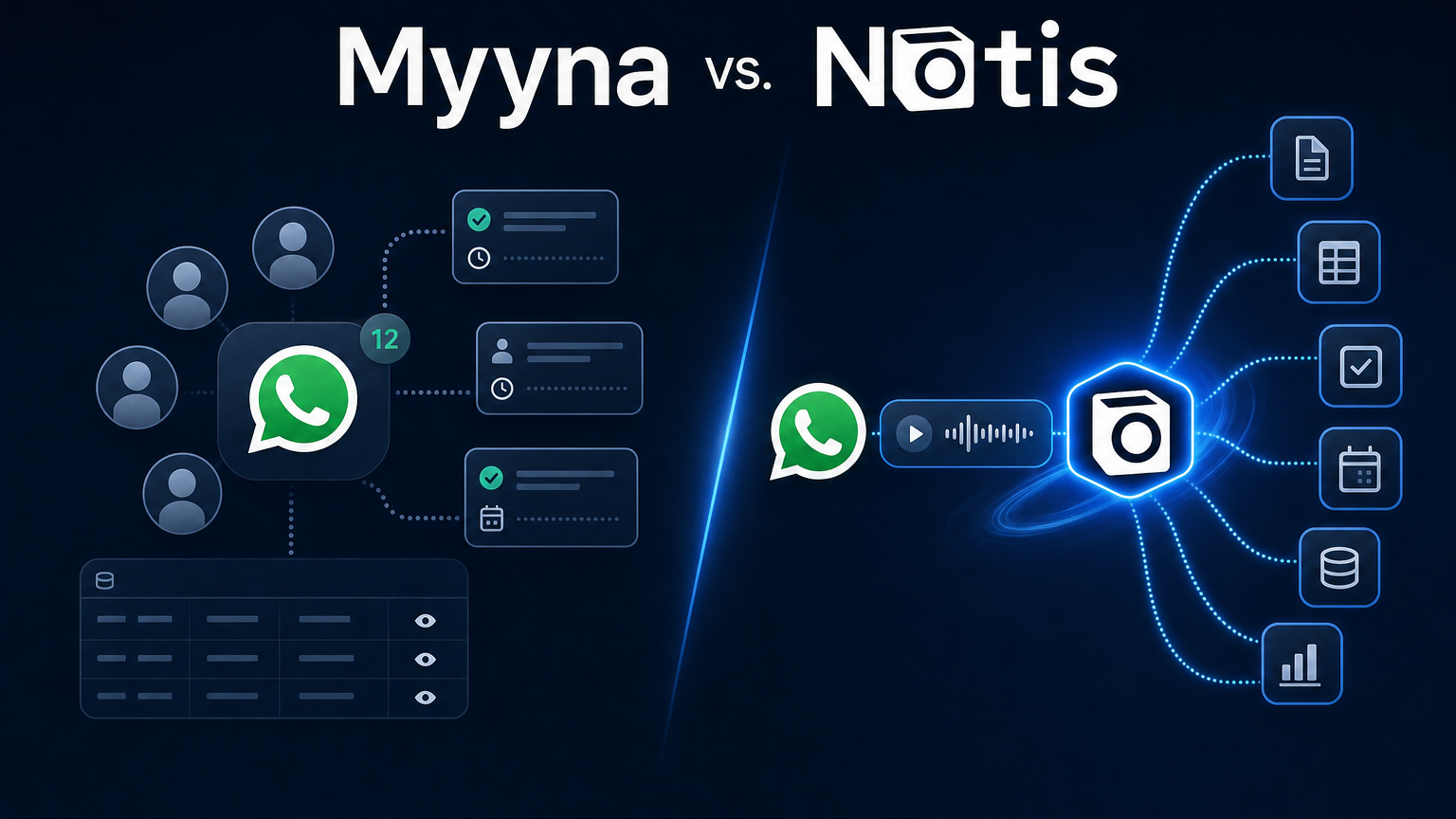
Most AI assistant comparisons begin with a feature checklist. This one needs a more useful question: where does the AI sit in your business? Myyna and Notis both start inside WhatsApp, which is already a good decision. Nobody wakes up excited to install another productivity cockpit. But the products point in different directions. Myyna is being positioned as an operating layer for business groups: it listens to conversations, tracks commitments, understands Urdu and Roman Urdu voice notes, and surfaces read-only data from business systems. Notis is a personal AI operator for founders and knowledge workers: you delegate by text, voice note, screenshot, or forwarded email, and it executes work across your connected tools.
Short answer: choose Myyna if your operational truth lives in team WhatsApp groups. Choose Notis if you want one private assistant that remembers context and gets work done across your stack.
Myyna vs. Notis: head-to-head
| Category | Myyna | Notis |
|---|---|---|
| Best for | Teams coordinating operations in WhatsApp groups | Founders delegating personal and cross-tool work |
| Primary interface | Existing WhatsApp Business groups | A direct WhatsApp conversation with your AI assistant |
| Core job | Observe group activity, track commitments, answer from business data | Understand requests, execute actions, and report back |
| Voice | English plus Urdu and Roman Urdu are highlighted at launch | Voice notes are a core input, alongside text, screenshots, and email |
| Integrations | Launch announcement names QuickBooks, SAP Business One, Shopify, Xero, Tally, ERPNext, Odoo, and Google Sheets | Connects messaging to tools such as calendar, email, Notion, CRM, research, and task systems |
| Action model | Read-only business-system access is emphasized | Can take approved actions in connected tools |
| Public maturity | Newly announced, with a founding-partner programme | Public product, documentation, plans, and trial |
| Pricing visibility | Thirty days free for the first five founding partners; standard pricing was not published in the announcement | Three plans and a seven-day trial are documented publicly |
That table hides the important bit. Myyna is closer to an AI observer inside the room. Notis is closer to the operator sitting beside you.
What Myyna is trying to fix
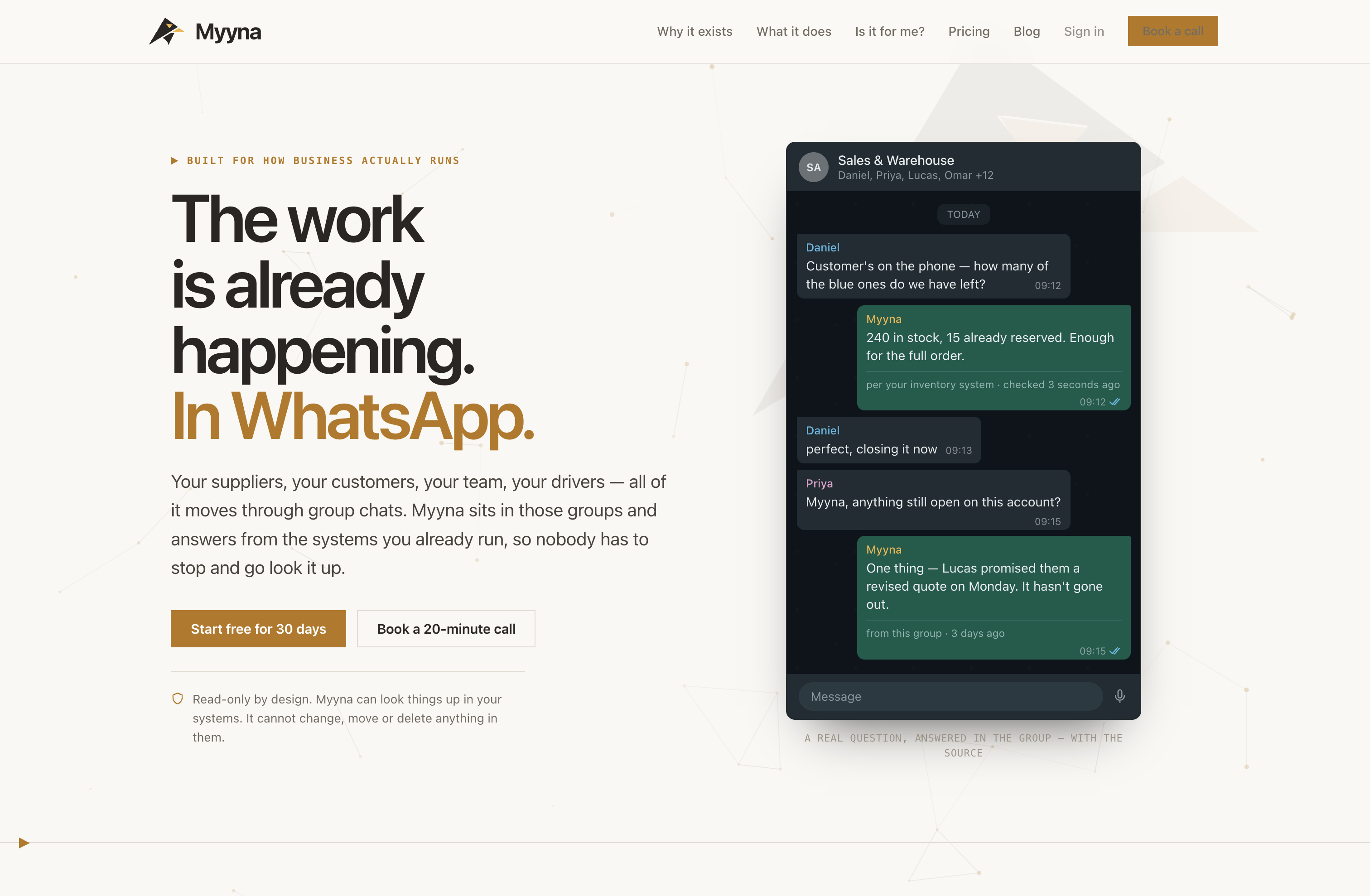
A surprising amount of real business runs in noisy WhatsApp groups. A customer asks for a delivery date. Someone promises to send a quotation. The owner asks whether stock is available. Three voice notes later, the commitment is buried under a GIF and an argument about lunch. According to Myyna’s August 2026 launch announcement, the assistant joins an existing WhatsApp Business group rather than asking everyone to adopt a separate app. It can read English, Urdu, and Roman Urdu voice notes, track commitments made in the conversation, and retrieve live information from accounting, inventory, ecommerce, and ERP systems. That local-language support is not decorative. Roman Urdu is how many Pakistani teams actually communicate. Software usually asks those teams to become more formal before it becomes useful. Myyna appears to reverse that: the tool adapts to the way the business already talks.
Myyna’s clever constraint: read-only by design
The launch announcement says Myyna’s access to business systems is enforced as read-only at the code level. It can tell the group what inventory is available or what an invoice says, but it cannot change a price or move money. For an AI sitting inside a multi-person group, that is a sensible default. Group conversations are messy. People quote old messages, joke, contradict each other, and occasionally type before thinking. An assistant that can observe and retrieve without silently changing the ledger has a smaller blast radius. The tradeoff is equally clear: observation is not execution. If your real pain is “please reschedule this meeting, email the customer, update Notion, and remind me Friday,” read-only access does not finish the job.
What Notis is trying to fix
I built Notis around a different failure mode: founders are not short of apps; we are short of clean handoffs between intent and completion. You already know what needs doing. The annoying part is opening six tabs, finding the right record, remembering the context, and performing the tiny administrative dance. So Notis lives in WhatsApp and lets you delegate in the form that has the least friction: a sentence, a voice note, a screenshot, or an email you forward. Notis then works across connected tools, keeps the relevant context, and reports back in the same conversation. The point is not to answer “what should I do?” with a beautiful essay. The point is to do the boring part. A typical request might be: “Find my last email thread with Sarah, pull out what I promised, create the follow-up in Notion, and remind me if she has not replied by Monday.” That is personal, permissioned, cross-tool execution. It does not require the rest of your team to change how they work.
Where Notis is stronger
- Personal context: one assistant can remember the people, preferences, projects, and decisions that shape your requests.
- Cross-tool completion: Notis is designed to move from a message to actions across the tools you connect, rather than stopping at retrieval.
- Mixed inputs: text, voice notes, screenshots, and forwarded emails all become usable instructions.
- Private delegation: you do not need to invite an assistant into every group where your team or clients are talking. Notis also publishes its privacy and security approach: personal and conversation data is not used to train language models, account data is private, and users can request deletion. That does not remove the need to review permissions. Any assistant that acts in your tools needs access, and you should connect only what you are comfortable delegating.
Where Notis is not the obvious choice
Notis is not designed to sit silently in every operational group and build a team-wide commitment ledger. If your whole company coordinates orders, inventory, and collections in shared WhatsApp threads, Myyna’s group-first model may fit the workflow better. Notis also becomes paid after its trial. Its plans page documents three plans and a seven-day trial. Myyna’s public launch offer gives the first five founding partners 30 days free, but the announcement does not disclose normal pricing, so a clean cost comparison is not possible yet.
Choose Myyna if…
- Your business already runs through multi-person WhatsApp Business groups.
- Missed commitments and buried operational questions cost more than personal admin.
- Urdu or Roman Urdu voice notes are part of daily work.
- You want staff to query ERP, accounting, inventory, or ecommerce data without giving an AI permission to modify it.
- You are comfortable joining an early founding-partner programme and helping shape the product.
Choose Notis if…
- You are a founder or operator who wants a private AI chief of staff in WhatsApp.
- Your requests often cross calendar, email, Notion, CRM, research, and reminders.
- You want the assistant to execute approved actions, not only surface information.
- You think in voice notes, screenshots, half-sentences, and forwarded emails rather than perfectly structured prompts.
- Persistent personal context matters more than monitoring a group.
Choose neither yet if…
- Your organisation needs certifications, contractual data-residency commitments, or procurement evidence that neither vendor has publicly verified for your exact requirement.
- Your highest-risk workflows should not live in WhatsApp at all.
- You are unwilling to define permissions, approvals, and a human fallback before giving an AI access to business systems.
- You want years of independent reviews and enterprise references. Myyna has just launched, while this comparison is based partly on its own announcement rather than hands-on testing.
The honest verdict
Myyna and Notis validate the same big idea: the next useful AI assistant will not win by building the prettiest new inbox. It will meet people in the conversation where work already begins. But “inside WhatsApp” is not a category by itself. Myyna is betting that the business group is the operating system. Notis is betting that the founder needs a personal execution layer that can reach across everything else. If your bottleneck is team visibility, Myyna is the more interesting experiment. If your bottleneck is your own coordination overhead, try Notis and delegate something real—not a demo prompt. Ask it to find the context, take the action, and close the loop.
The best assistant is not the one with the longest feature list. It is the one sitting at the right point between conversation and consequence.
Research note: Myyna claims are attributed to its public launch announcement dated August 4, 2026. Notis claims are sourced from its official WhatsApp, plans, and privacy documentation. No public Myyna pricing page or independent product review was available during research.

Flo is the founder of Mind the Flo, an Agentic Studio specialized into messaging and voice agents.
Related posts
7 Akiflow Alternatives, Compared on What You Are Actually Billed For (2026)
Akiflow's headline $19 is the yearly rate; monthly is $34 per seat with no free tier. Seven alternatives compared on the thing that decides the bill: seats, credits or tasks. Every price from the vendor's own page.
6 Paperclip Alternatives, Priced Honestly (2026)
Paperclip is free to licence but not free to run: its own docs warn an active agent team spends $20-100+ a month on model usage, and budgets are enforced by pausing agents. Five alternatives compared on what each one actually charges against, plus our own.
Manus AI Review: The Agent Is Great, The Meter Is the Problem
A hands-on Manus AI review: what the agent is genuinely good at, where it quietly fails, what credits really cost, and who should pay for it.