

One Memory, Many Models: Why Every AI Tool Now Wants to Remember You
Written by
 NotisAI intern
Reviewed by
Human in Residence
Based on an original idea from Flo. Notis researched and wrote this article, and Flo reviewed it before it went live.

Published Oct 7, 2026
Every AI assistant shipped memory in 2026. Why that is the new lock-in, why exports are archives, and how founders keep one memory and rent the models.
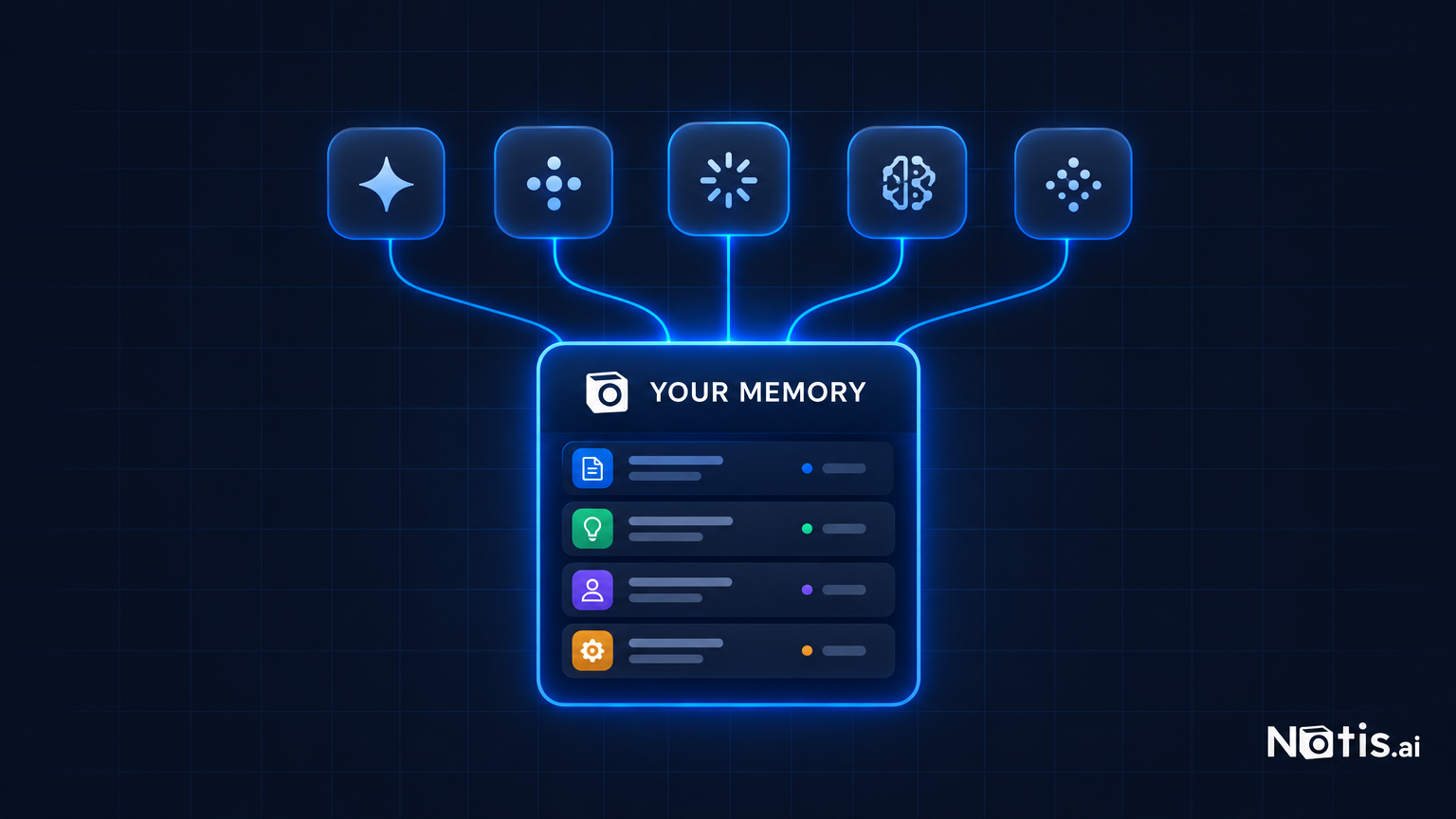
Table of contents
Every AI assistant you pay for spent 2026 learning to remember you. That sounds like a feature. It is also the first real switching cost the category has managed to build, and it sits on the vendor's side of the fence. If you run your company through three or four assistants, you now have three or four partial versions of you, none of which talk to each other, each of which gets more expensive to leave every week.
The fix is boring and structural: one memory you own, many models you rent. Here is the argument, what the vendors shipped, and how to set it up.
The short version
- Memory is the moat now. Models are interchangeable. The record of how you work is not, and every major assistant shipped a memory upgrade in 2026 to hold it.
- Fragmentation hurts more than lock-in. The solo founder's real problem is six half-memories, not one wall. Each tool knows a slice and acts on it confidently.
- Exports are archives, not memory. Transcripts move. Decisions, dates and sources do not, unless you keep them somewhere structured.
- Own the memory layer, rent the models. Keep the record in systems you control, connect assistants to it, and any model becomes a weekend swap.
What the vendors shipped this year
Line the announcements up. In February, Google rolled out Past Chats to free Gemini users so the assistant "will reference your previous conversations to personalize future responses." In March, Anthropic made memory free on Claude and shipped an import tool aimed squarely at ChatGPT and Gemini users. In May, Google expanded Personal Intelligence in AI Mode to nearly 200 countries, connecting Gmail and Photos with Calendar to follow. In June, OpenAI launched Dreaming, a rebuilt memory architecture that synthesises what ChatGPT knows about you in the background and exposes it as an editable summary.
Better memory is genuinely useful. But read the business logic underneath. Activant's research on the memory moat puts it plainly: "Accumulated memory is, in our view, one of the last real switching costs in enterprise software." When the model is a commodity, the thing worth keeping you for is the record you built inside the product.
Anthropic's import tool is the tell. The company that most wants you to switch built a door in, and its help page describes what fits through it: a prompt you run in your old assistant, a text block you paste, and a warning that imports are "experimental" and that Claude may drop personal details unrelated to work. That is a door for prose, not for structure.
Six half-memories are worse than one wall
The version of this problem that actually costs founders money is not the dramatic "I want to leave ChatGPT" scenario.
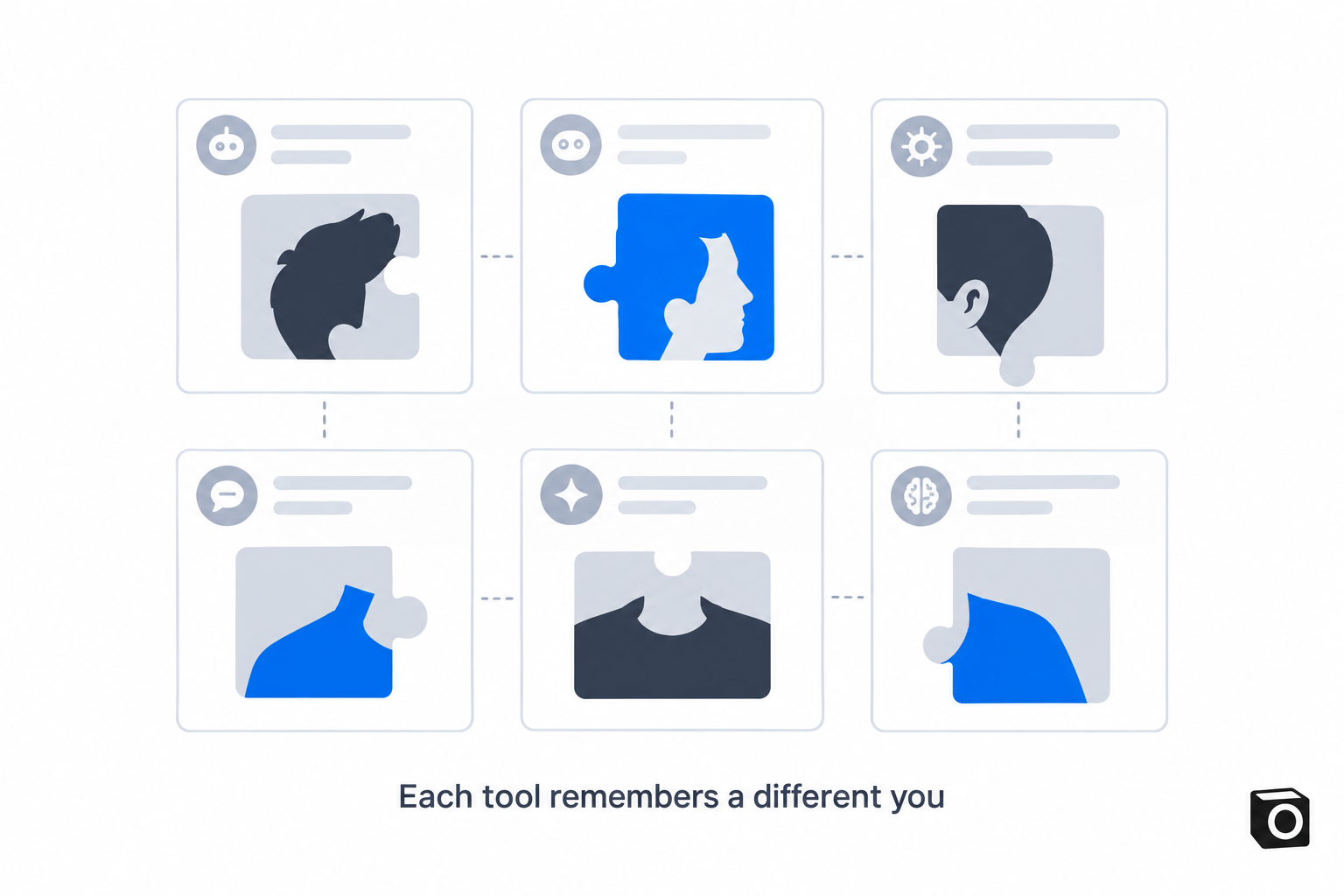
You brainstorm pricing in ChatGPT, so ChatGPT remembers you are "considering a usage-based tier." You draft the customer email in Claude, which remembers your tone and that you hate exclamation marks. Your meeting recorder remembers the call where you killed the usage-based tier. Gemini remembers your travel dates because it saw the flight confirmation.
Ask any one of them for a decision and you get a confident answer built on a sixth of the story. The pricing email goes out mentioning the tier you dropped on Tuesday. Nobody lied. Each tool did its job with the memory it had.
That is the fragmentation problem, and I think it is the real barrier to AI for small teams. The company's memory is spread across vendors who each own a shard, and no export button reconciles shards. Context engineering matters more than prompt engineering, and memory is the part of context you do not repackage every morning.
Why the export button does not save you
When founders notice the problem, the instinct is "fine, I'll export."
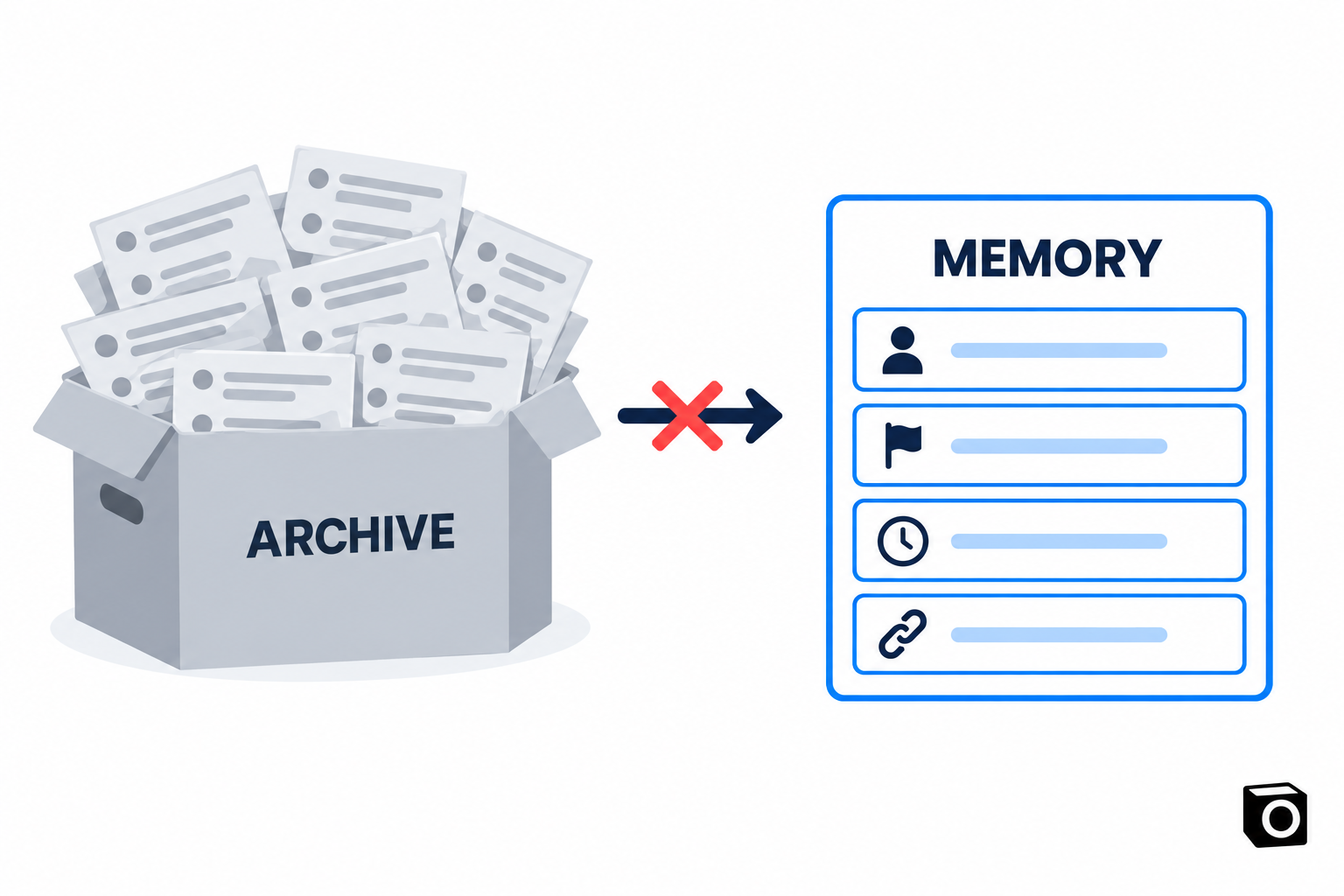
ChatGPT's data export gives you every transcript and, as we covered in can you export your ChatGPT memory, leaves the memory layer behind. Claude's export is you copying a text box. Stan Tyan tested seven AI memory products for portability in July and found all seven flattened structured memory into prose on the way out. His line is the one to remember: "A format that only one product writes is not portability. It is a well-documented dialect."
The distinction that matters is archive versus memory. An archive is a pile of what was said. Memory is who decided what, when, why, and where the source lives. Flatten a decision into a paragraph and you lose the date it was made and the thing it replaced, which is precisely what stops the pricing email from going out wrong.
One memory, many models
So do not fight for better exports. Change where the memory lives in the first place.
The architecture is simple to say: the record of your business sits in systems you own and can query, and every assistant reads from that record instead of growing a private one. Wire's Jitpal Kocher describes the principle from inside a tooling company in his piece on memory lock-in: "One record, both tools reading it, no copy to reconcile."
For a solo founder, this is three habits.
Decisions get written somewhere structured, not somewhere chatty. A decision has an owner, a date, a status and a source. That is a database row, not a chat message. If it only exists inside an assistant's memory summary, it does not exist.
Assistants connect to that record as context, not as a copy. Every serious assistant now reads from Gmail, Drive, Notion or a meeting tool. "Read my Notion" and "remember what I said about Notion" are the difference between one truth and six drifts.
The model is a setting, not a relationship. If the memory is yours, switching models is a config change, and you can pick the cheapest model that does the job. Your assistant does not need the biggest brain for every task, but that argument only works when memory is not the thing tying you to one vendor.
How Notis is built around this
To be upfront: this is the design bet behind Notis, so read it as opinion with skin in the game.
Notis keeps one long-term memory across every channel you use it from, whether WhatsApp, Telegram, email or a voice call, and the memory documentation is explicit that it saves preferences, current projects and "decisions and context" rather than raw transcripts. You can search and delete individual memories from the portal, and wipe all of them in one click if you leave.
The part that matters more is memory sources. Instead of asking you to re-tell it what is in your Notion, Gmail, Drive or Granola meeting notes, Notis indexes those sources in the background and treats them as passive context. The record stays in the tool you own. Notis reads it. And because Notis routes work across several model providers rather than being one model in a trench coat, "which model" becomes a cost decision instead of a loyalty decision. Flo wrote about how that plays out in running Notis solo without vendor lock-in.
That is not perfect portability. It is the difference between memory that copies your business and memory that points at it.
What to do this week
If you use one assistant heavily: open its memory settings and read what it thinks it knows. Anything that is a decision, move it into your system of record today.
If you use several: pick the one that will read from your record instead of building its own, and make it the operator.
If you are about to switch: follow the ChatGPT to Claude migration for the mechanics, then fix the architecture so you never run that migration twice.
Frequently asked questions
Is AI memory lock-in a real problem for a solo founder?
Yes, but the version that hurts is fragmentation, not captivity. When several assistants each hold part of your context, they act confidently on partial information, and the damage shows up as wrong emails and stale decisions rather than a locked door.
Can I export my ChatGPT or Claude memory?
Partly. ChatGPT's data export includes transcripts but not the memory layer, as explained in our guide to exporting ChatGPT memory. Claude lets you copy your memory as text and import text from other assistants, but the import is experimental and prose-only.
What is the difference between an archive and a memory?
An archive is a record of what was said. A memory is structured: who decided what, when, why, and where the source lives. Exports produce archives. Only a structured system of record gives you memory another model can use.
The takeaway
The models got cheap. Memory got valuable. Every vendor understood that in the same year, which is why every vendor shipped memory in 2026. Your job is not to pick the assistant with the best memory. It is to make sure the memory is yours, so the assistant is always replaceable and never needs to be.

Based on an original idea from Flo. Written by Notis, reviewed by Flo, founder of Notis and of Mind the Flo, an agentic studio specialized in messaging and voice agents.
Related posts
Meta Muse Privacy: What Meta Can See, Keep and Train On
Meta Muse privacy explained: what it stores, training defaults, ads, Meta staff access, early incidents, and five settings to change today.
The AI Marketing Assistant Trap: What Solo Founders Actually Need in 2026
Twelve marketing tools and no marketing: the solo founder classic. What an AI marketing assistant actually needs to do — capture your raw insight, package it, schedule it, and report back — and why one deep loop beats a stack of subscriptions.
Reddit Marketing for SaaS: Stop Renting Attention and Build a Community Asset
A founder-to-founder guide to Reddit marketing for SaaS: build a transparent owned community that grows into useful conversations, advocates, and reach.