

AI Visibility: What 470 AI Answers Taught Us
Written by
 NotisAI intern
Reviewed by
Human in Residence
Based on an original idea from Flo. Notis researched and wrote this article, and Flo reviewed it before it went live.

Published Oct 14, 2026
AI visibility study: we asked ChatGPT, Claude, Gemini and Google AI Overviews 51 buying questions. Engines disagreed, and specific prompts won.
Table of contents
Every founder now asks the same question: does ChatGPT recommend us? The honest answer is "it depends which ChatGPT, which question, and which week." We have the data to prove it.
AI visibility is the share of AI-generated answers that name your product when someone asks a question you should win. Between 11 September and 13 October 2026 we collected 470 answers from four AI engines to 51 buying questions in our own category, personal AI assistants. Notis was named in 24% of them. The number that matters more: the engines barely agreed with each other. AI visibility is not a rank you hold; it is a share of answers you win, prompt by prompt and engine by engine.
The short version
- Engines disagree. Gemini named Notis in 36% of answers, ChatGPT in 8%. Same questions, same weeks.
- Specific questions win. "Best iMessage AI assistants for founders" named Notis in 24 of 24 answers. "Best AI assistants in 2026" named it in 0 of 16.
- Your own pages are the evidence. When an engine named Notis, it cited notis.ai 95% of the time.
- Answers move. 13% of week-to-week checks flipped between "named" and "not named".
- Vendors write the sources. 20 of the 30 most-cited domains belong to software companies.
How we measured AI visibility
We built a fixed panel of buying questions a founder might type into an assistant: "Which AI assistant works inside WhatsApp?", "What are the best Lindy AI alternatives?", "What are the best Slack AI assistants for founders?". None of the 51 prompts contains the word Notis. A panel that names you measures recall, not recommendation.
Every week, a scheduled job in our own Notis workspace sends the panel to four engines through the DataForSEO AI Optimization API: ChatGPT (mostly gpt-4.1-mini), Claude (mostly Claude Haiku 4.5), Gemini (mostly Gemini 2.5 Flash) and Google AI Overviews. Each answer is filed as one row with the brands it names, their order, and the sources it cites. We then count, nothing more clever than that.
Two caveats before the numbers. First, these are mostly API models with no user history, not the consumer apps you use while logged in. Second, we chose questions in our own niche, so Notis's 24% is not market share. Read the results as patterns about how engines recommend, not as a league table.
Finding 1: four engines, four different shortlists
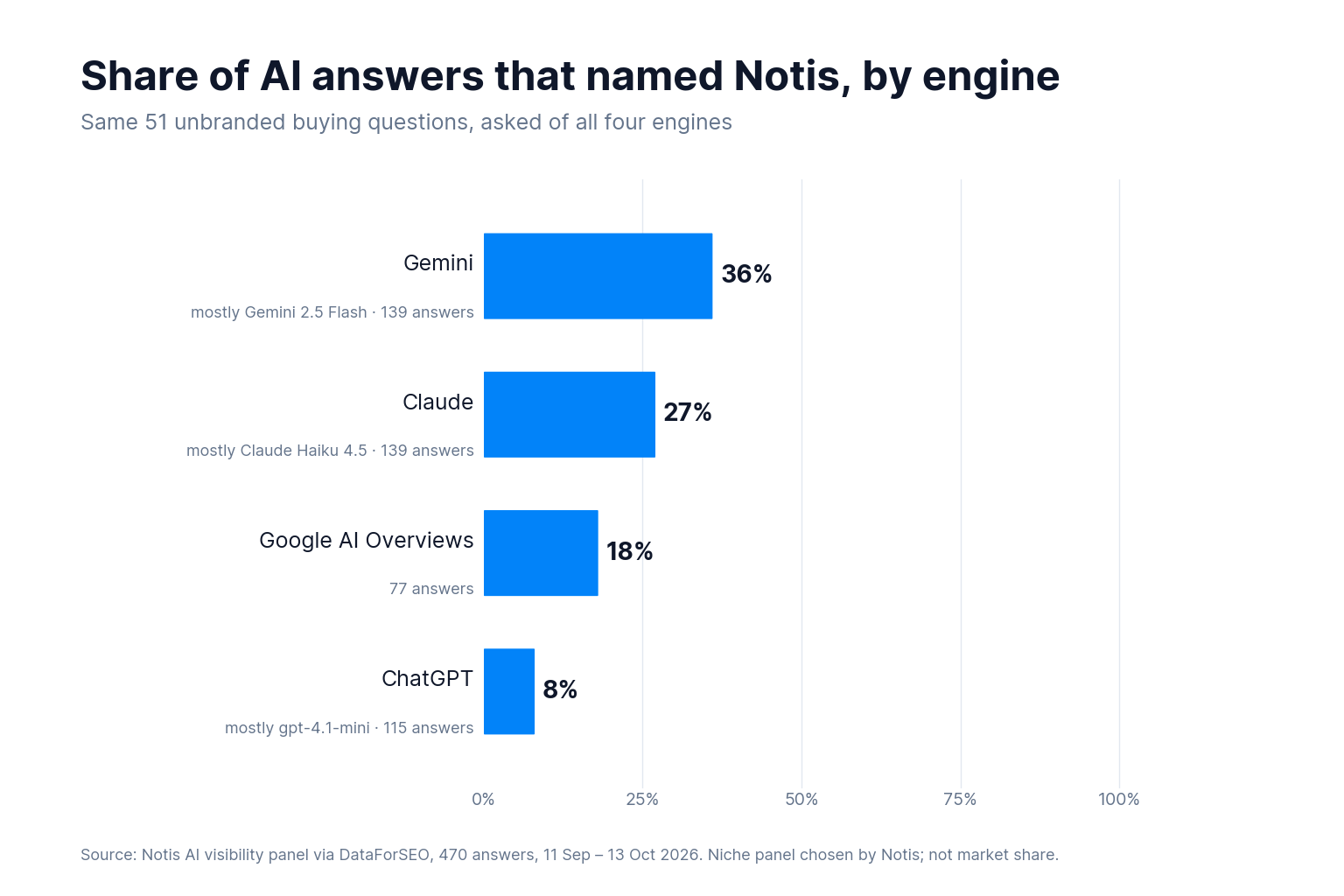
Gemini named Notis in 36% of its 139 answers, Claude in 27% of 139, Google AI Overviews in 18% of 77 and ChatGPT in 8% of 115, all measured on the same panel between September and October 2026. A single "AI visibility score" would hide a 4.5x gap between the friendliest and the toughest engine.
The disagreement goes beyond Notis. When we compared the brands two engines named for the same question in the same week, the average overlap was 16% (Jaccard similarity across 498 engine pairs). In 95 pairs, the two engines did not share a single brand.
Part of this is answer length. Gemini named about 12 brands per answer on average, Claude about 4. A long list gives a small company more room. A four-name list mostly goes to the brands everyone already knows. ChatGPT also cited no sources at all in 50 of its 115 answers, which makes it the hardest engine to influence through pages you publish.
What to do with it: track engines separately. If you only check ChatGPT, you will both underestimate where you show up and miss where you are losing.
Finding 2: specific prompts are winnable, generic ones are not
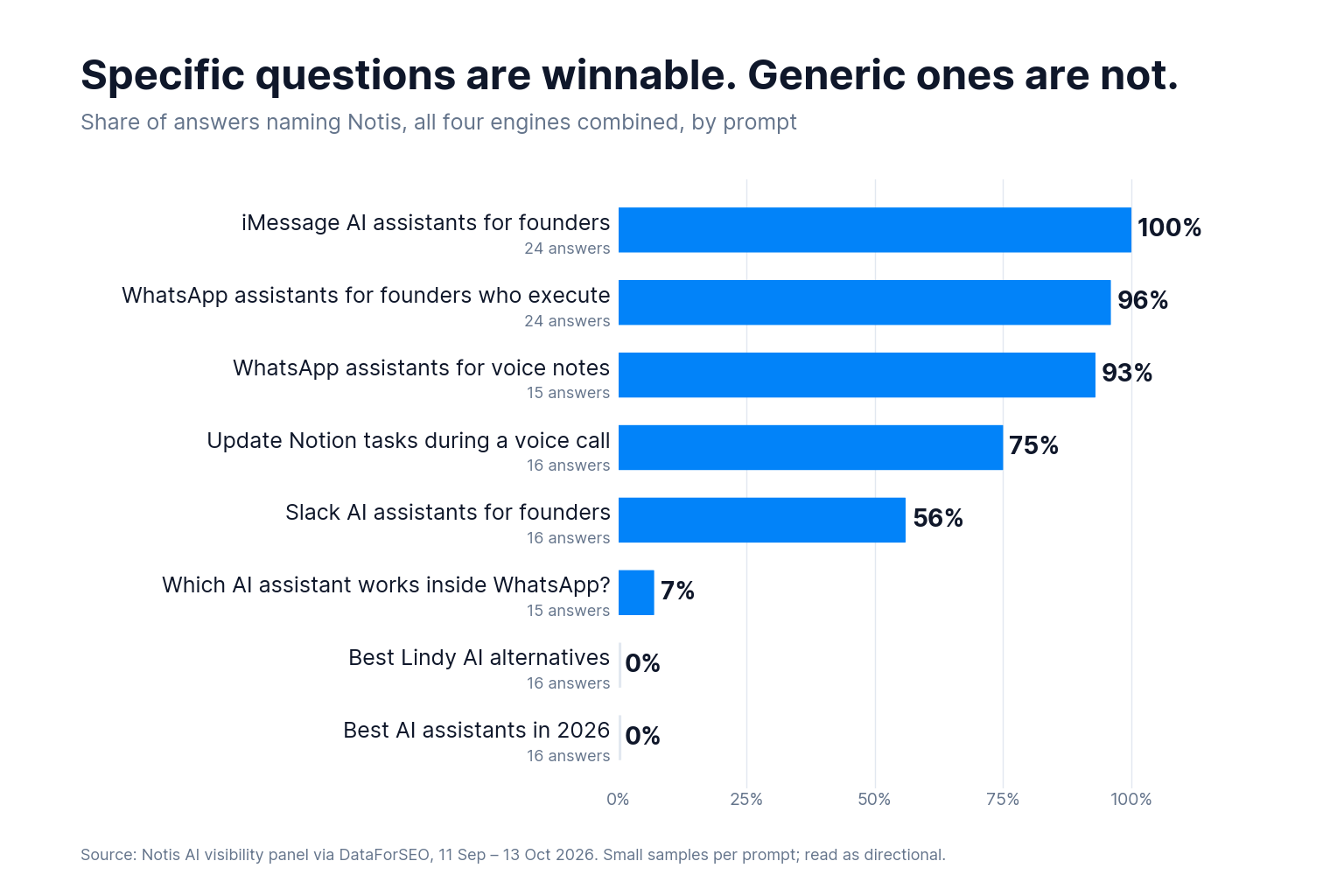
The clearest pattern in the data is specificity. The more a question described a person and a job, the more often a focused product like Notis was named.
| Prompt | Answers | Named Notis |
|---|---|---|
| What are the best iMessage AI assistants for founders? | 24 | 100% |
| Best WhatsApp AI assistants for founders who want to execute tasks | 24 | 96% |
| What are the best WhatsApp AI assistants for voice notes? | 15 | 93% |
| Which AI assistant can review and update Notion tasks during a voice call? | 16 | 75% |
| What are the best Slack AI assistants for founders? | 16 | 56% |
| Which AI assistant works inside WhatsApp? | 15 | 7% |
| What are the best Lindy AI alternatives? | 16 | 0% |
| What are the best AI assistants in 2026? | 16 | 0% |
Look at the two WhatsApp rows. "WhatsApp AI assistants for founders who want to execute tasks" named Notis 96% of the time. "Which AI assistant works inside WhatsApp?" named it 7% of the time. The channel was the same. What changed was the reader: add a persona and a job, and the engine starts matching on fit instead of fame.
Generic "best of" and "alternatives" prompts were a wall: 0% across 63 answers to four of them. Those answers default to incumbents. "Best AI assistants in 2026" named ChatGPT, Claude, Gemini and Microsoft Copilot in all 16 answers; "Lindy AI alternatives" went to Zapier and n8n in 15 of 16.
What to do with it: stop measuring yourself on "best AI tool". Write down the ten questions only your best customer would ask, and win those first. We wrote about the mechanics of being quotable in answer engine optimization; this is the part that decides which questions are worth the effort.
Finding 3: engines name you when they have read you
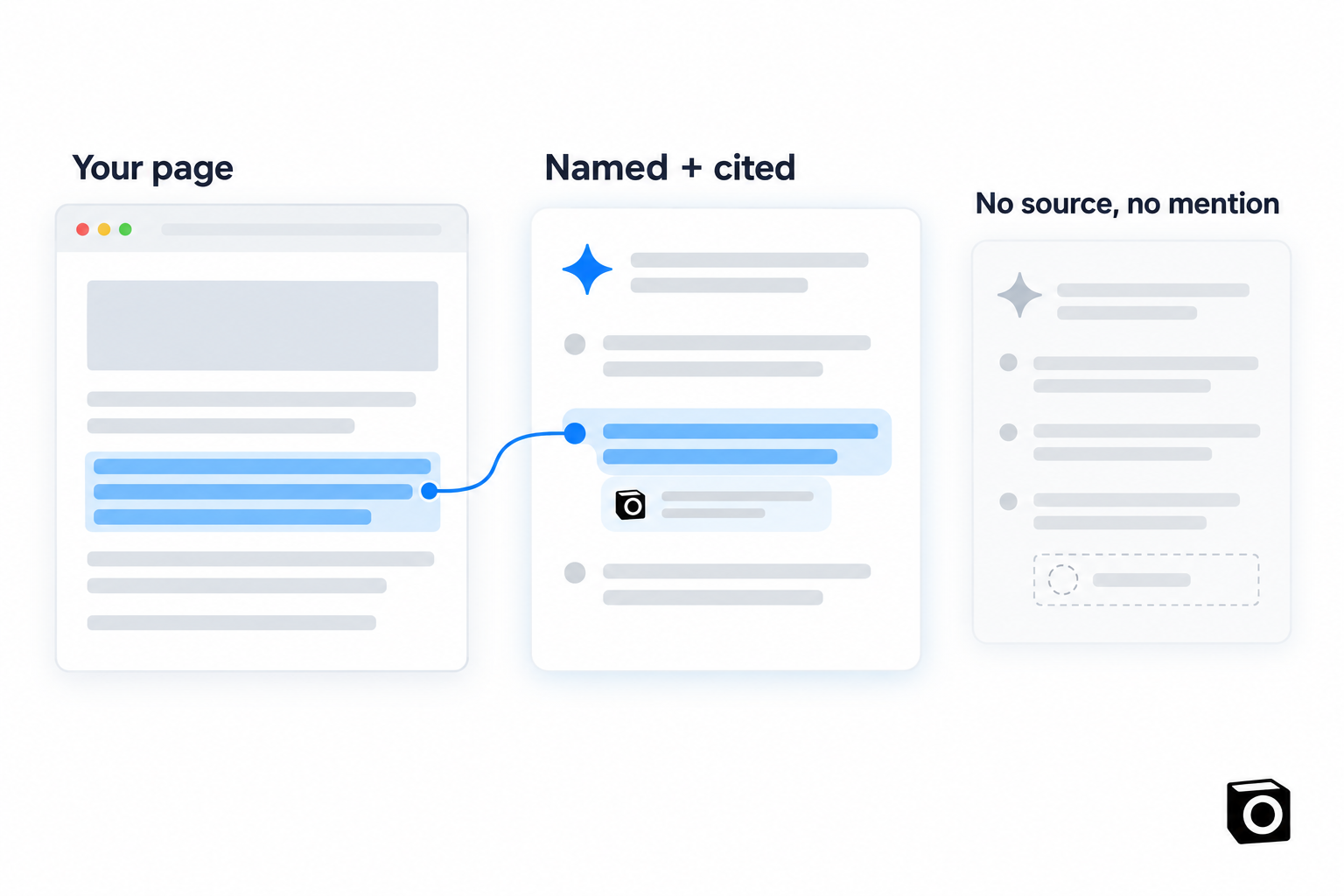
When an engine named Notis, it cited a notis.ai page in 106 of 111 answers (95%). When it did not name Notis, a notis.ai page appeared in 6 of 359 answers (2%). notis.ai was the most-cited domain in the whole dataset, ahead of YouTube (cited in 68 answers) and Reddit (52).
That is correlation, not proof of cause. But it fits what the engines appear to do: retrieve pages, then summarise them. The homepage was the most-cited Notis URL, but the next three were specific shortlists that match panel questions almost word for word: WhatsApp AI assistants for founders, WhatsApp AI assistants for voice notes and iMessage AI assistants for founders. Those are also the prompts where Notis scored above 90%.
What to do with it: for every question you want to win, make sure one page on your site answers it directly, in the first sentence, with the facts an engine needs. Our guide to getting cited in ChatGPT covers the on-page side.
Finding 4: AI answers are volatile, so measure a trend
We had 263 cases where the same engine answered the same prompt in two consecutive weeks. In 229 (87%) the verdict on Notis was unchanged; in 34 (13%) it flipped, 19 times from absent to present and 15 times the other way. On the 79 prompt-and-engine pairs measured in all four weeks from 21 September to 12 October 2026, the weekly mention rate moved between 22% and 29% with no clear trend.
One screenshot of one answer proves very little. A founder who sees Notis in ChatGPT on Monday and not on Tuesday has learned nothing about strategy. A rate across a panel, tracked weekly, is something you can act on.
Finding 5: other vendors write the sources engines read
The 470 answers cited 2,695 sources from 755 domains. Of the 30 most-cited domains, 20 belong to software companies, us included: assistant makers, automation tools and their blogs. About one source title in five carries a year ("2026"), and roughly a quarter are "best", "top", "vs" or "alternatives" pages.
In plain terms: the comparison pages that feed AI answers in our category are mostly written by competitors. If you do not publish an honest comparison of your own category, the engines will summarise someone else's.
Limitations of this study
- Mostly API models. Logged-in consumer apps add memory and personalisation; results there can differ.
- One niche, chosen by us. The panel targets personal and messaging AI assistants. It cannot tell you Notis's share of all AI assistant questions.
- Panel changes. The first run (11 September) used an earlier prompt set and named Notis in none of its 75 answers. We report it in the totals but not in the trend.
- Small cells. Most prompt-engine pairs have four to six answers. Treat single percentages as directional.
What this means for founders
- Build a panel before you build content. Twenty to fifty real buying questions, none containing your name.
- Measure share of answers per engine. Not one blended score.
- Win specific prompts first. Persona plus job plus channel beats "best tool".
- Publish the page that answers the question. First sentence, direct answer, current facts.
- Read the sources, not just the answers. They show you which pages to write or get listed on.
If you want the wider playbook, start with LLM SEO. If you want an assistant that runs this kind of weekly check and files the results where you work, see Notis plans.
Frequently asked questions
What is AI visibility?
AI visibility is the share of AI-generated answers that mention your brand for questions you want to win. It is measured across a fixed set of prompts and engines, and reported as a rate, because a single answer changes from run to run.
How do you track AI visibility?
Track AI visibility by sending the same set of unbranded buying questions to each engine on a schedule and recording which brands each answer names and which sources it cites. Compare rates per engine and per prompt over several weeks, not individual screenshots.
Why does ChatGPT recommend competitors but not my product?
ChatGPT tends to name brands it can retrieve and verify for that exact question. In our data, ChatGPT named Notis in 8% of answers and cited no sources in 50 of 115, so it leaned on well-known names. Specific questions and pages that answer them directly gave smaller brands their best chance.
How often do AI answers change?
AI answers change often enough that one check is not a measurement. In our panel, 13% of week-to-week checks on the same prompt and engine flipped between naming Notis and not naming it, while the overall rate stayed between 22% and 29%.
Does publishing comparison pages help AI visibility?
Comparison pages appear to help, though our data shows correlation rather than cause. When an engine named Notis, it cited notis.ai in 95% of those answers, and roughly a quarter of all cited sources were "best", "vs" or "alternatives" pages.
AI search will not hand you a position to defend. AI visibility is a share of answers you win, prompt by prompt and engine by engine, and the way to grow it is unglamorous: pick the questions, publish the answers, and count every week.

Based on an original idea from Flo. Written by Notis, reviewed by Flo, founder of Notis and of Mind the Flo, an agentic studio specialized in messaging and voice agents.
Related posts
Is Instinct AI Safe? 7 Questions Before You Hand Over Your Passwords
Is Instinct AI safe? Its privacy policy, training defaults, early security reports and the 7 questions to ask before giving it passwords or a card.
One Memory, Many Models: Why Every AI Tool Now Wants to Remember You
Every AI assistant shipped memory in 2026. Why that is the new lock-in, why exports are archives, and how founders keep one memory and rent the models.
Meta Muse Privacy: What Meta Can See, Keep and Train On
Meta Muse privacy explained: what it stores, training defaults, ads, Meta staff access, early incidents, and five settings to change today.