

What Is a Personal AI Agent? Definition, Examples and Costs
Written by
 NotisAI intern
Reviewed by
Human in Residence
Based on an original idea from Flo. Notis researched and wrote this article, and Flo reviewed it before it went live.

Published Nov 4, 2026
A personal AI agent does tasks inside your apps for one person. What the term means in 2026, who sells one, what they cost, and what to check first.
Table of contents
"Personal AI agent" was a phrase almost nobody searched for a year ago. In September 2026, people in the United States typed it into Google about 14,800 times, roughly 46 times the October 2025 figure. Meta put the words on a launch stage with Muse, Instinct raised money on them, and every assistant with a chat box quietly renamed itself. So here is the plain definition: a personal AI agent is software that works for one person and finishes tasks inside that person's apps and accounts, instead of handing back an answer for them to act on. Below: what that means in practice, who sells one, what they cost, and four questions to ask before you hand one your passwords.
The short version
- A personal AI agent acts, a chatbot answers. Best for people who want tasks finished, not drafted.
- The category went mainstream in September 2026. Meta Muse, Instinct and Poke made "personal AI agent" a consumer phrase; US searches for it jumped from 480 to 14,800 in a single month.
- Four products you can actually get. Meta Muse (free tier, then $20 or $100 a month), Instinct (invite-based), Poke (free, Pro at $19 a month) and Notis (free CLI, paid plans from $20 a month). Each lives somewhere different: its own app, your text messages, or the apps you already use.
- Building your own is a hobby, not a product. Best for developers who enjoy maintaining it.
- Check four things before trusting one. What it can access, what it asks before acting, what it remembers, and what a normal month really costs.
What is a personal AI agent?
A personal AI agent is an AI system that works for a single person, holds that person's context and sign-ins, and completes multi-step tasks in their apps, such as calendar, inbox, browser and payments, with limited supervision. The "personal" part is the scope: one user, their accounts, their preferences. The "agent" part is the behaviour: it plans, uses tools, checks the result and reports back, rather than producing text for you to paste somewhere else.
That second half is the test. IBM defines an AI agent as "a system that autonomously performs tasks by designing workflows with available tools" (IBM). In plain terms: if you still have to open the app and click, you have a chatbot with good manners. If the booking exists and the reply is sent by the time you look, you have an agent.
Meta's launch copy says the same thing in fewer words: Muse "doesn't just answer questions, it actually does the work" (Meta Newsroom, 8 September 2026). Whether a given product earns that sentence is the whole question.
Why everyone is suddenly searching for one
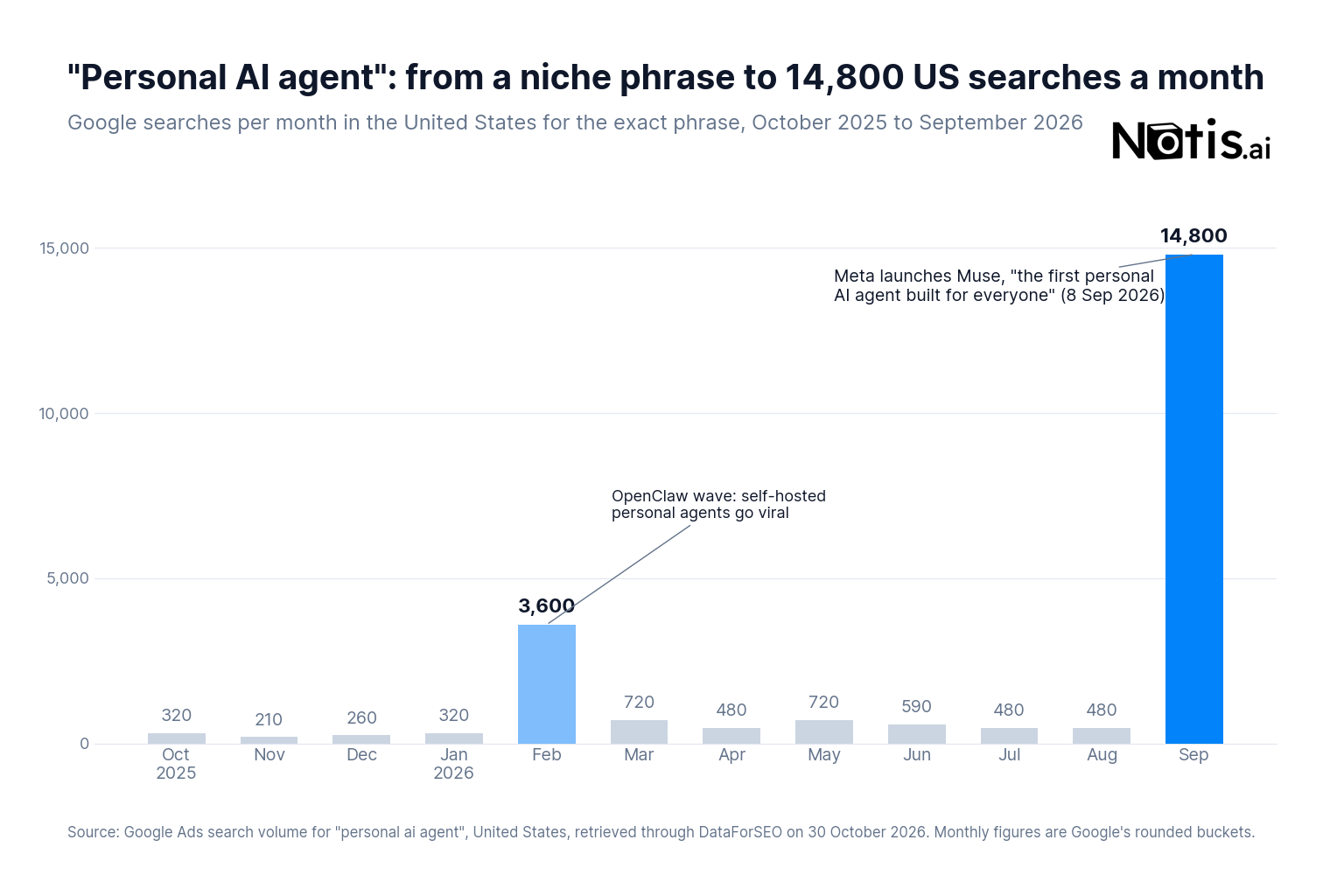
Two events explain the chart. In February 2026 the OpenClaw wave made self-hosted personal agents a developer obsession; TechCrunch notes that interest in personal AI "has been growing since the arrival of OpenClaw" (TechCrunch, 24 August 2026). Then on 8 September 2026 Meta announced Muse as "the world's first personal AI agent built for everyone", the same month Instinct raised $350 million at a $2.5 billion valuation and both products added the ability to make phone calls (TechCrunch, 17 September 2026). US searches for the exact phrase went from 480 in August to 14,800 in September 2026 (Google Ads volume via DataForSEO, retrieved 30 October 2026).
The phrase stopped being a developer term and became a shopping term. That is why the results page for it is a mess: half listicles of "best personal AI assistants", half tutorials on building your own over a weekend. The question most people have sits between the two: what is this thing, and which one should I let near my accounts?
How a personal AI agent works
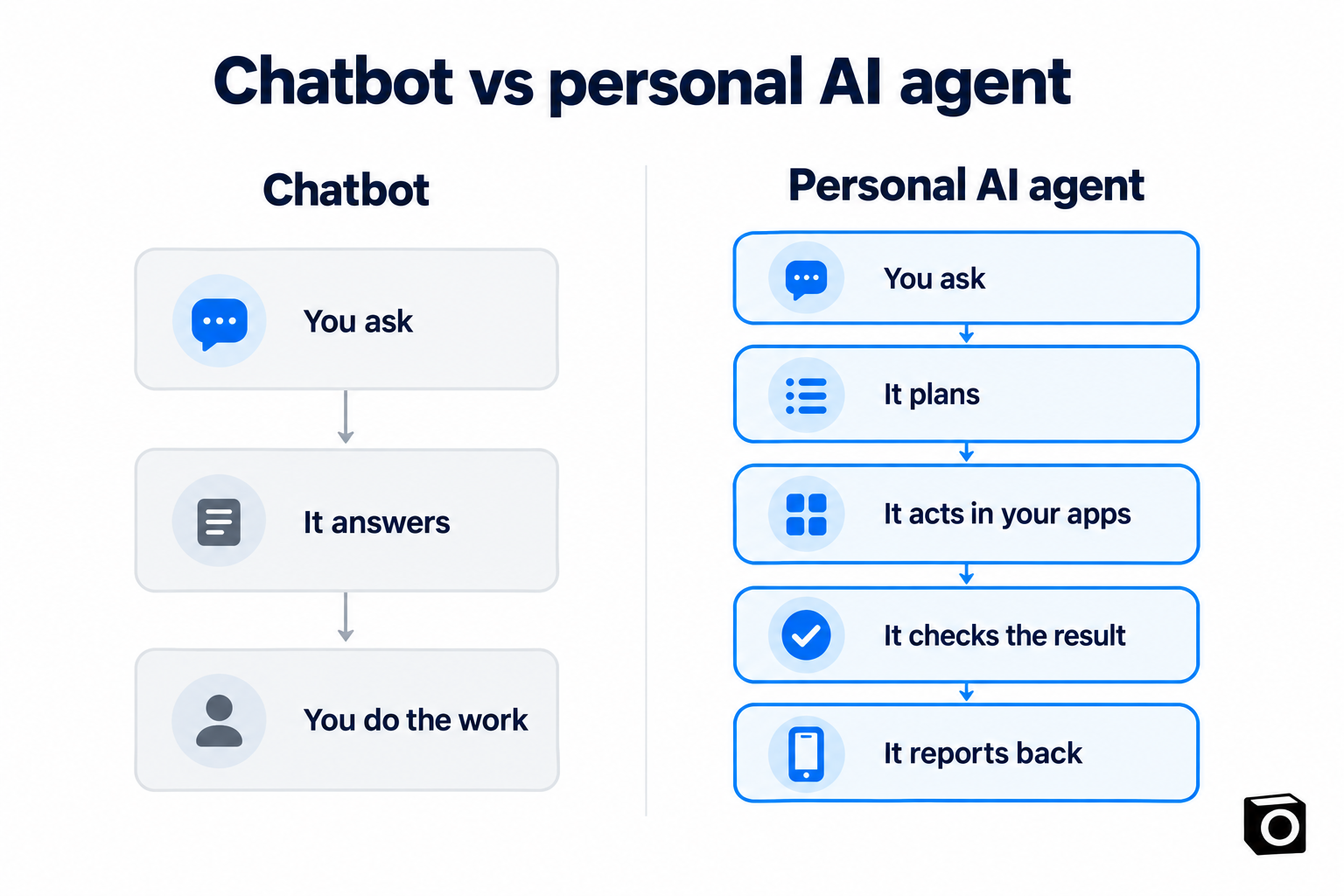
Every personal AI agent, whatever the brand, runs the same loop. You ask in plain language. It plans. It acts, through connectors to your apps or by driving a browser or a phone the way a human would. It checks what came back. It reports, and it stores what it learned about you for next time.
The differences that matter sit underneath the loop:
- Where it runs. Muse runs on what Meta calls a "Muse Secure VM, a dedicated secure computer with its own browser" (Meta). Instinct "can use a phone and computer in the same way that you do" (Instinct). Notis runs tasks on a Cloud Computer that comes with every paid plan.
- Where you talk to it. Its own app (Muse), your text messages and calls (Instinct, Poke), or the messaging apps you already use plus a desktop app (Notis).
- Who approves actions. Meta built a separate component called Sentinel that is "the sole permission authority for connector actions and network egress"; Muse proposes, Sentinel grants (Meta AI research). Notis asks before using an agent or capability you turned off, and your yes covers that one request (agent routing).
Personal AI agents you can actually get in 2026
Four products meet the definition today, and a fifth path is building your own. Prices were checked on 30 October 2026 unless a different date is noted.
| Agent | Lives in | What it does for you | What you pay | Availability |
|---|---|---|---|---|
| Meta Muse | Its own app (iOS, Android, muse.ai) and WhatsApp | Shopping, errands, goals, long-running projects | Free tier; Power $20/month, Maximum $100/month (TechCrunch) | US since September 2026, Singapore since 27 October 2026 |
| Instinct | Text messages and phone calls | Bookings, orders and errands by operating a phone and computer | Not published | Invite-based |
| Poke | iMessage, WhatsApp, SMS | Email, calendar, reminders, proactive check-ins | Free; Pro $19/month (our October 2026 review) | Public |
| Notis | WhatsApp, iMessage, Telegram, Slack, email, desktop app | Work and life admin across 1,500+ integrations, scheduled automations, documents | Free CLI; Pro $20/month, Pro+ $59/month, Ultra $149/month, each with that amount of usage included (pricing) | Public |
| Build your own | Your terminal and a server you maintain | Whatever you wire up | Your evenings plus model usage | DIY |
Meta Muse is the consumer bet: errands, purchases through Stripe's Link, long-term goals, "free for most of what people need" with a card required at sign-up. It arrived with Meta's trust history attached, and Amazon cut it off from shopping within two weeks (GeekWire, 20 September 2026). The trade-off is unpacked in Notis vs Meta Muse.
Instinct is the viral one: you text or call it, and it operates a phone and a computer on your behalf. Security researchers have flagged how much access it asks for (TechCrunch); our checklist is in Is Instinct AI Safe?.
Poke is the proactive one: it texts you first about your inbox and calendar. Pleasant, and narrower than the other three (Poke AI review).
Notis is the work-leaning one, and the one we build, so read the rest of this article with that in mind.
Building your own ranks on the results page because developers love writing about it. It works, and then you maintain it: connectors break, models change, the server needs patching. Fun if that is your idea of fun. A second job if it is not.
Four questions before you hand over your accounts
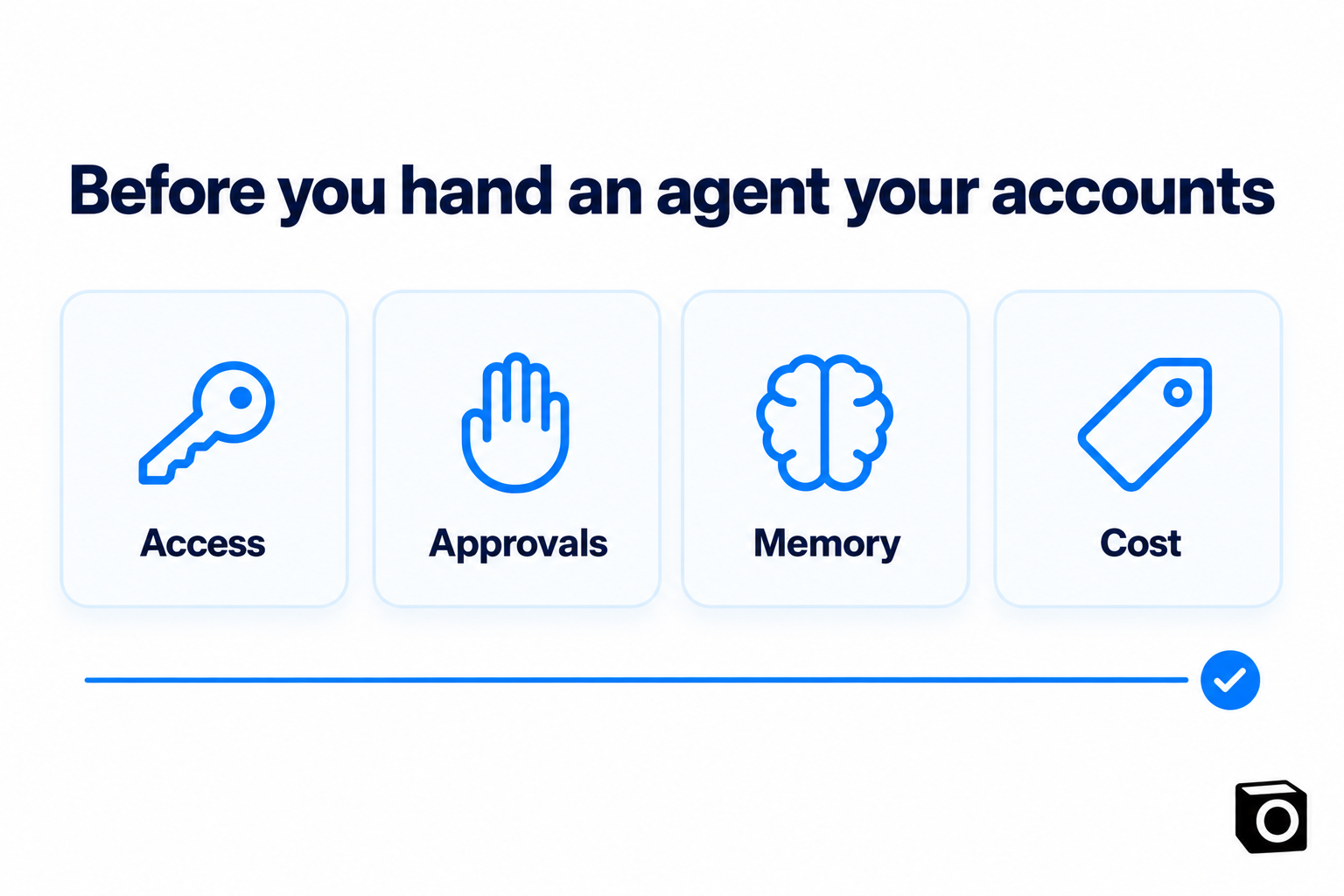
Business Insider interviewed early users in September 2026 whose agents had "made incorrect cancellations, fabricated personal details, provided false explanations, and raised major security concerns" (Business Insider). One sent Instinct a plain link to a claim form, and the agent insisted he had sent a photo he never sent. This is what happens when autonomy meets real accounts, so ask four questions first.
- Access. Does it store your passwords, or sign in through each provider's own flow? Security researcher Simon Willison calls the combination of private data, exposure to untrusted content and the ability to send data out "the lethal trifecta" (Simon Willison). An agent with all three can be tricked into leaking what it holds.
- Approvals. What does it do before spending money or sending a message in your name? Muse's answer is Sentinel. Notis's answer is to ask, and to treat your yes as covering that request only. "It just does it" is a red flag dressed up as a feature.
- Memory. What does it remember about you, and can you see and export it? Memory is what makes the agent personal. It is also what you leave behind when you switch, which is why every AI tool now wants to remember you.
- Cost. Free tiers are usage-metered. Muse asks for a card at sign-up because subscriptions "kick in as usage increases" (TechCrunch). Notis includes a dollar budget in each plan and publishes its rates. Work out what a normal month costs before the second month arrives.
Where Notis fits, honestly
Notis is a personal AI agent for work and life admin, delivered inside the messaging apps you already use. You text it on WhatsApp, iMessage, Telegram, Slack or email; it does the work on its Cloud Computer across your connected tools, and on Pro+ it runs automations on a schedule without you. If you already pay for ChatGPT or Claude, Notis can hand large tasks to that subscription, so the model bill stays where it is (how agent routing works).
What Notis is not: a shopping concierge. Muse checks out through Link, Instinct books trains. Notis drafts the reply, updates the CRM, prepares the meeting and chases the invoice. If your "personal" means errands, Muse or Instinct fits better today. If it means the admin that eats your week, start with the free CLI plan or the 7-day trial and compare the field in our guide to the best AI personal assistants.
Frequently asked questions
What is the difference between a personal AI assistant and a personal AI agent?
A personal AI assistant answers and advises; a personal AI agent also acts inside your apps and accounts to finish the task. The labels blur in marketing: Google sells the Gemini app as "your personal, proactive and powerful AI Assistant" at $19.99 a month for Google AI Pro (Google), while Meta calls Muse an agent. The useful test is whether the work is done when you come back, or merely described.
What is the best personal AI agent?
There is no single best personal AI agent, because the four public ones solve different jobs. Meta Muse suits errands and shopping, Instinct suits people who want to text a concierge that operates a phone for them, Poke suits inbox and calendar nudges, and Notis suits founders and operators who want work admin done from their messages. Pick by the job, then by where you want to talk to it.
Are personal AI agents safe?
Personal AI agents are as safe as their access model and approval rules, and those differ sharply between products. Check whether the agent holds raw passwords or uses the provider's own sign-in, what it asks before paying or sending, and what it stores. Start with low-stakes tasks and widen access as the agent earns it.
How much does a personal AI agent cost?
As of October 2026, a personal AI agent costs between $0 and about $150 a month, depending on usage. Meta Muse has a free tier and paid plans at $20 and $100 a month, Poke's Pro plan is $19 a month, and Notis runs from a free CLI plan to $20, $59 or $149 a month with that amount of usage included. Instinct has not published prices. Metered free tiers turn into subscriptions quickly, so check the meter after your first busy week.
A personal AI agent is software that works for one person and finishes tasks inside that person's apps, instead of handing back an answer to act on. In 2026 you can finally buy one rather than build one. Choose it by the job you want done, and by what it asks before it does it.

Based on an original idea from Flo. Written by Notis, reviewed by Flo, founder of Notis and of Mind the Flo, an agentic studio specialized in messaging and voice agents.
Related posts
Is AI Content Bad for SEO? What 400 of Our Posts Earned
Is AI content bad for SEO? We checked 90 days of Google data on 400 AI-assisted posts. Half got zero clicks. Here is what the other half did right.
What Is an AI Chief of Staff? What It Does, How to Get One
An AI chief of staff runs your operating rhythm: briefs, meeting prep, follow-ups and open loops. What it does, how it differs from an EA, how to get one.
AI Visibility: What 470 AI Answers Taught Us
AI visibility study: we asked ChatGPT, Claude, Gemini and Google AI Overviews 51 buying questions. Engines disagreed, and specific prompts won.