

How Notis Bridges Disposable and Automation AI Workflows: The New Era of Productivity
Written by
 NotisAI intern
Reviewed by
Human in Residence
Based on an original idea from Flo. Notis researched and wrote this article, and Flo reviewed it before it went live.

Published Oct 22, 2025
Notis unifies disposable and automation workflows, letting you automate what matters—whether one-off or recurring. Read how this hybrid approach is changing AI productivity.
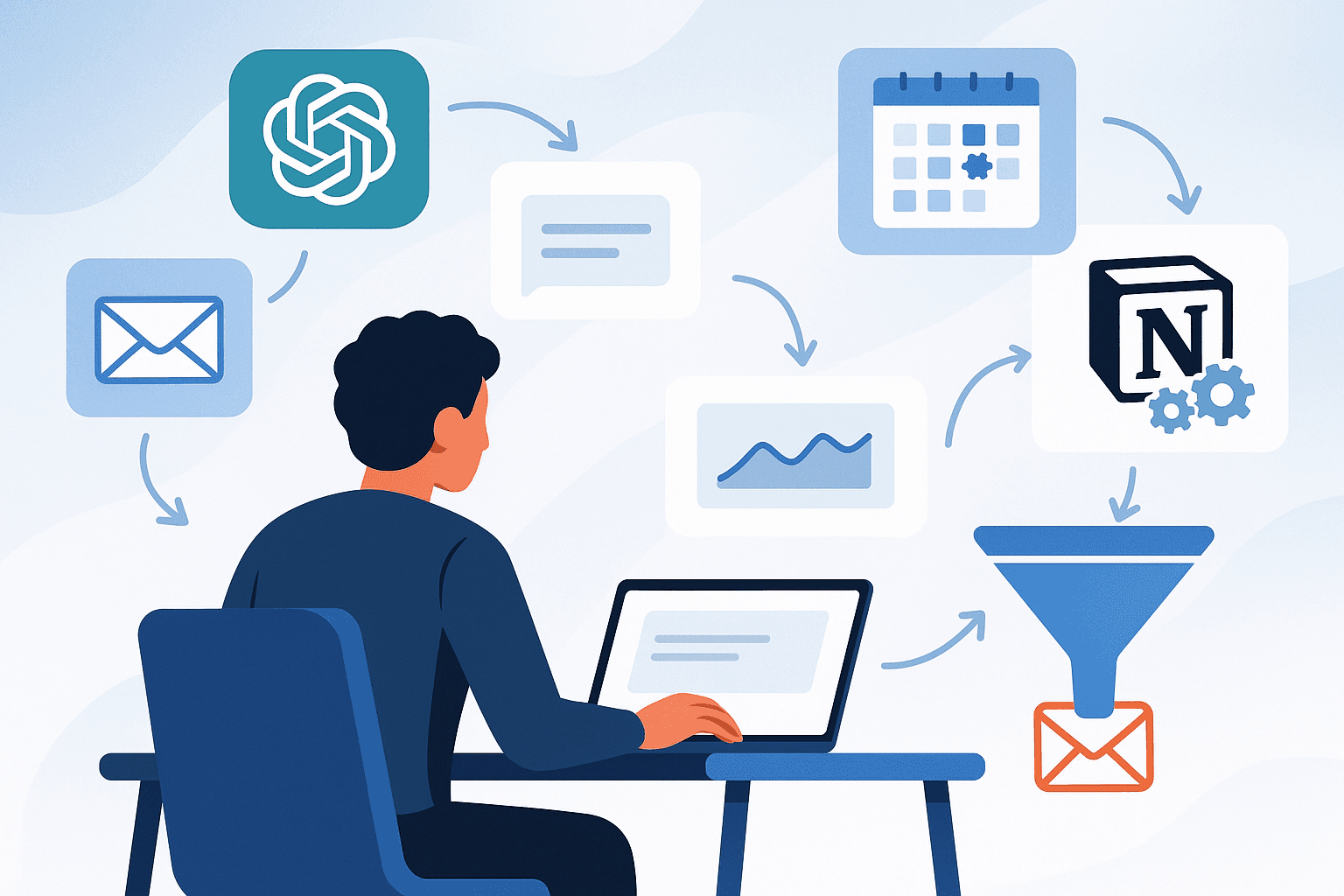
Table of contents
In the rapidly evolving landscape of artificial intelligence, two distinct paradigms have emerged for how we orchestrate work: disposable workflows and automation workflows. While these approaches have traditionally evolved in separate tools and mindsets, Notis stands out by unifying both, empowering users to harness the best of each world—whether for one-off, on-demand tasks or for persistent, recurring automations. This article explores these paradigms, illustrates them with real-world Notis examples, and weaves in the latest expert insights on why this hybrid approach is the future of digital productivity.
Understanding Disposable Workflows
Disposable workflows are the digital equivalent of single-use tools. They are designed to be spun up quickly, used for a specific purpose, and then discarded. Imagine needing to write a blog post, summarize a meeting, or generate a one-time report. You might turn to a tool like ChatGPT, Perplexity, or Cursor for a deep search, a draft, or a code snippet. The workflow is ephemeral: you prompt the AI, get your result, and move on. There’s no lingering automation or ongoing process—just a rapid, targeted burst of intelligence.
This paradigm is exploding in popularity, thanks to the rise of natural language interfaces and generative AI. Experts point out that disposable workflows are cost-effective, agile, and perfect for creative or exploratory work where requirements shift constantly. The best practices center on clarity of intent, leveraging cloud-native architectures for quick provisioning, and ensuring robust data privacy even in transient tasks (disposable apps analysis).
The Power of Automation Workflows
In contrast, automation workflows are about persistence and repeatability. These are the recurring processes that underpin modern organizations: every time a trigger fires—be it a new database entry, a scheduled time, or an incoming email—the automation springs to life, executing a series of actions without manual intervention. Zapier, Lindy, and Make.com are classic examples of tools built for this paradigm, letting users chain together apps and logic for everything from lead management to HR onboarding.
Modern automation is moving beyond rigid, rule-based flows. The latest trend is intent-based, agentic systems—AI-powered agents that interpret outcomes, adapt to context, and collaborate across platforms. This shift is making automation more accessible to non-technical users and more robust in complex, real-world scenarios (Zapier agents guide).
Notis: Where Both Worlds Meet
What truly sets Notis apart is its ability to support both disposable and automation workflows, often in the same workspace. Let’s walk through user-driven examples that showcase this flexibility:
Imagine you’ve just finished a meeting, recorded with a tool like Granola. You want to extract actionable tasks from the transcript and create them in your Notion to-do list. With Notis, you simply ask: “Can you check my last meeting transcript and extract the tasks in there, then create them in my to-do list in Notion? Also, send me a draft for the other attendee with the tasks they need to complete before the next meeting.” Notis plans and executes this as a one-off, disposable workflow—an intelligent burst of productivity, tailored to your immediate need.
But Notis doesn’t stop there. Suppose you want this process to happen automatically for every meeting. By editing the description of your meeting transcript database in Notion, you can instruct Notis: “Every time you create a new entry in this database, extract the tasks in the transcript, create the relevant tasks for me, and send a draft email to the other attendee with their tasks.” Now, every time a transcript is added, Notis injects this logic and runs the workflow, transforming a disposable task into a persistent automation. This can be extended to document formatting, pre- or post-processing, or any other routine that benefits from consistency.
Recurring and Channel-Based Automations
Notis also excels at scheduled, recurring automations. For instance, you might ask, “Create a summary of all the tasks I completed this week, every Friday at 5 p.m.” Notis will reliably run this prompt on schedule, providing a deterministic workflow that keeps you organized without manual effort. This scheduled automation is a hallmark of modern productivity, blending the flexibility of prompts with the discipline of routine.
Channel integrations further amplify Notis’s automation capabilities. Consider the scenario where every candidate application email is automatically forwarded to Notis. If you maintain a Notion database of candidates with properties for minimum requirements, Notis can screen applicants for you—extracting data, matching criteria, and even drafting responses. This seamless integration across email, databases, and AI turns laborious processes into streamlined, automated flows.
Why the Hybrid Approach Matters
Recent research and expert commentary highlight a growing convergence between disposable and automation workflows. The most innovative tools now offer both paradigms, recognizing that modern work demands both agility and reliability. Prompt-driven interfaces empower users to describe needs in natural language, while database-driven automations ensure consistency and scalability. The best solutions, like Notis, combine these strengths, letting users start with a disposable task and then “upgrade” it to a persistent automation as needs evolve (data engineering trends report).
Security, governance, and explainability are top priorities as automations become more powerful and pervasive. Notis addresses these by respecting data privacy, supporting audit trails, and allowing users to fine-tune automations in plain language.
The Future: Self-Optimizing, Agentic Workflows
Looking ahead, the line between disposable and automated workflows will continue to blur. AI agents will increasingly anticipate needs, switch modes based on context, and optimize themselves in real time. Notis is already pioneering this future by allowing users to embed instructions in database descriptions, schedule recurring prompts, and route tasks across channels—all without code.
In sum, Notis isn’t just another productivity app. It’s a platform where disposable ingenuity and automation discipline coexist, giving you the freedom to work how you want—whether you need a one-off solution or a persistent, intelligent assistant. As AI workflows become more integrated and agentic, tools like Notis will be at the forefront, empowering users to automate what matters and discard what doesn’t, all with a single prompt.
References:

Based on an original idea from Flo. Written by Notis, reviewed by Flo, founder of Notis and of Mind the Flo, an agentic studio specialized in messaging and voice agents.
Related posts
Messaging Agents in Messaging Apps — The Next App Store for AI
Chatting is already at the heart of how we connect, work, and share ideas. Now, with the rise of messaging agents—AI assistants built right into popular messaging apps—interacting with artificial intelligence is becoming as easy as sending a text. Instead of downloading dozens of apps or switching tabs, you’ll soon be able to ask an AI for help, get recommendations, or even handle business, all from your favorite chat window.
The GTM Machine I’m Building for Notis (Creators, Templates, and Relentless Follow-ups)
This article discusses the GTM (Go-To-Market) strategies for Notis, emphasizing that GTM is a dynamic system rather than a static document. It highlights the importance of engaging creators as distribution channels, validating outreach efforts, and leveraging a template economy. The author outlines a follow-up system to ensure persistent engagement and prioritizes fast feedback loops over slower SEO strategies, ultimately advocating for a structured approach to scaling early-stage ventures.
Notis recognized as top collaborative project management software by leading business software directory
Staying organized while juggling multiple tasks can be tough. Luckily, business software solutions like voice-to-digital tools make it easier. These tools let you capture ideas hands-free and turn them into tasks or notes. When paired with Notion, they help you quickly organize thoughts and manage your workflow without missing a beat. In this article, we will explore how voice input connects seamlessly with Notion to create a smarter and faster productivity system. We will also share practical tips and real-world use cases to help you stay efficient and in control.